North Korea Formally Abandons Unification Goal, Deepening Divide with Seoul
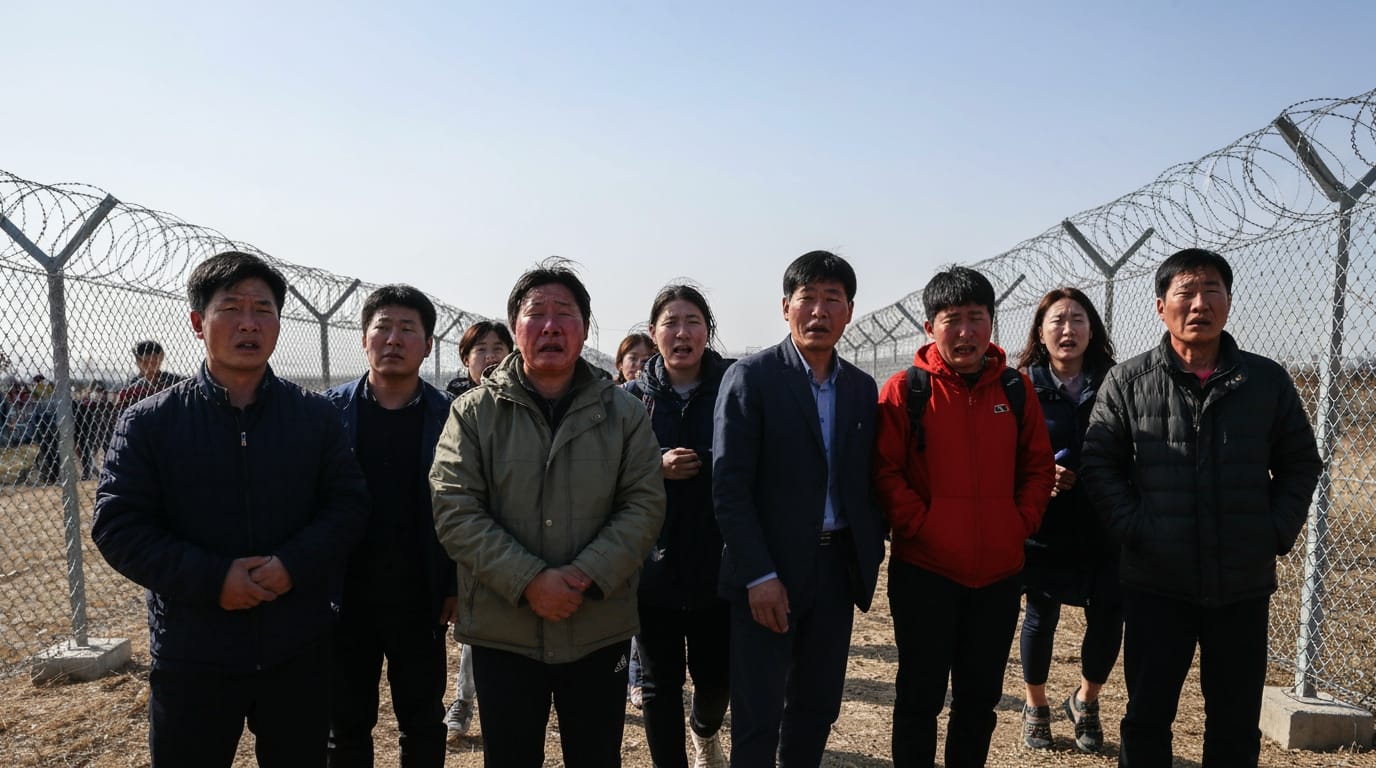
Pyongyang has fundamentally altered its foundational legal document, removing all references to the long-standing objective of national reunification with South Korea and formally designating its southern neighbor as a separate, hostile state. This seismic constitutional shift, codified by North Korea's Supreme People's Assembly (SPA) in March 2026, marks an irreversible departure from decades of official policy that once envisioned a unified Korean Peninsula. The move escalates tensions and sets a new, more perilous course for inter-Korean relations, compelling Seoul to recalibrate its approach amidst a deeply frozen diplomatic landscape.
For generations, the notion of a single Korean nation was enshrined in the constitutions of both Koreas, a shared, albeit often rhetorical, aspiration that persisted despite the 1950-53 Korean War. North Korea's latest amendments dismantle this historical framework, openly declaring South Korea as its primary adversary and solidifying a "two hostile states" doctrine that analysts warn eliminates any pretense of shared identity or reconciliation. This drastic policy change underscores leader Kim Jong Un's hardened stance, cementing a division that has long been a de facto reality into a de jure principle.
The Constitutional Revolution: Erasing Reunification
The constitutional amendments formally adopted by North Korea's Supreme People's Assembly in March 2026 represent a profound ideological and political restructuring. Central to these changes is the complete removal of all phrases and concepts related to national reunification, peaceful reunification, and great national unity from both the preamble and main text of the constitution. Notably, references to the reunification-related achievements of state founders Kim Il-sung and Kim Jong-il have also been expunged, effectively severing historical links to the idea of a unified Korea.
The revised constitution now explicitly defines North Korea's territory as the area bordering China and Russia to the north and the Republic of Korea (South Korea) to the south, including corresponding territorial waters and airspace. This redefinition abandons previous constitutional claims over the entire Korean Peninsula, acknowledging South Korea as a distinct, separate state. This stands in stark contrast to the previous wording that referred to the "northern half" of the Korean Peninsula, a phrase now conspicuously absent. The official state media, in October 2024, confirmed a constitutional provision identifying the Republic of Korea as a "hostile state". These changes follow Kim Jong Un's clear directive, first articulated in January 2024, to erase unification as a national goal and redefine South Korea as an "invariable principal enemy".
A Decades-Old Dream Abandoned
For decades, the pursuit of reunification served as a cornerstone of North Korea's national ideology, often presented as a sacred duty stemming from the division imposed after World War II. North Korean leaders consistently articulated a vision of national unity, even as relations with the South swung between periods of engagement and extreme animosity. This latest constitutional overhaul marks the formal abandonment of this long-standing goal, signaling a belief within Pyongyang that reunification is no longer a viable or desirable objective. Kim Jong Un had previously declared in December 2023 and January 2024 that unification was impossible and that North Korea would no longer regard South Korea as a counterpart for reconciliation.
This dramatic policy shift was visibly underscored by the demolition of the Monument to the Three Charters for National Reunification in Pyongyang by late January 2024, a towering arch that symbolized the aspiration for peaceful reunification. The physical removal of such a prominent symbol reinforced the ideological break, leaving no doubt about Pyongyang's intention to permanently discard the reunification narrative.
Intensifying Hostility and Military Posture
The constitutional amendments are not merely symbolic; they provide legal justification for North Korea's increasingly aggressive rhetoric and military posturing towards the South. By designating South Korea as a "hostile state," Pyongyang now considers any infringement on its newly defined territory as an act of war, demanding "merciless consequences". This formal declaration of hostility effectively ends the "provisional special relationships" framework, such as the 1991 Basic Agreement, which had previously governed inter-Korean ties and acknowledged a unique, if strained, bond between the two Koreas.
In May 2026, Kim Jong Un further emphasized this hardened stance by ordering stronger military preparations along the border with South Korea, instructing frontline units to become an "impregnable fortress" to deter war. He called for adjusting training systems and expanding drills to reflect modern warfare and the development of North Korea's military capabilities, including redefining operational concepts. This comes after North Korea reportedly blasted sections of road and rail links connecting the two Koreas in October 2024, an action justified as legitimate against a hostile state. Such actions and statements suggest a potential for heightened military tensions and reduced prospects for any future dialogue or de-escalation efforts.
International Repercussions and South Korea's Response
The formal constitutional abandonment of reunification and the hostile designation of South Korea have significant implications for regional stability and international relations. North Korea's strategy appears to involve strengthening alliances with China and Russia, while simultaneously attempting to engage directly with the United States and Japan to drive wedges between allied nations. Pyongyang also aims to solidify its status as a nuclear-armed state, using these constitutional changes to justify its nuclear program to the international community.
In response to Pyongyang's rigid new stance, South Korea is navigating a complex diplomatic landscape. While acknowledging North Korea's constitutional revisions, the administration of President Lee Jae Myung is reportedly shifting its policy towards "peaceful coexistence and co-development" with North Korea. This new approach, outlined in a May 2026 white paper by Seoul's Unification Ministry, prioritizes maintaining peace, managing stable relations, and reducing the risk of escalation, rather than confrontation. The paper emphasizes trust-building measures, reduced military tension, and respect for Pyongyang's political system, explicitly stating that Seoul does not seek regime collapse or unification by absorption. However, despite this softer tone from Seoul, inter-Korean relations remain "virtually frozen," with no significant people-to-people or economic exchanges for years.
An Unpredictable Future for the Peninsula
North Korea's constitutional changes represent a pivotal moment in inter-Korean relations, officially terminating the aspirational goal of reunification that has defined the peninsula for generations. By enshrining South Korea as a hostile, separate state, Pyongyang has drawn an indelible line, signaling a future of permanent division and intensified animosity. While South Korea endeavors to pursue a strategy of peaceful coexistence, the North's hardened stance, backed by an increasingly explicit nuclear doctrine and military modernization efforts, casts a long shadow over any prospects for stability. The international community watches closely as the Korean Peninsula enters a new, unpredictable era, where the hope of one nation has been supplanted by the certainty of two hostile states.


