Bundestag Passes Landmark Pension Reform Amidst Political Tensions
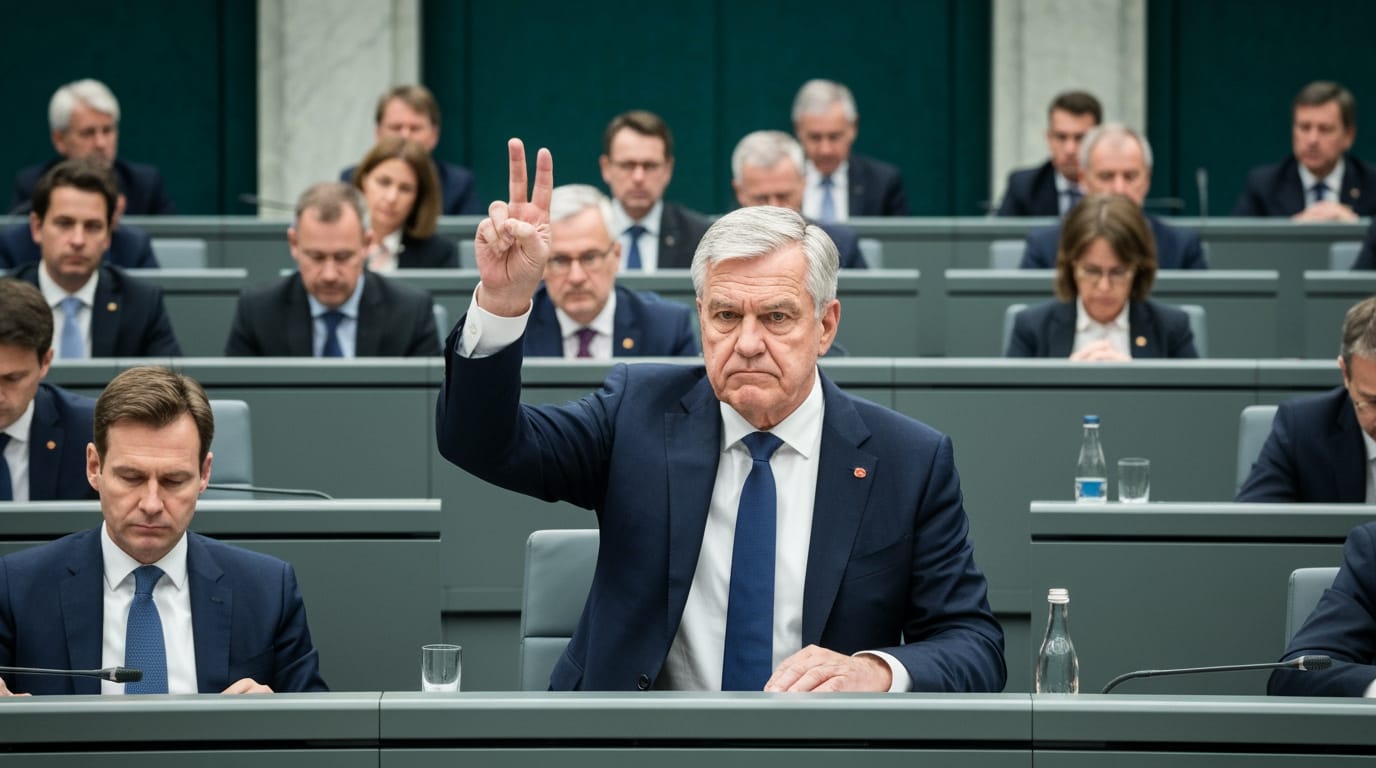
BERLIN, Germany – The German Bundestag has approved a significant pension reform package, a move hailed by the ruling coalition as a crucial step toward securing the future of the nation's social welfare system, yet one that exposed deep divisions within the government's own ranks. The contentious legislation, passed on Friday, December 5, 2025, aims to stabilize pension levels and introduce a capital-funded component designed to bolster the system against the pressures of an aging population. The vote, which saw Chancellor Friedrich Merz's coalition narrowly secure a majority, marks a pivotal moment for Germany's long-term financial stability but leaves open questions about intergenerational fairness and future adjustments.
A Narrow Victory for the Coalition
The vote in the Bundestag concluded with 318 members in favor, 224 against, and 53 abstentions, out of 597 participating members. This outcome, though a victory for the CDU/CSU-SPD coalition led by Chancellor Friedrich Merz, underscored the intense debate and internal strife preceding its passage. Merz had explicitly called for a "chancellor's majority," signifying an absolute majority of all 630 Bundestag members, a target he ultimately achieved. The most significant hurdle came from within his own party: the youth wing of the CDU/CSU, known as the Junge Union (JU), mounted a vocal rebellion against key aspects of the bill.
Initially, a group of 18 younger lawmakers threatened to oppose the package, arguing that its provisions would unfairly burden future generations. These critics, including Pascal Reddig, the 30-year-old chair of the CDU's youth wing in parliament, contended that the reform's costs, estimated to be around 120 billion euros by 2031, were unsustainable and went against principles of intergenerational justice. Despite the strong internal opposition, only seven Union lawmakers ultimately voted against the bill, with two abstaining, showcasing a partial quelling of the rebellion but also signaling lingering discontent. The opposition parties, AfD and the Greens, largely rejected the proposal, while the Left Party strategically abstained, a move that helped the government secure the necessary votes.
Tackling Germany's Demographic Challenge
The impetus for the pension overhaul stems from Germany's looming demographic crisis. As in many industrialized nations, Germany faces a rapidly aging population, characterized by declining birth rates and increasing life expectancy. The nation's public pension system operates on a pay-as-you-go (PAYG) model, meaning the contributions of current workers directly finance the pensions of current retirees. This system becomes increasingly strained as the ratio of pensioners to contributors rises. Projections indicate that the ratio of elderly individuals (65+) to the working-age population (20-64) in Germany will climb from 37.3% in 2022 to nearly 49.8% by 2050, meaning almost one pensioner for every two workers. This imbalance places immense pressure on the labor market and public finances, threatening the long-term solvency of the pension system. Without reform, the current net pension level, which stands at 48% of the average wage, was projected to gradually fall to 44.9% by 2040 due to a built-in "sustainability factor" designed to adjust pension levels based on demographic changes.
A Two-Pronged Approach: Stabilization and Capital Funding
The newly approved package employs a dual strategy to address these challenges. Its most immediate and publicly debated component is the legislative guarantee to maintain the state pension level at 48% of the average wage until at least 2031. This measure aims to provide security for current and near-future retirees, ensuring that pension benefits do not diminish as quickly as demographic trends might otherwise dictate. Federal Labour Minister Bärbel Bas (SPD) emphasized that this agreement would "ensure that millions of pensioners will get an adequate pension."
Alongside this stabilization, the reform introduces the "Generationenkapital" (Generational Capital) or "Aktienrente" (Equity Pension), a pioneering capital-funded component. This initiative involves establishing a public foundation, the "Stiftung Generationenkapital," tasked with managing a substantial portfolio of assets, projected to grow to between €150 billion and €200 billion in the long term, through investments in global capital markets. The government plans to inject an initial €10 billion annually into this fund for the next 15 years, financed through credit, with the goal of diversifying pension financing beyond the traditional pay-as-you-go system. The returns generated from these investments are expected to begin flowing into the statutory pension insurance system by the mid-2030s, with an anticipated impact on first-pillar pension members by 2036. The fund's management will initially be overseen by KENFO, Germany's nuclear waste management fund, ensuring professional, globally diversified, and return-oriented investment. The intention is to alleviate pressure on contribution rates and provide a supplementary financial pillar for future pensions.
Beyond these core elements, the package also includes provisions to expand mothers' pensions, enhance company pension schemes, and introduce an "active pension" model to incentivize individuals to continue working beyond the official retirement age.
Debates on Fairness and the Road Ahead
Despite the reform's passage, the debate over its long-term implications, particularly for intergenerational fairness, is far from over. Critics, predominantly from younger political factions, argue that stabilizing pension levels primarily through increased contributions effectively shifts the financial burden onto younger, working generations. They contend that while the Generationenkapital is a welcome addition, its projected impact will only partially offset the rising contribution rates necessary to maintain the pension level.
Moreover, the Bundesbank has suggested that more fundamental reforms might be necessary, including a review of the minimum retirement age and potentially linking it to life expectancy after 2031 to ensure true sustainability. Concerns also persist regarding the inherent risks of investing public pension funds in capital markets, although the government has indicated it will take over risks through the national budget.
Chancellor Merz himself acknowledged that this package is merely "not the end of our pension politics but just the beginning." He announced that a state commission will present proposals for a more comprehensive pension reform by mid-2026, which the government intends to expedite through parliament. This signals an ongoing commitment to adapt the German pension system further, recognizing that the current reforms, while significant, are initial steps in a continuous process of adjustment to demographic and economic realities.
Conclusion
The Bundestag's approval of the pension reform package represents a critical juncture for Germany's social contract. By both stabilizing current pension levels and introducing a forward-looking capital-funded component, the government seeks to navigate the complex challenges posed by an aging society. While the narrow vote and internal dissent highlight the politically sensitive nature of pension reform, the passage of this legislation provides a measure of stability for millions of current and future retirees. Yet, as Chancellor Merz indicated, this is merely the first chapter in a longer reform story, with further adjustments likely needed to ensure the system remains robust, affordable, and generationally fair in the decades to come.