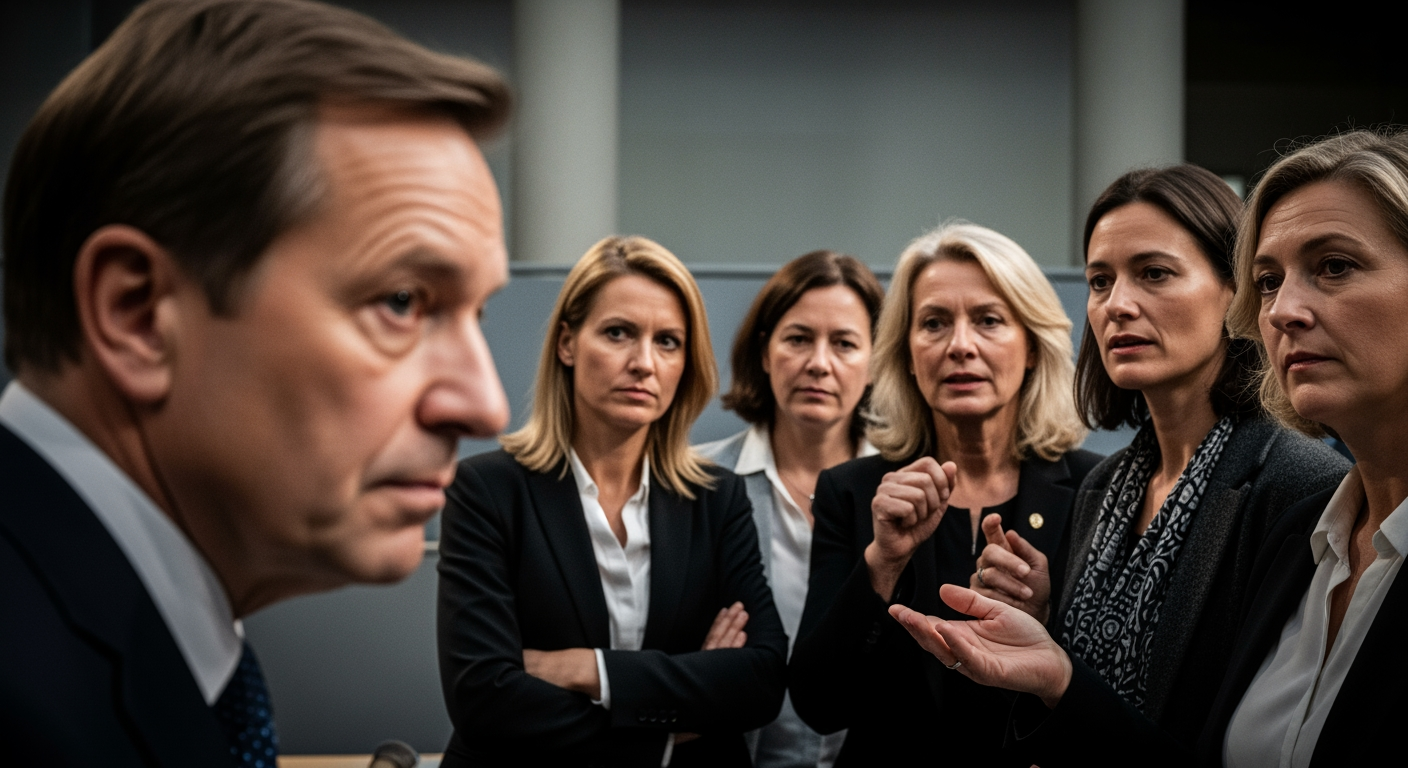
BERLIN – German Chancellor Friedrich Merz finds himself at the center of a burgeoning national debate, facing a wave of criticism from women across the country following a series of controversial statements and actions. The growing backlash highlights deep-seated concerns regarding gender equality, public safety, and political representation, prompting protests, an open letter from prominent figures, and renewed scrutiny of the Chancellor’s stance on women's rights.
The recent uproar stems primarily from Merz's remarks linking perceived problems in German cities, or the "Stadtbild," to irregular immigration, which he then controversially defended by telling a reporter to "ask your daughters" what he might have meant. This comment, widely interpreted as implying that women feel unsafe due to migrants, ignited significant public outrage and mobilized women's groups and activists nationwide.
The "Stadtbild" Controversy and the Daughters' Demand for Action
The controversy intensified after Chancellor Merz stated that while irregular immigration had decreased since he took office, "we still have this problem in the cityscape," a phrase understood as a reference to visible diversity in Germany's population. When questioned by a reporter about these remarks, Merz doubled down, advising, "Ask your daughters, ask your friends – everyone will confirm this is a problem, at least after dark". He further asserted, "I have nothing to take back. On the contrary."
This response, which critics swiftly labeled as racist and patronizing, sparked widespread condemnation across the political spectrum and civil society. Thousands gathered outside the Christian Democratic Union (CDU) headquarters in Berlin under the slogan "We are the daughters," directly challenging Merz's assertion and rejecting the use of women's safety as a pretext for what they viewed as divisive anti-immigrant rhetoric. Environment activist Luisa Neubauer, addressing the crowd, stated that women would "not be used as an excuse for racist and unacceptable statements".
In response to the escalating outcry, 60 prominent women, including politicians, artists, scientists, and civil society leaders, signed an open letter to Chancellor Merz titled "We are the daughters — 10 demands to Friedrich Merz for our safety". The letter criticized the Chancellor for framing the debate in a way that pits victims of sexism against victims of racism, accusing him of using women's vulnerability to "stir up resentment against people with a migrant background in Germany". The signatories emphasized their desire to discuss women's safety seriously, "and not as a cheap excuse to justify racist narratives". Their demands include better prosecution of sexual and domestic violence, improved lighting and surveillance in public spaces, incorporation of femicide into criminal law, and adequate funding for women's shelters and safe houses.
A recent survey conducted by the Civey public opinion research institute for the Funke Media Group highlighted the urgency of the issue, revealing that 55 percent of women in Germany do not feel safe in public places, with clubs and train stations being areas of particular concern. This finding underscores the legitimate need for enhanced public safety measures, a concern the open letter signatories aim to address without resorting to discriminatory narratives.
Questioning Gender Representation and Cabinet Composition
Beyond the "Stadtbild" comments, Chancellor Merz has also drawn fire for his approach to gender representation within his party and potential government. A widely circulated social media image of Merz and his all-male transition team following the recent election reignited long-standing questions about his commitment to bridging Germany's persistent gender gap. The image, depicting six beaming election winners with no women among them, prompted satirical comments and sharp criticism from political opponents. Green party co-leader Franziska Brantner tartly remarked that "The new Syrian government is probably more diverse than the Union's negotiating team".
Merz has previously expressed reservations about a gender-balanced cabinet, stating that "We wouldn't do women any favours with that". He cited the "crass miscasting" of former female defense minister Christine Lambrecht, who resigned in January 2023 amid criticism, as a reason not to explicitly seek out women for ministerial roles. Despite introducing a gender-parity quota for his party's executive board in 2022 to signal seriousness on the issue, his public statements and the composition of his recent team have fueled skepticism among critics who fear that under his leadership, women will take a backseat in politics. This stance stands in contrast to the previous government under Olaf Scholz, which prioritized near 50/50 gender parity in its cabinet until its implosion.
Historical Positions on Women's Rights and Social Issues
Critics have also pointed to Merz's historical record on women's rights and social issues, which further contributes to the current wave of criticism. His 1997 vote against making marital rape punishable by law has been repeatedly brought up. While Merz has since stated he would vote differently today, this past action continues to be a point of contention for those scrutinizing his views on women's autonomy and safety.
Furthermore, Merz has voiced opposition to the "Selbstbestimmungsgesetz" (Self-Determination Law), a recent legislative initiative designed to make it easier for trans and non-binary individuals to change their legal gender. This opposition aligns with a broader shift within the CDU under Merz, where the party is perceived by some as moving away from a more supportive discourse on intersex and LGBTQ+ rights that characterized the era of former Chancellor Angela Merkel.
In a more recent development, Merz also proposed the possibility of female conscription as part of future Bundeswehr reforms, acknowledging the legal and social hurdles involved and suggesting a political discussion on amending the Basic Law, which currently only allows men to be called for military service. While presented as part of strengthening Germany's defense capabilities, this suggestion has added another dimension to the ongoing debate about women's roles and responsibilities in society under his leadership.
The "Frauenproblem" and Political Implications
Collectively, these incidents and Merz's public image have led political analysts to suggest he faces a significant "Frauenproblem" (women problem). Polls indicate that Merz's favorability ratings are lower among women voters, a phenomenon sometimes referred to as the "Merkel gap," reflecting a historical appeal of Angela Merkel among educated, politically independent female voters over 45. Exit polls from the last general election showed a stark gender split, with 30% of men voting for Merz's bloc compared to just 27% of women, and an even more pronounced divide among younger voters. Political analyst Matthias Jung described Merz as "more of a liability than an asset" for his party, noting an exodus of traditionally conservative older female voters from the party.
The ongoing criticism from women across Germany underscores a deeper societal expectation for political leaders to actively champion gender equality and inclusive policies. As Chancellor Merz navigates these challenges, his ability to address these concerns and demonstrate a more modern and inclusive approach will be crucial for his political standing and the broader perception of his leadership. The "We are the daughters" movement and similar initiatives signal a clear demand for concrete action and a refusal to be used as political pawns in broader policy debates. The coming months will reveal how the Chancellor responds to these pressures and whether he can bridge the perceived gap with a significant segment of the German electorate.