"Cockroach Janta Party" Emerges as Potent Voice of Disgruntled Indian Youth, Demanding Accountability
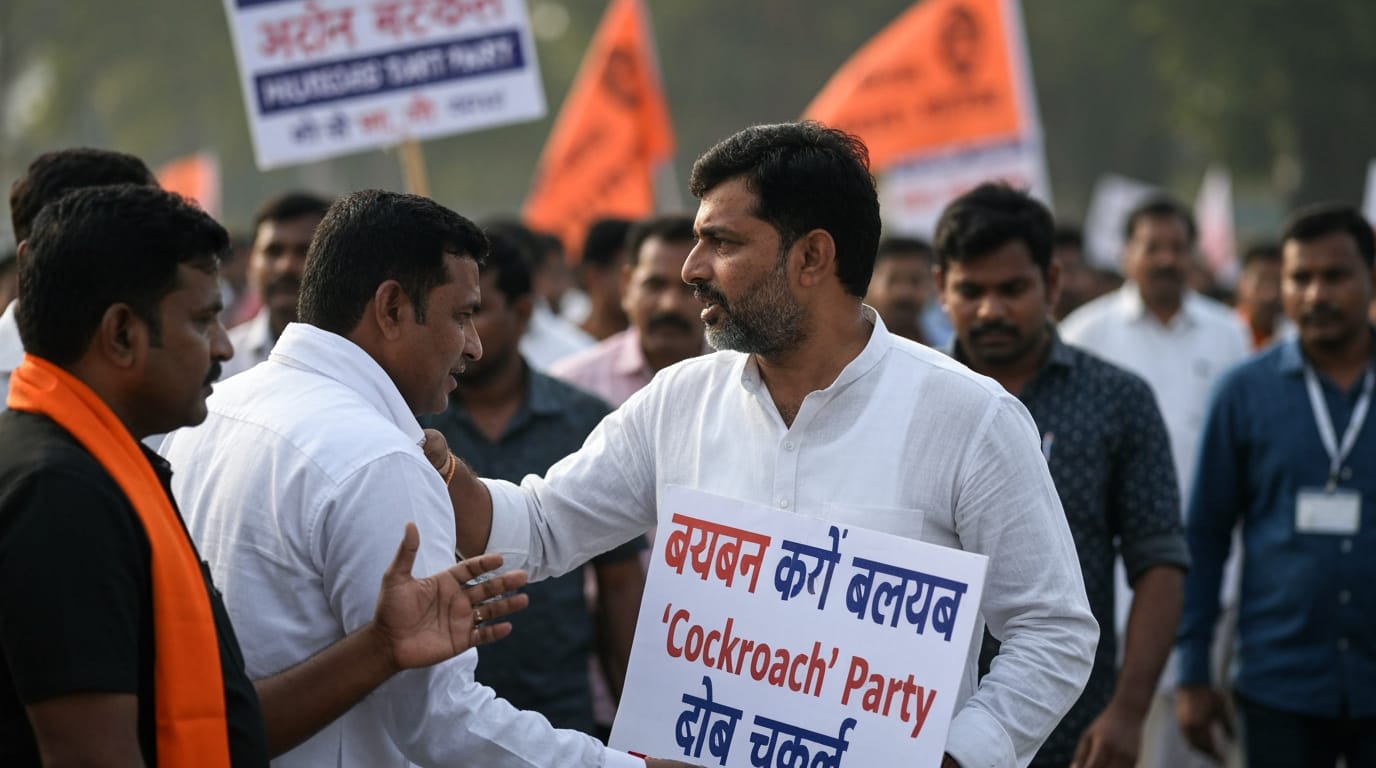
NEW DELHI, India — What began as a satirical response to a controversial judicial remark has rapidly evolved into a significant youth protest movement in India, with hundreds taking to the streets and millions mobilizing online under the banner of the "Cockroach Janta Party" (CJP). This unconventional political force, founded by communications strategist Abhijeet Dipke, channels widespread frustration among young Indians over issues ranging from unemployment to alleged examination irregularities, posing a unique challenge to the established political landscape.
From Insult to Icon: The Birth of the CJP
The genesis of the Cockroach Janta Party can be traced back to May 15, 2026, when Chief Justice of India Surya Kant ignited a nationwide controversy. During a court hearing, Kant reportedly described some activists and unemployed youth as "cockroaches" and "parasites of society." The remarks, though later clarified by Kant as being directed specifically at individuals with fraudulent degrees, sparked immediate outrage among India's youth, who felt disparaged and misrepresented.
Seizing upon this moment of collective indignation, Abhijeet Dipke, a 30-year-old Boston University graduate and former political communications strategist, launched the Cockroach Janta Party online on May 16, 2026. The name itself is a deliberate act of political satire, directly referencing the Chief Justice's insult while also parodying the ruling Bharatiya Janata Party (BJP). Dipke, who had previously worked with the Aam Aadmi Party, aimed to transform the perceived insult into a badge of resilience and a rallying cry for protest.
The movement's online adoption was swift and staggering. Within days of its inception, the CJP amassed over 20 million followers on Instagram, surpassing the official social media presence of the BJP and the Indian National Congress, India's largest political entities. The CJP's website, launched with the tagline "Voice of the Lazy & Unemployed," described itself as a "platform for all the 'cockroaches' out there," jokingly listing eligibility criteria such as being unemployed, lazy, chronically online, and capable of professional ranting. This rapid digital mobilization underscored a deep well of discontent among a demographic often feeling marginalized from mainstream political discourse.
The Grievances: Education, Employment, and Accountability
While born from a specific judicial remark, the CJP quickly broadened its focus to encompass a range of systemic issues plaguing Indian youth. At the forefront of its demands is the resignation of Union Education Minister Dharmendra Pradhan. This call for accountability stems from widespread allegations of irregularities in the National Eligibility cum Entrance Test (NEET) 2026 paper leak and issues with the Central Board of Secondary Education (CBSE) On-Screen Marking system. Many students and parents have expressed profound frustration over these issues, which they believe threaten the careers and futures of millions.
Beyond immediate educational concerns, the CJP articulates broader frustrations, including high youth unemployment rates, rising living costs, and a perceived lack of government accountability. The movement's manifesto also touches upon other critical policy areas, calling for measures such as barring retired Chief Justices from Rajya Sabha seats, prosecuting vote deletion under the UAPA, ensuring 50% women's reservation in Parliament, canceling media licenses owned by large conglomerates like Ambani and Adani, and implementing a 20-year ban on political defectors. These demands reflect a comprehensive critique of governance and institutional practices in India.
Taking to the Streets: The Physical Manifestation of Dissent
Transitioning from a powerful online presence to tangible street activism, the CJP staged its first major physical protest on June 6, 2026, at Jantar Mantar in New Delhi. Hundreds of supporters, predominantly young students, college-goers, and competitive exam aspirants, gathered to voice their anger. Many wore paper cockroach masks and carried placards, symbolically reclaiming the derogatory term and transforming it into a badge of honor. Founder Abhijeet Dipke, who flew in from the United States specifically to lead the demonstration, emphasized the movement's defiance. "The youth of the country will no longer fear anyone, they will fight," Dipke told supporters, adding, "Cockroaches don't ever fear, they never die either."
The protest, though granted police permission, saw heightened security, with significant police deployment and steel barricades around the protest zone. Brief moments of tension and minor detentions were reported, including individuals raising slogans against the CJP protesters. Notable figures, such as activist Sonam Wangchuk, also joined the demonstration, further amplifying the movement's visibility.
Following this initial success in the capital, the CJP announced a broader national campaign, commencing with a rally in Pune on June 11, 2026, and plans for protests in other cities. Dipke stated that supporters would return to New Delhi later in the month if the Education Minister did not resign, signaling the movement's intent for sustained pressure.
A New Voice: Satire as a Political Tool
The Cockroach Janta Party represents a novel approach to political activism in India, masterfully leveraging satire, memes, and self-deprecating humor to engage a digitally native generation. By embracing the "cockroach" label, the movement has turned a pejorative term into a symbol of resilience and collective identity. Its online content, including videos and memes mocking unemployment, corruption, and political dysfunction, has garnered millions of views, creating a resonant platform for dissent.
This digitally driven, satirical strategy has allowed the CJP to grow at an unprecedented pace, quickly establishing itself as a significant online political entity. However, its rapid rise has also drawn the attention of the government. Authorities temporarily blocked the CJP's X (formerly Twitter) account, a move the party has challenged in a Delhi court. Additionally, a senior cabinet minister accused the group of seeking followers from "anti-India gang," indicating official discomfort with the movement's growing influence. Despite these challenges, the CJP's ability to translate online momentum into real-world protests marks it as a distinct and formidable force in contemporary Indian politics.
The Enduring Swarm
The emergence of the Cockroach Janta Party highlights a pivotal shift in youth engagement with politics in India. Born from a moment of perceived insult, it has skillfully utilized social media and satire to construct a powerful, albeit unregistered, platform for discontent. The movement's focus on tangible issues like examination irregularities and unemployment, combined with its innovative communication style, resonates deeply with a demographic often feeling unheard.
As the CJP continues its nationwide protest campaign, demanding the resignation of the Education Minister and advocating for broader reforms, its trajectory will be closely watched. The ability of this "swarm" to maintain its momentum, translate its vast online following into sustained offline pressure, and navigate responses from the establishment will determine its long-term impact on India's political discourse and policy-making. The Cockroach Janta Party stands as a testament to the evolving nature of activism, where a single, ill-considered remark can ignite a vibrant and resilient movement for change.


