"Cockroach" Party Swarms Jantar Mantar in Delhi, Demanding Accountability Amidst Youth Frustration
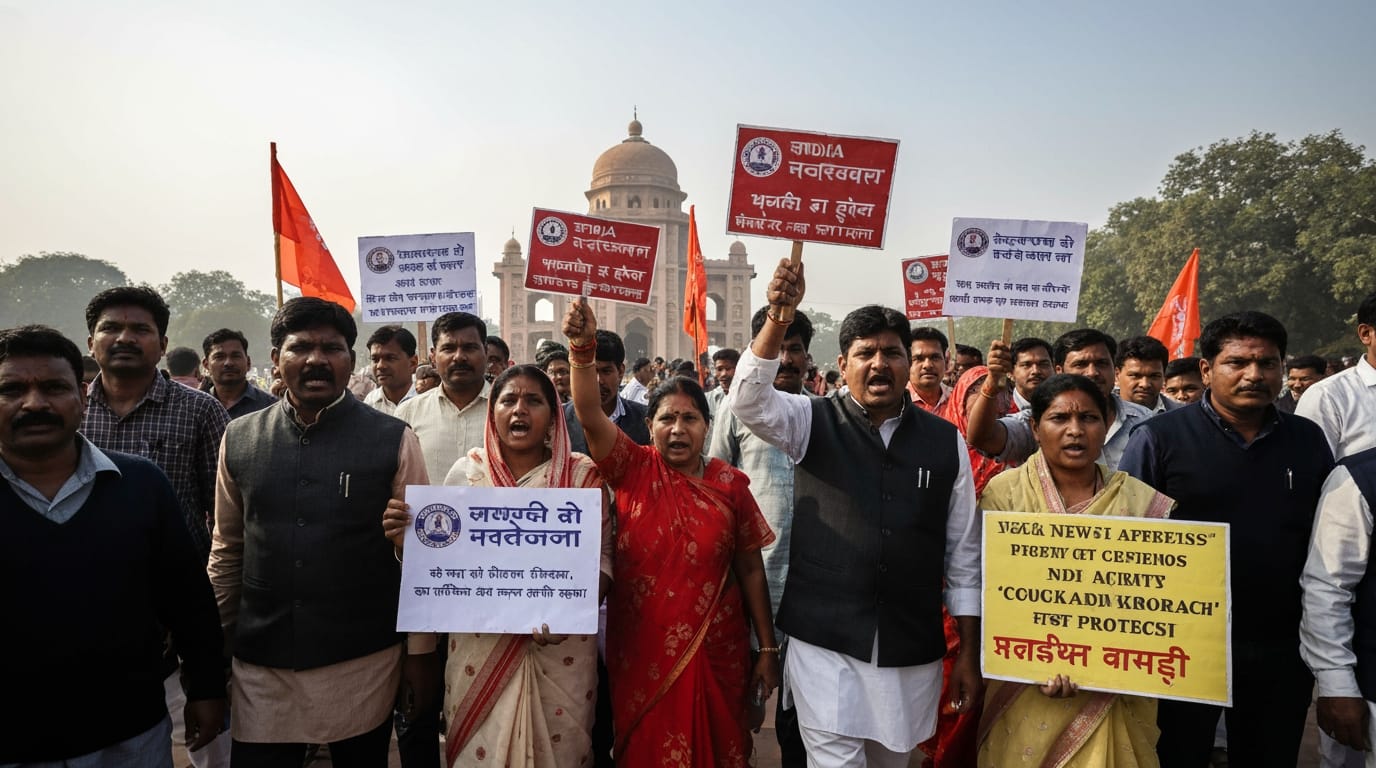
NEW DELHI – In a striking display of satirical defiance turned tangible protest, hundreds of supporters of the "Cockroach Janta Party" (CJP) converged at Jantar Mantar in New Delhi today, Saturday, June 6, 2026, demanding the immediate resignation of Union Education Minister Dharmendra Pradhan. The demonstration marks a pivotal moment for the nascent, online-born movement, translating its immense digital following into a physical assertion against what its members describe as systemic failures impacting India's youth.
The CJP's presence at the capital's designated protest hub comes after weeks of rapid proliferation across social media platforms, fueled by widespread frustration over examination irregularities and a broader sense of disenfranchisement among young Indians. The movement's unconventional name, a deliberate reclamation of a derogatory term, underscores its unique approach to political engagement, blending sharp satire with serious calls for governmental accountability.
The Genesis of the "Cockroach" Movement
The "Cockroach Janta Party" emerged from an unexpected spark of controversy just weeks ago. On May 15, 2026, during a Supreme Court hearing, Chief Justice of India Surya Kant made remarks comparing certain confrontational activists and unemployed youth to "cockroaches" and "parasites of society." This analogy, intended to criticize those with fraudulent credentials and institutional critics, ignited immediate national outrage.
Responding swiftly, political communications strategist Abhijeet Dipke, a former associate of the Aam Aadmi Party, launched the "Cockroach Janta Party" online on May 16, 2026. Dipke, who studied public relations in Boston, chose to turn the insult into a badge of resilience, creating a satirical platform that rapidly resonated with millions. Within days, the CJP's Instagram account garnered over 20 million followers, surpassing even established political parties like the ruling Bharatiya Janata Party (BJP). The movement's core ideology, as humorously outlined, welcomes the "unemployed, lazy, and chronically online," serving as a wry commentary on the socio-economic anxieties plaguing India's younger generation. This swift online explosion demonstrated the profound hunger among youth for an outlet to voice their grievances.
Demands at Jantar Mantar: A Call for Accountability
The primary demand articulated by the CJP at Jantar Mantar was the resignation of Union Education Minister Dharmendra Pradhan. This demand is directly linked to recent widespread discontent over alleged examination-related lapses, including significant paper leaks in the National Eligibility cum Entrance Test (NEET-UG) and issues with the Central Board of Secondary Education's (CBSE) new on-screen marking evaluation system for Class 12 examinations. These controversies have severely impacted the academic and career prospects of countless students, fueling a potent sense of injustice and despair.
Hundreds of CJP supporters, many of them young, gathered at the iconic protest site, carrying placards and some donning symbolic cockroach masks. Organizers emphasized the peaceful nature of their demonstration, with a large banner explicitly stating "peaceful protest." Chants of "Cockroaches are coming, Dharmendra Pradhan is going!" echoed through the air, embodying the movement's characteristic blend of satire and direct political challenge. Abhijeet Dipke, who flew back from the United States specifically to lead the protest, urged participants to carry a book and the Tricolour, signaling both intellectual engagement and national allegiance to their cause. The protest, therefore, is not merely about a minister's resignation but symbolizes a deeper quest for systemic reform and transparency in the nation's educational framework.
Jantar Mantar: A Historic Canvas for Dissent
Jantar Mantar's selection as the protest venue is deeply significant, reinforcing its role as India's premier site for public dissent. Originally an 18th-century astronomical observatory, it transformed into the capital's designated protest ground in 1993. This shift occurred after earlier mass demonstrations, notably a large farmers' protest in 1988, near the Boat Club area, posed significant security and logistical challenges.
Strategically located near the Indian Parliament, Jantar Mantar offers protesters visibility and symbolic proximity to the corridors of power, ensuring their voices are heard by the political establishment and the national media. However, its design with limited entry and exit points also allows for relatively controlled management by law enforcement agencies, balancing the right to protest with security concerns. Over the decades, Jantar Mantar has been the backdrop for numerous landmark movements, including Anna Hazare's anti-corruption agitation in 2011 and protests following the Nirbhaya gang rape case in 2012-2013, solidifying its identity as a crucial public forum where citizens confront the state. The CJP's choice of this site underscores its intention to leverage this historical resonance for its contemporary youth movement.
From Digital Surge to Street Confrontation
The transition of the CJP from a viral online sensation to a physical street protest posed a significant test for the movement's ability to mobilize offline. Abhijeet Dipke and his team successfully rallied supporters, primarily through social media, drawing hundreds to Jantar Mantar. This shift from memes and hashtags to public demonstrations highlights a growing trend in Indian activism, where digital movements seek to establish tangible presence and impact.
Authorities responded to the anticipated gathering with heightened security. Delhi Police deployed paramilitary forces and personnel across key locations in the capital, including increased surveillance around the homes of VIPs, such as the Prime Minister and Education Minister. While there were initial reports of police not receiving a formal permission request, later updates confirmed that the CJP was granted permission to protest at Jantar Mantar from 10 am to 5 pm. Notably, the Delhi High Court had earlier declined an urgent hearing on a Public Interest Litigation (PIL) seeking preventive and crowd-control measures for the planned protest, allowing the demonstration to proceed. Amidst the CJP protest, a small group of counter-protesters, raising "Jai Shri Ram" slogans and demanding action against the CJP, were detained by Delhi Police, indicating the complex and often polarized landscape of public discourse in India. The movement has also faced digital pushback, with some CJP social media handles reportedly being blocked in India.
A New Voice for Frustrated Youth
Today's protest by the "Cockroach Janta Party" at Jantar Mantar represents more than just a demand for a minister's resignation; it symbolizes a collective articulation of deep-seated frustrations among India's youth. The movement effectively repurposed a derogatory label into a symbol of resilience and collective identity, offering a unique avenue for expressing discontent over issues like unemployment, education, and economic opportunities.
By taking their satirical online movement to the streets, the CJP has demonstrated its capacity to bridge the digital-physical divide, challenging traditional forms of political engagement. Whether this nascent "party" can sustain its momentum and translate its broad appeal into concrete policy changes or a lasting political force remains to be seen. However, its emergence and the scale of its initial physical protest undeniably signal a potent and evolving landscape of youth activism in India, where humor, satire, and digital prowess are increasingly becoming tools for demanding accountability from those in power. The "cockroaches," once dismissed, have certainly made their presence felt, demanding attention and a response from the system they critique.


