Czechia Plunges Into Constitutional Crisis as President Alleges Blackmail by Foreign Minister
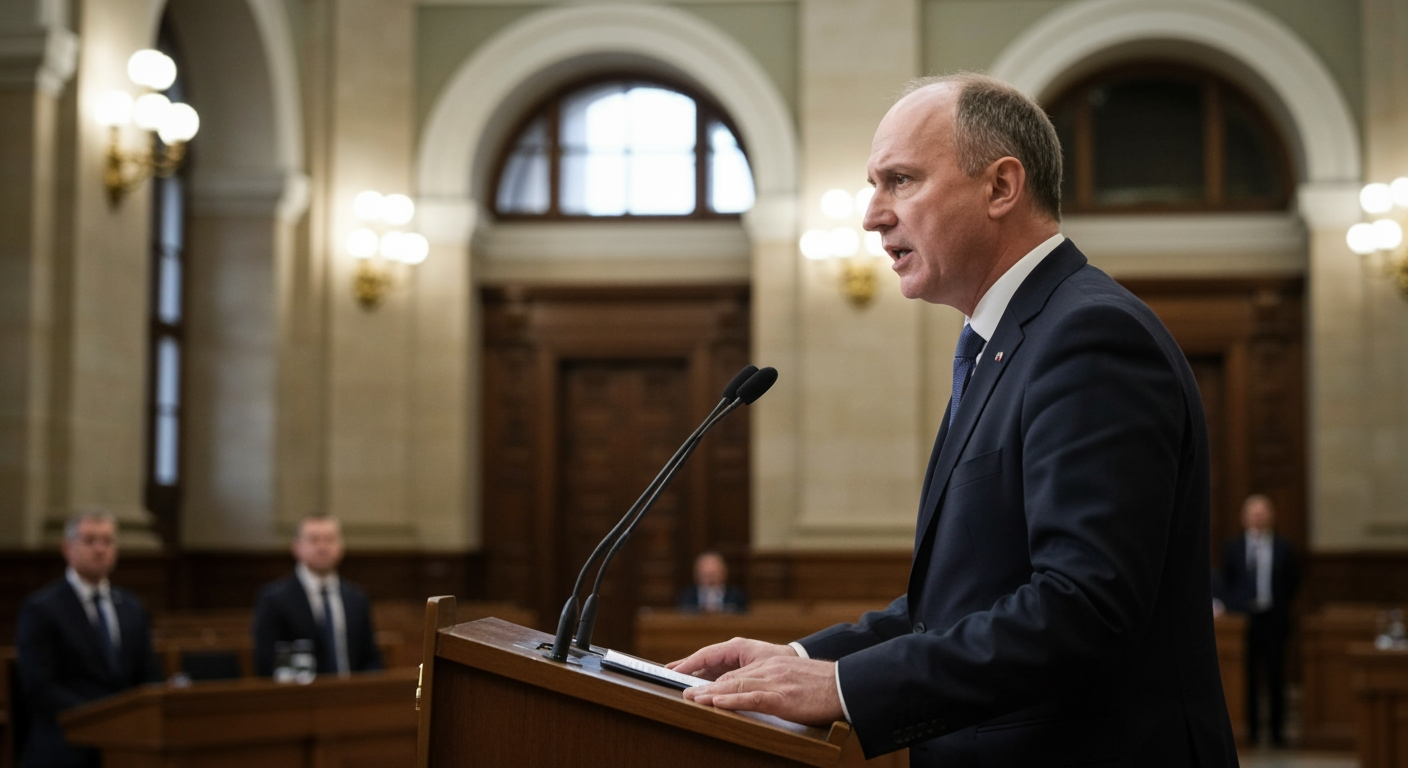
PRAGUE – A profound political crisis has engulfed Czechia, pitting President Petr Pavel against Foreign Minister Petr Macinka, with accusations of attempted blackmail and constitutional overreach threatening the stability of the nation's government. The unprecedented public feud, unfolding over a disputed ministerial appointment, has ignited calls for resignations and cast a shadow over the country's political landscape, raising concerns about governance and its international standing.
The escalating tensions reached a critical point when President Pavel publicly accused Foreign Minister Macinka of the Motorists party of attempting to blackmail him. The alleged pressure was exerted through "extremely serious" text messages sent by Macinka to one of Pavel's advisors, aiming to force the president's approval of Filip Turek as the new Environment Minister. This dramatic revelation has intensified a simmering conflict between the head of state and a key member of Prime Minister Andrej Babiš's coalition government.
Appointment Impasse and Public Accusation
The root of the current dispute lies in President Pavel's steadfast refusal to appoint Filip Turek, a prominent figure and honorary president of the Motorists party, to a ministerial post. Turek was initially considered for the Foreign Minister role but faced strong opposition due to what critics described as "radical statements and critical attitude toward the European Union." Following this initial rejection, the Motorists party then proposed Turek for the Environment Ministry. President Pavel, however, reiterated his opposition, citing Turek's involvement in various controversies and problematic past social media posts.
The conflict escalated into a public spectacle when President Pavel convened an impromptu press briefing on Tuesday, January 27, 2026. He disclosed that Foreign Minister Macinka had sent text messages to his advisor, Petr Kolář, which Pavel interpreted as a direct attempt to influence his constitutional duties through intimidation. In these messages, Macinka reportedly warned of severe political consequences if Pavel continued to block Turek's appointment, threatening to "burn bridges in a way that will go down in political science textbooks." The foreign minister also allegedly cautioned that failure to negotiate would lead to "surprising consequences." Following these revelations, President Pavel announced his intention to file a complaint with security services and seek legal counsel to determine if the messages constitute a criminal offense.
Constitutional Battleground and NATO Threat
In response to President Pavel's accusations, Foreign Minister Macinka vehemently denied any attempt at blackmail. He characterized his communication as "legitimate means of political negotiation" and accused President Pavel of exceeding his constitutional authority by refusing to appoint Turek. Macinka argued that influencing political positions is the "essence of every negotiation" and stated that Pavel's stance demonstrated "contempt for the will of the Chamber of Deputies."
The dispute has spotlighted the delicate balance of power within Czechia's parliamentary democracy. The President, as the head of state and commander-in-chief, holds the authority to appoint and recall the Prime Minister and other members of the government. However, this power is typically exercised within established constitutional frameworks and political norms. While the President can veto bills, this power is typically limited and can be voided during constitutional crises. Foreign policy, though coordinated with the head of state, is primarily determined by the government.
Further escalating the confrontation, Macinka issued a new threat, stating that if Pavel persisted in his refusal to appoint Turek, he would inform NATO Secretary General Mark Rutte that President Pavel was disregarding the constitution and therefore unfit to represent Czechia at the upcoming NATO summit in Ankara in July 2026. This followed earlier criticism from Macinka in mid-January, when he publicly chastised Pavel for making statements during a visit to Kyiv regarding the potential transfer of aircraft to Ukraine, arguing that the president had not consulted with the government on such a sensitive matter.
Political Fallout and Calls for Resignation
The political fallout from the escalating feud has been immediate and widespread. Prime Minister Andrej Babiš, whose ANO party leads the coalition government alongside the far-right SPD and the Motorists party, has attempted to de-escalate the situation. While he described Macinka's messages as "unfortunate" and "not his style," Babiš defended his foreign minister against criminal accusations, stating that it was "private communication with an adviser and therefore certainly cannot be considered blackmail." The Prime Minister has called for calm and invited both President Pavel and Minister Macinka to a joint meeting, although reports indicate President Pavel prefers to meet only with the Prime Minister to discuss the matter.
Opposition parties, however, have reacted with strong condemnation, demanding Foreign Minister Macinka's immediate resignation. Leaders from parties such as the Civic Democratic Party (ODS), TOP 09, and the Pirates have labeled Macinka's behavior as "scandalous" and "mafia-like," arguing that he is prioritizing party interests over national stability. The opposition has pressed the government to at least apologize for Macinka's remarks.
Deeper Divisions and Future Implications
This public confrontation underscores deeper ideological and political divisions within the Czech political system. President Pavel is widely regarded as firmly pro-Western and a strong advocate for NATO and EU interests. Conversely, the coalition government includes parties like the Motorists, which has notably campaigned against the EU's Green Deal, and the far-right SPD, which is pro-Russian. This ideological disparity contributes to the friction between the presidency and parts of the government, particularly concerning foreign policy and European integration.
The ongoing feud not only destabilizes the current government but also raises fundamental questions about the functioning of Czech democratic institutions. The direct public conflict between the head of state and a government minister, coupled with allegations of blackmail and constitutional violations, risks eroding public trust in political leadership. The long-term implications for Czechia's governance, its legislative processes, and its standing within the European Union and NATO remain uncertain. As the situation continues to unfold, a swift and decisive resolution is crucial to restore political stability and ensure the effective functioning of the state.
The immediate challenge lies in addressing the ministerial appointment deadlock and diffusing the personal animosity that has spilled into the public sphere. The outcome of President Pavel's legal actions and the government's internal response to Macinka's conduct will significantly shape the trajectory of Czech politics in the coming months.
Related Articles


Mounting Frustration Grips Russia as Economic Hardship and War's Toll Deepen
Moscow, Russia – A palpable shift in public sentiment is emerging across Russia, with growing frustration among citizens fueled by a confluence of economic pressures, increasing internet restrictions, and the undeniable...

Germany's Strategic Calculus: Ukraine Aid is an Investment in European Security, Not Charity
Berlin – The ongoing provision of substantial aid to Ukraine by Germany and its allies is increasingly being framed not as an act of altruism, but as a crucial investment in European security and stability. This...