Denmark Affirms Unwavering Support for Greenland Amid Heightened Geopolitical Tensions
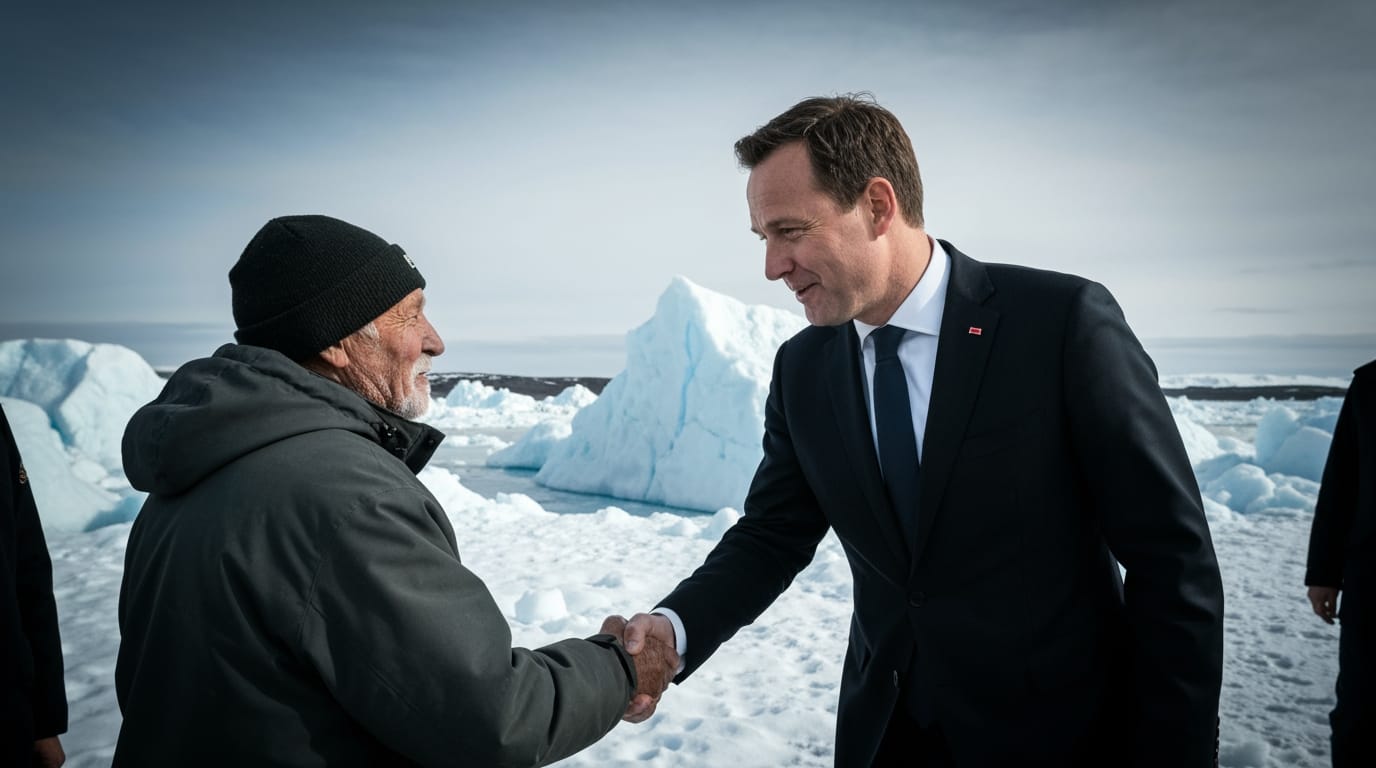
Nuuk, Greenland – Danish Prime Minister Mette Frederiksen concluded a pivotal visit to Greenland's capital, Nuuk, on Friday, January 23, 2026, aiming to solidify Denmark's commitment to the autonomous territory. The trip served as a powerful declaration of solidarity amid a period described by Frederiksen as "very, very difficult," particularly due to renewed external interest in the strategically vital Arctic island. Her visit underscored the complex interplay of geopolitical maneuvering, independence aspirations, and economic realities shaping Greenland's future.
The Prime Minister's presence in Nuuk, where she met with Greenland's Prime Minister Jens-Frederik Nielsen, was largely seen as a direct response to recent geopolitical pressures, including persistent suggestions from former U.S. President Donald Trump regarding the acquisition of Greenland. Both Danish and Greenlandic leaders have consistently rejected any notion of a sale or transfer of sovereignty. Greenland's Prime Minister Nielsen explicitly stated that the territory "chooses Denmark" over the United States, emphasizing the strong historical and constitutional ties that bind the two entities.
A Firm Rejection of External Acquisition
Frederiksen's visit took place against a backdrop of increasing international scrutiny and competition over the Arctic. While on an inspection ship alongside Greenlandic leaders, the Danish Prime Minister directly addressed the United States, asserting in English, "You cannot annex another country – not even with an argument about international security." This unequivocal statement highlighted the collective stance of the Kingdom of Denmark against any attempts to unilaterally alter Greenland's status. The Danish Foreign Minister, Lars Lokke Rasmussen, also indicated that diplomats from Denmark and the U.S. had met to establish a plan for proceeding with discussions in a "calm process," signaling an intent to de-escalate recent diplomatic tensions.
The United States has long held strategic interests in Greenland, dating back to World War II, with the presence of the Thule Air Base serving as a cornerstone of continental defense and NATO's deterrence strategy. However, the recent rhetoric from a former U.S. president regarding acquisition has been met with widespread condemnation from both Danish and Greenlandic officials. Bipartisan U.S. congressional delegations have also engaged with officials in Copenhagen, seeking to reassure them of respect for Greenland's territorial integrity and the principle of self-determination. These diplomatic efforts aim to reinforce the understanding that Greenland is an ally, not an asset to be purchased.
Greenland's Crucial Geopolitical Stature
Greenland's geopolitical significance extends far beyond its historical ties to Denmark. The world's largest island occupies a critical position at the convergence of the Atlantic and Arctic Oceans, making it a crucial waypoint for maritime and air routes. Its strategic location is paramount for NATO, enabling the monitoring of military developments and activities in the air, at sea, and in space, particularly concerning Russia and China's expanding presence in the Arctic region. Since 2022, Danish security strategy has explicitly recognized that the Arctic is no longer a low-tension zone, elevating Greenland's importance as one of the three pillars of Denmark's national security, alongside the Faroe Islands and continental Denmark.
During her visit, Prime Minister Frederiksen discussed enhancing Arctic security with NATO chief Mark Rutte, agreeing that the alliance should bolster its engagement in the region. This consensus reflects a growing recognition of the Arctic as a theater of strategic competition, where melting ice caps are opening new shipping lanes and increasing access to natural resources. The collaboration between Denmark, Greenland, and NATO is geared towards strengthening deterrence and defense capabilities, ensuring the stability of the entire alliance in this increasingly vital area.
The Path to Independence and Economic Realities
Greenland, home to a population of approximately 56,000, predominantly Indigenous Inuit, operates as a self-governing country within the Kingdom of Denmark. Since gaining self-rule in 2009, Greenland has managed most domestic matters, including education, health, and natural resource development, while Denmark retains control over foreign affairs, defense, and monetary policy. The 2009 Self-Government Act also granted Greenlanders the right to declare independence following a referendum.
The ambition for full independence is strong within Greenland, with a 2025 poll indicating that 84% of Greenlanders support this goal, a significant increase from 67.7% in 2019. However, achieving economic self-sufficiency remains a primary challenge. Greenland currently relies heavily on an annual block grant from Denmark, amounting to approximately 4.3 billion Danish kroner (around $600 million USD). This financial assistance supports essential services and contributes significantly to the island's economy. Independence would necessitate the cessation of this grant, requiring Greenland to generate substantial revenues independently.
To strengthen cooperation and support Greenland's long-term sustainability, Denmark recently pledged an additional 1.6 billion Danish kroner (approximately $253 million USD) for investments in healthcare and infrastructure between 2026 and 2029. These funds are intended to aid Greenland in its pursuit of a more self-sustaining economy, potentially paving the way for eventual independence.
Untapped Resources and Environmental Deliberations
Greenland is endowed with vast natural resources, including iron ore, graphite, tungsten, palladium, zinc, gold, and significant deposits of rare earth elements (REEs). These rare earths, crucial for manufacturing batteries, wind and solar technologies, and advanced military equipment, have attracted considerable international attention. Western nations view Greenland's mineral wealth as a potential avenue to reduce their reliance on China, which currently dominates global REE supply chains. Notable deposits like Kvanefjeld and Tanbreez are central to this interest.
However, the pursuit of resource extraction is not without its controversies. Environmental concerns, the impact on traditional Inuit livelihoods, and a standing ban on uranium mining have complicated some projects. While mining presents a potential path to economic independence, Greenlanders are engaged in a crucial debate about balancing development with environmental protection. This ongoing discussion underscores the importance of careful planning and sustainable practices as Greenland navigates its economic future.
Navigating a Complex Future
Prime Minister Frederiksen's visit to Greenland serves as a powerful symbol of Denmark's reinforced commitment to its Arctic partner. By affirming support and rejecting external pressures, Denmark aims to maintain stability and foster continued cooperation in a region of escalating global interest. Greenland stands at a critical juncture, balancing its aspirations for greater autonomy and eventual independence with the economic realities of its current relationship with Denmark and the increasing geopolitical significance of its vast landscape and resources. The ongoing dialogue between Nuuk and Copenhagen, coupled with careful consideration of its unique environmental and cultural context, will be pivotal in shaping Greenland's trajectory in the years to come.


