Devastating Ambush in Northern Mali Claims Dozens of Soldiers and Russian Mercenaries, Exposing Deepening Security Crisis
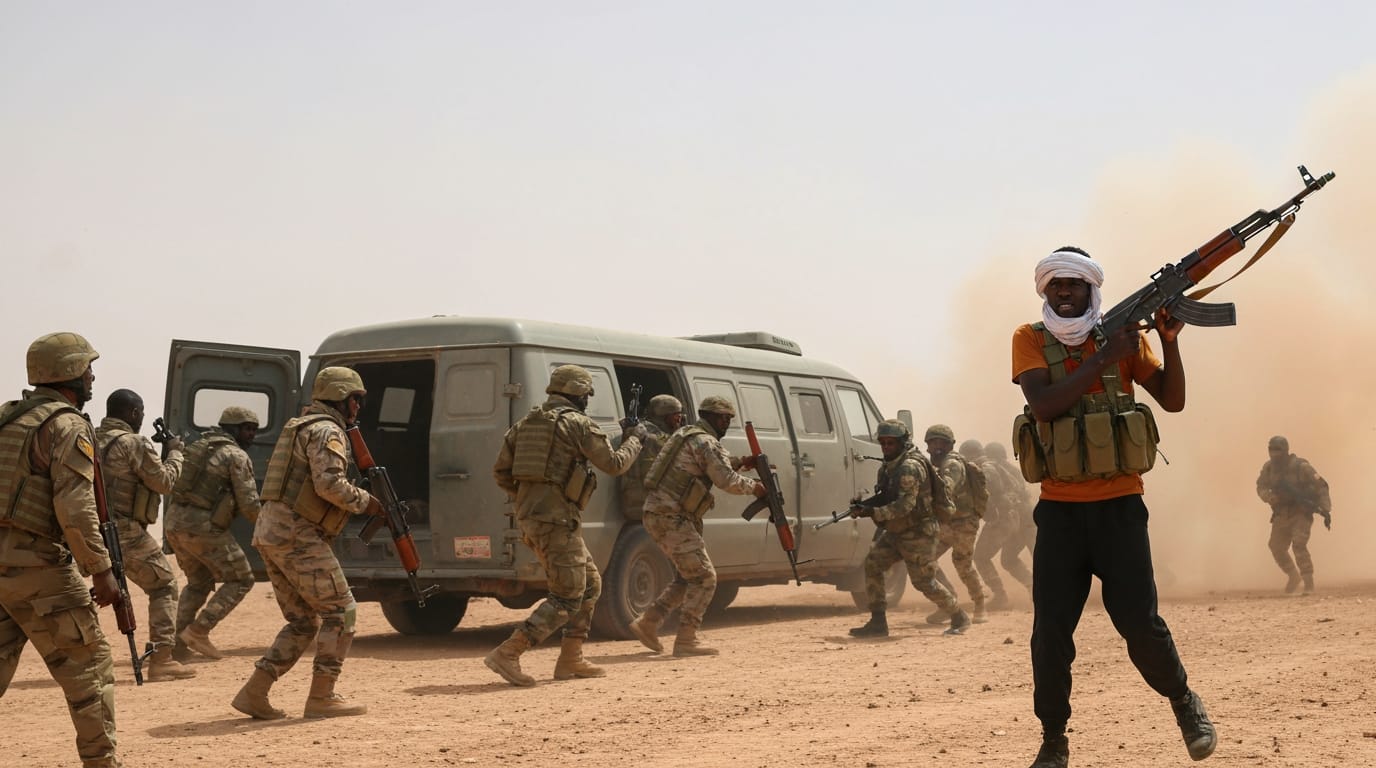
TINZAOUATEN, MALI – A multi-day ambush in northern Mali in July 2024 resulted in the deaths of scores of Malian soldiers and Russian mercenaries, marking one of the deadliest single incidents for the Russian contingent in the Sahel nation and underscoring the escalating complexity of Mali's long-running insurgency. The attack near the Algerian border, carried out by a coalition of rebel groups, signals a significant blow to the Malian transitional government's efforts to stabilize the volatile region and raises further questions about the effectiveness and human cost of relying on foreign military assistance.
The Brutal Ambush at Tinzaouaten
The assault unfolded between July 25 and 27, 2024, when a military convoy consisting of Malian Armed Forces (FAMa) personnel and Russian mercenaries, identified as belonging to the Wagner Group or its successor, the Africa Corps, was ambushed on the outskirts of Tinzaouaten, a strategic locality close to the Algerian border in northern Mali. The convoy had been conducting search operations for Tuareg rebels in the strongholds of Inafarak and Tinzaouaten, areas historically contested by various armed groups.
The rebel coalition Strategic Framework for the Defense of the People of Azawad (CSP-DPA) claimed responsibility for the coordinated attack, stating their forces seized armored vehicles, trucks, and tankers. Reports on casualties varied significantly, reflecting the fog of war in the remote region. The CSP-DPA asserted a devastating toll, claiming 84 Russian mercenaries and 47 Malian soldiers were killed, with another 30 troops either dead or severely injured, and seven captured. They also reported nine of their own fighters killed and 12 injured. Al-Qaeda-linked Jama'at Nasr al-Islam wal-Muslimin (JNIM) also claimed involvement, stating 50 mercenaries and 10 Malian soldiers died in a separate ambush using improvised explosive devices, though CSP denied JNIM's participation in the main battle.
In contrast, the Malian army acknowledged losses but presented a significantly lower figure, reporting two soldiers killed and ten injured in the ambush, while claiming to have killed approximately 20 rebels and destroyed several of their vehicles. Russian military bloggers, known for their proximity to mercenary operations, also reported substantial losses for the Russian side, with some citing at least 20 Wagner fighters killed near the Algerian border and others estimating between 20 and 80 fatalities. The rebels secured control of Tinzaouaten and expanded their territorial influence in the Kidal Region following the engagement.
Mali's Enduring Insurgency: A Decade of Turmoil
The Tinzaouaten ambush is the latest tragic chapter in Mali's protracted security crisis, which began with a Tuareg separatist insurgency in 2012. This initial rebellion, fueled by well-armed Tuareg fighters returning from Libya's 2011 civil war, quickly devolved into a broader conflict with the emergence of various jihadist groups, some affiliated with al-Qaeda and the Islamic State. The government's perceived weak response to the insurgency triggered a military coup in 2012, setting a precedent for subsequent political instability, including additional coups in 2020 and 2021.
Despite a 2015 peace agreement aimed at resolving some of the northern grievances, the accord largely failed to include all armed factions, leaving significant portions of the insurgency unaddressed. The ongoing conflict is characterized by a complex interplay of ethnic-based movements, jihadist groups, and criminal networks vying for control, particularly in the vast, sparsely populated northern and central regions. This persistent insecurity has been exacerbated by pervasive corruption and extreme poverty, creating fertile ground for recruitment by militant organizations. Mali's instability has also had severe regional implications, with violent extremism spilling over into neighboring countries like Burkina Faso and Niger.
Russia's Controversial Footprint: From Wagner to Africa Corps
In late 2021, following the withdrawal of French forces and the United Nations peacekeeping mission (MINUSMA), Mali's transitional military government turned to Russia for security assistance, inviting the Wagner Group, a Russian private military company (PMC), into the country. Despite international alarms from the United States and European nations regarding Wagner's known record of human rights abuses and destabilizing activities, Bamako justified the deployment by referring to the Russians as "trainers" helping local troops with equipment.
However, reports from organizations like The Sentry and insights from analysts indicate a "triple failure" of the Russian presence in Mali. First, the Russian fighters proved largely ineffective in securing northern and central Mali, failing to live up to the Malian authorities' expectations of a decisive military solution against the insurgents. Second, their arrival coincided with a significant increase in attacks against civilians and widespread human rights abuses, including extrajudicial killings, torture, and sexual violence. These brutal tactics, far from quelling the insurgency, are believed to have alienated local populations and inadvertently boosted recruitment for jihadist groups. Third, the Wagner Group's actions reportedly undermined trust within the Malian security apparatus itself, with Malian military personnel expressing resentment over Russian disrespect for command structures and operational mistakes.
Following the death of Wagner's leader Yevgeny Prigozhin in August 2023, the Kremlin sought to consolidate control over its mercenary operations abroad, leading to the creation of the Africa Corps. While the Wagner Group formally announced its departure from Mali in June 2025, many of its personnel were absorbed into the Africa Corps, effectively continuing Russia's military presence under a different banner, directly controlled by the Russian Ministry of Defense. This transition means Moscow now bears direct public responsibility for the actions, failures, and human rights abuses committed by these forces.
Far-Reaching Implications for Mali's Security and Stability
The devastating ambush in Tinzaouaten underscores the profound and ongoing challenges facing Mali's security landscape. The significant casualties among both Malian soldiers and Russian mercenaries highlight the potent threat posed by various insurgent groups, who continue to operate with tactical effectiveness in the country's vast and difficult terrain. Such losses inevitably impact troop morale, deplete resources, and may lead to a reassessment of military strategies.
The incident further complicates the already strained relationship between the Malian authorities and their Russian partners. While the Malian government continues to frame the Russian presence as a beneficial training mission, the high casualty count among the mercenaries and criticisms regarding their operational effectiveness and conduct raise serious questions about the long-term viability and ethical implications of this partnership. The Sentry report, for instance, suggests that Russian survivors of the July 2024 defeat accused Malian intelligence of underestimating rebel numbers and abandoning them, while Malian officers accused Russians of ignoring chains of command and treating them with racism.
For the civilian population, who bear the brunt of the violence, the increased militarization and the reported abuses by all parties only deepen their suffering and mistrust in state authority. The cycle of violence, fueled by political instability, poverty, and external military interventions, shows little sign of abating, leaving Mali in a precarious position with profound consequences for regional peace and security. The battle of Tinzaouaten serves as a stark reminder of the intractable nature of Mali's conflict and the heavy price paid by all involved.


