Europe Ramps Up Defenses Amid Shifting Global Order and U.S. Uncertainty
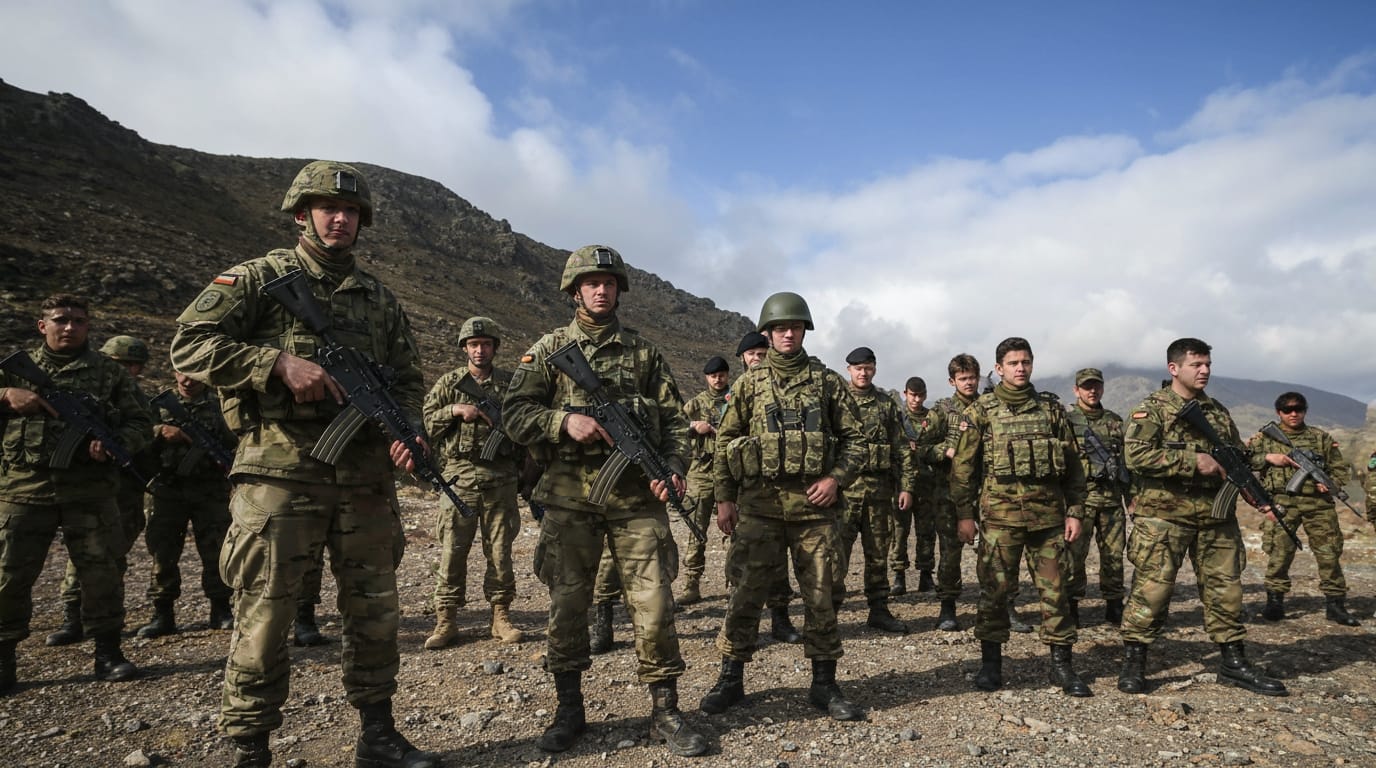
Brussels, Belgium – A profound strategic realignment is underway across Europe as nations accelerate efforts to bolster their own defense capabilities, driven by an escalating threat environment and growing apprehension regarding the long-term reliability of U.S. security commitments. This pivotal shift marks a significant departure from decades of reliance on American military might, ushering in an era where European strategic autonomy is no longer merely an aspiration but an urgent imperative. With unprecedented increases in defense spending and a renewed focus on continental cooperation, Europe is confronting the complex challenge of securing its future in an increasingly volatile world.
The Shifting Geopolitical Sands
The impetus for Europe's intensified defense posture stems from a confluence of critical geopolitical factors. Foremost among these is Russia's continued aggression in Eastern Europe, which has fundamentally altered threat perceptions across the continent. Simultaneously, a perceived recalibration of U.S. strategic priorities towards the Indo-Pacific, coupled with the potential for a reduced American military footprint in Europe, has underscored the need for greater European self-sufficiency. Experts suggest that a U.S. drawdown, even if partial, could expose structural weaknesses in Europe's defense architecture, particularly in critical areas such as strategic airlift, intelligence, surveillance, reconnaissance (ISR), refueling, and integrated air and missile defense, capabilities still heavily dependent on U.S. assets. The prospect of a diminished U.S. commitment has thus spurred European leaders to contemplate scenarios that were once considered remote, pushing the continent toward a more robust and unified defense strategy.
Historically, Europe's defense landscape was heavily shaped by the Cold War, during which the North Atlantic Treaty Organization (NATO), with the United States at its core, provided the primary security umbrella. Following the Cold War, many European nations significantly reduced their defense expenditures, misjudging the enduring nature of geopolitical threats. This trend began to reverse after Russia's annexation of Crimea in 2014 and has been "turbocharged" by the full-scale invasion of Ukraine. Now, the discourse has moved beyond merely meeting NATO spending targets to actively planning for a future where Europe must assume greater responsibility for its own security.
A New Era of Financial Commitment
In response to these evolving threats, European defense spending has surged to unprecedented levels. In 2024, the 27 European Union (EU) Member States collectively spent an estimated €343 billion on defense, marking a 19% increase from 2023 and bringing spending to 1.9% of their combined GDP. Projections indicate this upward trend will continue, with EU defense spending expected to reach €381 billion in 2025, or 2.1% of GDP, exceeding the previous NATO 2% target for the first time since the European Defence Agency began collecting data. This financial commitment is largely driven by record levels of equipment procurement and increased investment in research and development.
Across NATO, European allies and Canada have also significantly increased their collective investment in defense, rising from 1.43% of their combined GDP in 2014 to 2.02% in 2024. In 2024, 23 of NATO's 32 members met or exceeded the 2% GDP defense spending guideline, a substantial increase from just three allies in 2014. While the U.S. remains the largest military spender globally, contributing approximately two-thirds of NATO countries' annual defense spending, European nations are clearly stepping up their financial contributions. The recent 2025 NATO Summit in The Hague saw allies commit to a new target of investing 5% of GDP annually on core defense requirements and security-related spending by 2035, with at least 3.5% allocated to core defense needs.
This increased spending reflects a conscious determination among Member States to strengthen Europe's military capabilities and reduce long-standing dependencies. Countries such as Poland (close to 4% of GDP), Estonia (3.4%), Latvia, and Lithuania (both well over 3%) are leading the charge in defense expenditure relative to their GDP. Germany's defense budget also saw a significant real uplift of 23.2% in 2024.
Forging a Unified Defense: Initiatives and Challenges
Beyond financial investment, Europe is actively pursuing a range of initiatives aimed at fostering deeper defense cooperation and developing a more integrated defense industrial base. Key EU defense initiatives include the Permanent Structured Cooperation (PESCO), the European Defence Fund (EDF), the Coordinated Annual Review on Defence (CARD), and the Capability Development Plan (CDP). PESCO, a treaty-based framework involving 26 participating Member States, aims to deepen defense cooperation through joint planning, development, and investment in shared capability projects. As of March 2025, PESCO encompasses 68 collaborative projects focused on enhancing military capabilities and interoperability.
The European Defence Fund, with an allocation of approximately €8 billion for 2021-2027, plays a crucial role in supporting collaborative defense research and development projects across Member States. The 2025 EDF Work Programme, the largest to date with €1.065 billion, prioritizes next-generation defense technologies, enhanced industrial collaboration, and addressing critical capability gaps in areas such as ground combat systems, air combat, space-based capabilities, and cyber defense. These initiatives are designed to reduce fragmentation in defense spending and ensure access to cutting-edge, interoperable equipment.
Despite these ambitious efforts, significant challenges persist in achieving true European strategic autonomy. Experts point to the "collective action problem," where individual national incentives can undermine joint action, leading to a "strategic cacophony" due to divergent threat perceptions and national defense policies. Fragmentation of national planning and procurement efforts remains a hurdle, with countries often prioritizing national industries over cooperative purchasing, hindering efficiency and interoperability. The European defense industry itself faces challenges, including being undersized and largely organized along national lines, making it difficult to scale up production quickly. Europe's reliance on the U.S. for certain defense technologies, particularly in cyber, unmanned systems, electronic warfare, air defense, and space surveillance, is also a significant obstacle.
Bridging the Capability Gap
A critical aspect of Europe's self-reliance drive involves addressing specific capability gaps that currently render the continent dependent on U.S. support. These include strategic airlift, intelligence, surveillance, and reconnaissance (ISR), aerial refueling, and integrated air and missile defense. Without U.S. Patriots or THAAD systems, Europe is seen as lacking adequate missile defense capacity across almost the entire threat spectrum. Similarly, there are major concerns over Europe's low numbers of surveillance aircraft and its limited space capabilities, both in terms of satellites and launch capacity.
While analysts believe Europe can achieve self-sufficiency in areas like battlefield command and control, long-range strike, and suppression of enemy air defenses within five years, other domains, such as space-based ISR, may require five to ten years to develop sufficient capacity to reduce reliance on the U.S.. Efforts like the European Long-Range Strike Approach (ELSA) project are underway to extend conventional land-attack capabilities beyond 2,000 km. The EU is also leveraging its fiscal and regulatory frameworks, such as the Security Action for Europe (SAFE) loan mechanism of up to €150 billion, to encourage rapid and significant increases in defense investments through joint procurement.
Public Sentiment and the Path Forward
Public opinion across Europe generally supports increased defense spending and stronger EU defense cooperation. A June Eurobarometer survey found that 77% of EU citizens are in favor of a common defense and security policy, and 80% believe cooperation in defense matters should be increased at the EU level. Two-thirds of EU citizens also agree that more money should be spent on defense in the EU. However, support for national defense spending is not uniform, with frontline countries like Lithuania, Finland, and Poland showing higher prioritization compared to countries like Spain and Greece, where other issues like employment and migration take precedence.
Despite the strong support for increased spending, a survey by the European Council on Foreign Relations revealed significant skepticism about the EU's ability to achieve security independence from the U.S. within five years. Only in Denmark and Portugal did a majority believe this was possible, with majorities in Italy and Hungary deeming it "very difficult" or "practically impossible". This highlights the ongoing challenge of translating political will and financial commitments into concrete, effective capabilities that can truly stand independent.
Conclusion
Europe finds itself at a historic juncture, compelled by shifting global dynamics and internal realignments to forge a more robust and self-reliant defense identity. The significant increases in spending, coupled with a suite of cooperative initiatives, underscore a continent serious about its security. Yet, the path to strategic autonomy is fraught with challenges, including overcoming fragmentation, bridging critical capability gaps, and maintaining sustained political will. The journey ahead will demand unprecedented levels of cooperation, innovation, and strategic foresight to ensure Europe can effectively deter threats and safeguard its interests, regardless of future shifts in transatlantic relations. The ongoing transformation of European defense will inevitably reshape NATO and the broader international security architecture, marking a critical chapter in global affairs.


