Zelenskyy Declares Putin a 'Slave to War' on Global Stage, Urges Unwavering Support
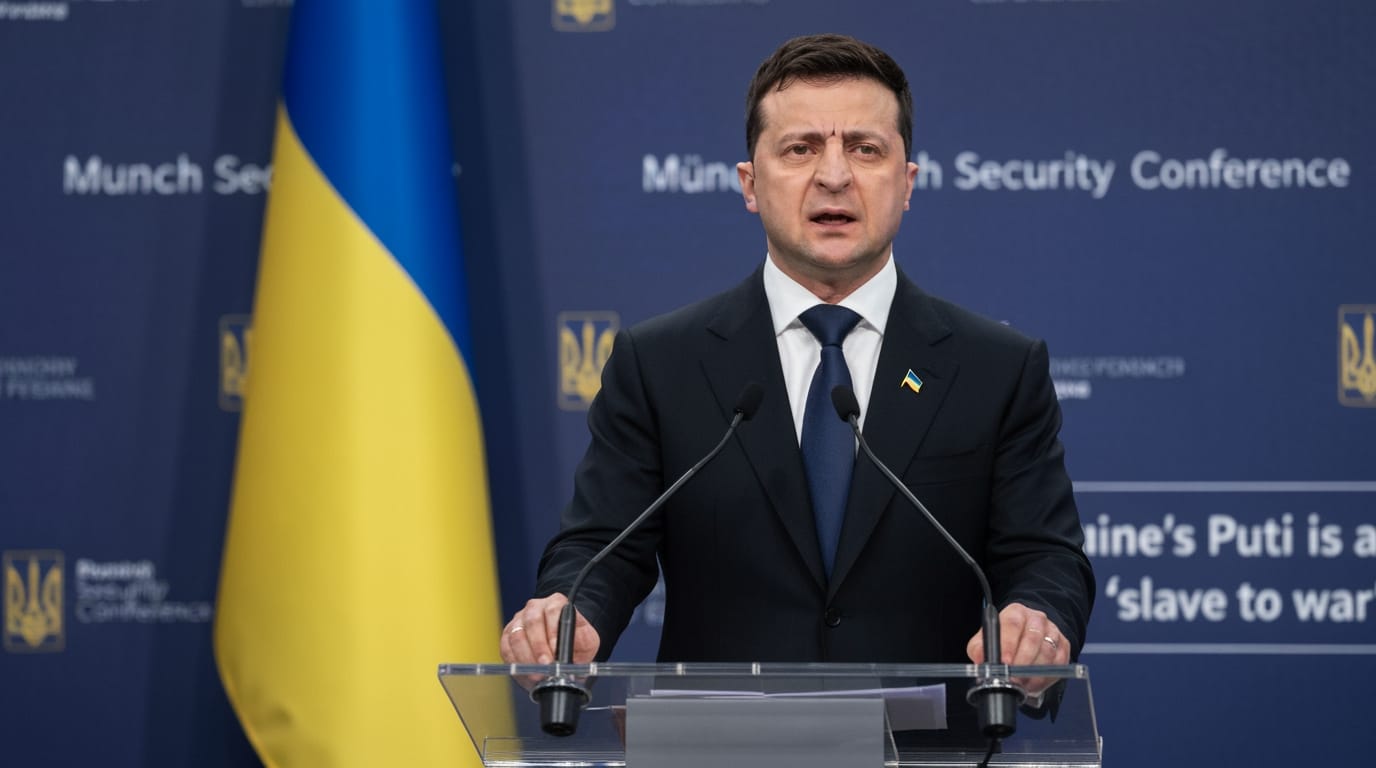
MUNICH, Germany – Ukrainian President Volodymyr Zelenskyy delivered a stark and impassioned address at the Munich Security Conference today, characterizing Russian President Vladimir Putin as a "slave to war" who is incapable of envisioning a life without conflict. His powerful remarks, made just days before the fourth anniversary of Russia's full-scale invasion of Ukraine, served as an urgent plea for continued and expedited Western military and financial assistance, underscoring the severe implications of wavering international support for global security. The Ukrainian leader's speech resonated through the hallowed halls of the Bayerischer Hof hotel, drawing a standing ovation from numerous world leaders and security officials, and firmly placing Ukraine's existential struggle at the forefront of global geopolitical discussions.
A Chilling Portrait of Unrelenting Aggression
During his address, President Zelenskyy painted a grim picture of a Russian leader consumed by imperial ambition, seemingly consulting "more with Tsar Peter and Empress Catherine about territorial gains than with any living person about real life." He described Putin as someone unable to escape the "very idea of war," asserting that the Russian president would not halt his aggression at Ukraine's borders, but would continue to threaten other European nations if not decisively stopped. Zelenskyy drew parallels between Putin's current actions and historical blunders, warning against the illusion that the conflict could be resolved by dividing Ukraine, an outcome he equated to the catastrophic "Munich 1938" scenario, where the sacrifice of Czechoslovakia failed to prevent a wider European war. This historical reference underscored his message that concessions to an aggressor only embolden further expansion, a message that resonated with many attendees concerned about the fragility of the current international order.
Zelenskyy's portrayal aimed to dismantle any lingering notions of a rational or negotiable peace with the current Russian leadership, asserting that Putin "cannot imagine life without power or after power." He argued that Russia's leadership is solely driven by a desire for territorial conquest and domination, making true peace impossible without a decisive victory for Ukraine and robust security guarantees that safeguard not only his nation but the entire European continent. This uncompromising stance highlighted the deep chasm between Kyiv's perspective and any calls for immediate negotiations that might involve territorial concessions, reinforcing Ukraine's resolve to fight for its full territorial integrity.
Urgent Calls for Air Defense and Energy Aid
The Ukrainian President provided a sobering account of the war's toll on his nation, revealing that "not a single power plant" in Ukraine has escaped damage from Russian attacks, forcing millions to endure harsh winter conditions with heating cuts. This deliberate targeting of civilian infrastructure, a tactic Kyiv and its allies accuse Moscow of employing to break the population's will, formed a crucial backdrop to his urgent appeals. He emphasized that despite the widespread destruction, Ukrainian workers continue to generate electricity, a testament to their resilience and determination.
A central theme of Zelenskyy's plea was the critical need for accelerated deliveries of Western-supplied air defense systems. He specifically mentioned the Patriot and NASAMS missile systems, noting the precarious situation where missile supplies sometimes arrive "literally at the last moment" before new Russian strikes. Zelenskyy detailed the immense scale of Russian aerial assaults, citing tens of thousands of drones and thousands of missiles launched against Ukraine in January alone. He asserted that these defensive capabilities are not merely about protecting Ukraine but are essential for holding the "European front," arguing that Ukrainian forces are effectively shielding independent nations like Poland, the Baltic states, Moldova, and Romania from Russian aggression. The President stressed that a lack of air defense missiles represents "the worst news during war," directly impacting the lives of his people and the strategic balance on the battlefield. He also mentioned that Ukraine aimed to eliminate at least 50,000 Russian soldiers per month and cited that Russia was paying a price of 156 soldiers per kilometer gained in Donetsk, underscoring the human cost of the conflict.
The Global Stage and Lingering Doubts
The Munich Security Conference, a pivotal annual gathering for global security policy, provided a high-profile platform for Zelenskyy's address. Attended by dozens of heads of state, hundreds of ministers, and numerous security experts from over a hundred countries, the conference focused heavily on the ongoing war in Ukraine. The event’s overarching theme, "Lose-Lose?", reflected widespread concerns about growing geopolitical tensions and the erosion of global cooperation, themes exacerbated by the conflict in Ukraine. Ukraine's urgent need for support and the imperative to combat "Ukraine fatigue" among allies were leading topics throughout the discussions. Notably, Russian officials were absent from the conference, highlighting the diplomatic isolation Moscow faces on the world stage, and allowing Zelenskyy's unfiltered message to dominate the conversation.
Despite the widespread support and standing ovation received, Zelenskyy also voiced concerns about the uneven burden of the conflict and the nature of international negotiations. He remarked that the United States "often returns to the topic of concessions and too often those concessions are discussed only in the context of Ukraine, not Russia." This statement, coupled with a reference to pressure felt from figures like former U.S. President Donald Trump regarding peace opportunities, underscored the complex political landscape in which Ukraine seeks to maintain unified Western backing. The Ukrainian leader also highlighted that "weapons evolve faster than political decisions meant to stop them," pointing to the increasing lethality of Russian weaponry, such as Iranian-designed Shahed drones. Discussions at the conference also included strategies for increasing European defense production and utilizing frozen Russian assets to aid Ukraine, reflecting a broader effort to solidify long-term support.
A Defining Moment for Global Security
President Zelenskyy's address at the Munich Security Conference served as a potent reminder of the severe and far-reaching consequences of Russia's aggression, extending far beyond Ukraine's borders. His forceful characterization of Putin as a "slave to war" was not merely rhetorical flourish but a strategic attempt to shape international perception of the conflict and underscore the fundamental ideological battle at play. By framing the war as a defense of the broader European security architecture and democratic values, he sought to reinforce the imperative of sustained and robust support from Western allies.
The conference, described by some as reflecting a mood of "deep gloom" regarding the future of European security, nevertheless provided a crucial forum for leaders to reaffirm their commitment to Ukraine. However, Zelenskyy's pointed remarks about waning support and the calls for Ukrainian concessions also highlighted the ongoing challenges in maintaining a unified front amidst prolonged conflict. As Ukraine prepares for another round of trilateral talks with Russia and the United States, the demand for "real security guarantees" remains paramount, emphasizing that any lasting peace must precede, rather than merely follow, a robust framework to prevent future aggression. The future trajectory of the conflict, and indeed of global security, hinges on whether the international community can translate the powerful rhetoric heard in Munich into concrete, unwavering action.