European Finance Ministers Reignite Call for Energy Windfall Tax Amidst New Mideast Conflict
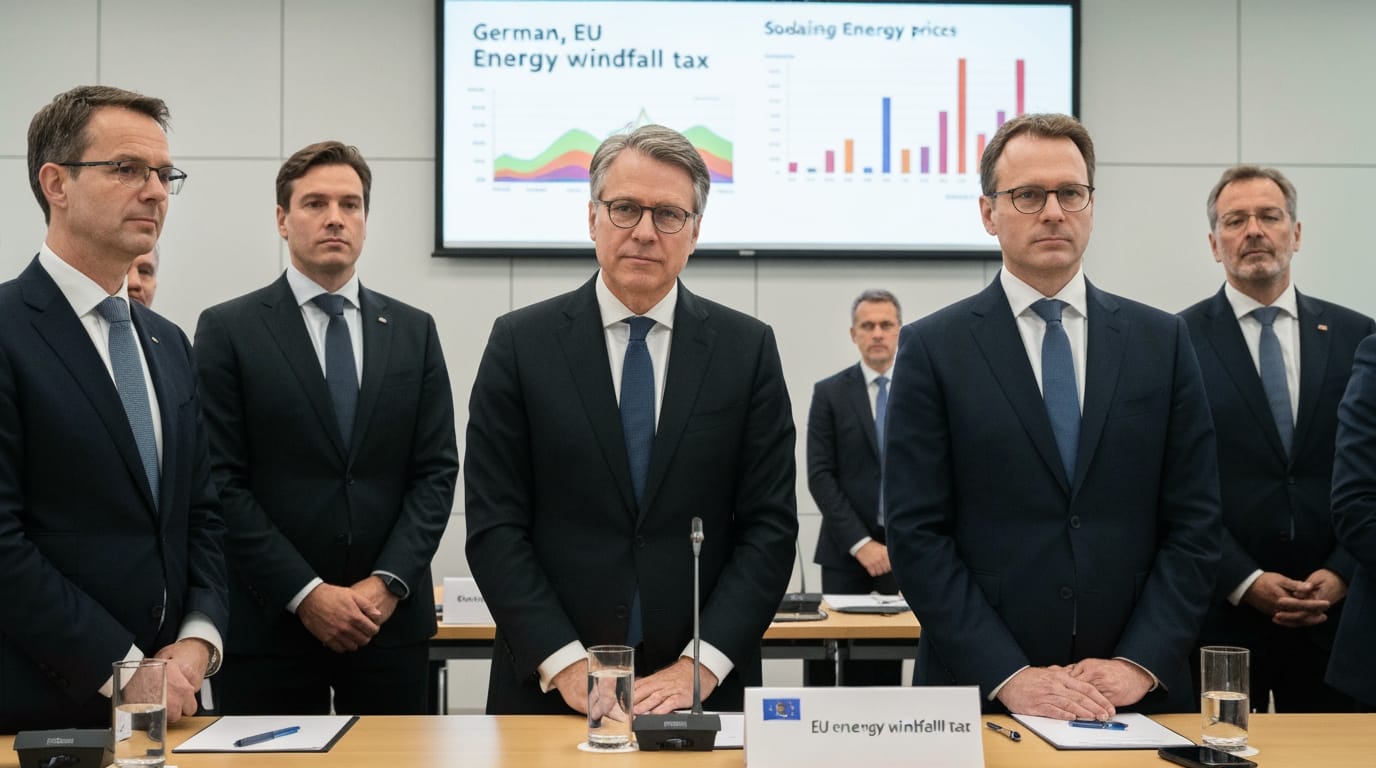
BRUSSELS – Five European Union finance ministers, including Germany, are urgently advocating for a bloc-wide windfall profit tax on energy companies. The renewed push comes as escalating tensions in the Middle East, specifically the US-Israel-Iran conflict, have triggered a significant surge in global oil and gas prices, threatening to exacerbate inflation and burden European households. This move signals a proactive stance by key EU nations to mitigate the economic fallout of ongoing geopolitical instability by requiring energy firms to contribute a portion of their unexpectedly high earnings.
The joint call, formalized in a letter sent Friday to European Commissioner for Climate Wopke Hoekstra, highlights a rapid 70% increase in European gas prices over the past six weeks, a trajectory reminiscent of the energy crisis that followed Russia's 2022 invasion of Ukraine. The ministers, representing Germany, Italy, Spain, Portugal, and Austria, argue that those profiting from war-driven price hikes must "do their part to ease the burden on the general public." They stress the importance of ensuring that the financial strain of the energy crisis does not disproportionately fall on consumers or public finances.
Responding to a New Energy Shock
The recent surge in energy prices stems from the ongoing conflict in the Middle East, particularly the effective closure of the Strait of Hormuz, a crucial transit point for approximately 20% of the world's oil and liquefied natural gas shipments. This disruption has fueled widespread concerns about global energy supply and pushed the Eurozone's annual inflation rate to 2.5% in March, up from 1.9% in February. European Union Energy Commissioner Dan Jorgensen has warned that fuel prices are unlikely to "go back to normal in a foreseeable future," underscoring the severity of the current market distortions.
In their letter, the five finance ministers underscored the need for a coordinated European response, calling for the European Commission to "swiftly develop a similar EU-wide contribution instrument grounded on a solid legal basis." This urgent plea reflects a growing consensus among some member states that extraordinary times necessitate extraordinary measures to protect citizens from economic hardship caused by external shocks.
The 2022 Precedent: A "Solidarity Contribution"
The current proposal draws heavily on the precedent set during the 2022 energy crisis. Following Russia's full-scale invasion of Ukraine, Europe experienced soaring gas and electricity prices, leading to substantial, unanticipated profits for energy companies. In response, the European Commission, in September 2022, proposed a "solidarity contribution" on fossil fuel companies and a revenue cap on electricity generators.
The 2022 solidarity contribution applied to fossil fuel companies in the oil, gas, coal, and refining sectors, taxing profits that exceeded 20% of their average yearly taxable profits from 2018 to 2021, at a rate of at least 33%. Additionally, a revenue cap of €180 per megawatt hour was imposed on electricity producers using technologies like wind, solar, and nuclear. These measures were projected to raise approximately €140 billion, with €25 billion from fossil fuel producers and €117 billion from the revenue cap, all intended to provide relief to struggling households and businesses.
While the 2022 measures were implemented, Germany, a key proponent, introduced its national windfall tax on March 1, 2023, but ultimately halted its levy by the end of June 2023 as energy prices declined. Despite being temporary, some countries like the Czech Republic, Hungary, and Spain extended the application of these taxes beyond 2023, demonstrating a varied approach to the initial EU directive.
Navigating Economic Complexities and Criticism
The implementation of windfall taxes, while popular for their perceived fairness, has not been without complexities and criticism. Proponents argue that such taxes prevent energy companies from unjustly benefiting from external crises, ensuring a fairer distribution of economic burdens during challenging times. The revenues generated can be vital for governments to support vulnerable populations and mitigate inflationary pressures without increasing national deficits.
However, critics raise concerns about the potential for windfall taxes to distort markets and deter future investment in the energy sector, including renewable energy projects. Some argue that penalizing domestic production could lead to increased reliance on energy imports and hinder long-term energy security goals. Legal challenges have also emerged, with some entities, such as the Klesch Group, contesting the 2022 EU "solidarity contribution" on grounds of investor protection, claiming it to be arbitrary and discriminatory. Germany's own experience highlighted the delicate balance required to ensure such a tax does not undermine market incentives or trust in the economic system.
The Path Forward: Seeking a "Solid Legal Basis"
The renewed call for an EU-wide windfall tax comes at a critical juncture, as European nations grapple with persistent economic vulnerabilities stemming from their reliance on imported fossil fuels. The five finance ministers' emphasis on developing a "solid legal basis" for any new instrument suggests a lesson learned from the challenges faced during the 2022 implementation. This approach aims to create a robust and legally sound framework that can withstand potential challenges and ensure effective revenue collection.
The discussions will likely focus on the precise definition of "excess profits," the applicable tax rate, the duration of the measure, and how the collected funds will be distributed to best serve public interest and support economic stability. While specific details on the proposed tax rate or corporate thresholds are not yet public, the ministers' letter signals a clear intention to act swiftly and decisively.
Conclusion
As Europe faces another significant energy price shock driven by geopolitical conflict, the united call from German and other EU finance ministers for a windfall tax on energy companies underscores a strategic commitment to shield citizens and economies from external volatility. This renewed initiative builds upon past experiences, aiming to implement a more robust and legally defensible mechanism to redistribute profits deemed extraordinary amidst crisis. The outcome of these discussions will be pivotal in shaping Europe's approach to economic fairness, energy security, and its response to the unpredictable nature of global events. The challenge remains for European policymakers to balance the immediate need for consumer relief with the long-term imperative of fostering investment and maintaining a stable energy market, all while demonstrating unity and resolve in the face of ongoing geopolitical turbulence.


