Europe's Kitchen Garden Is Drying Up as Spain Faces Severe Water Scarcity
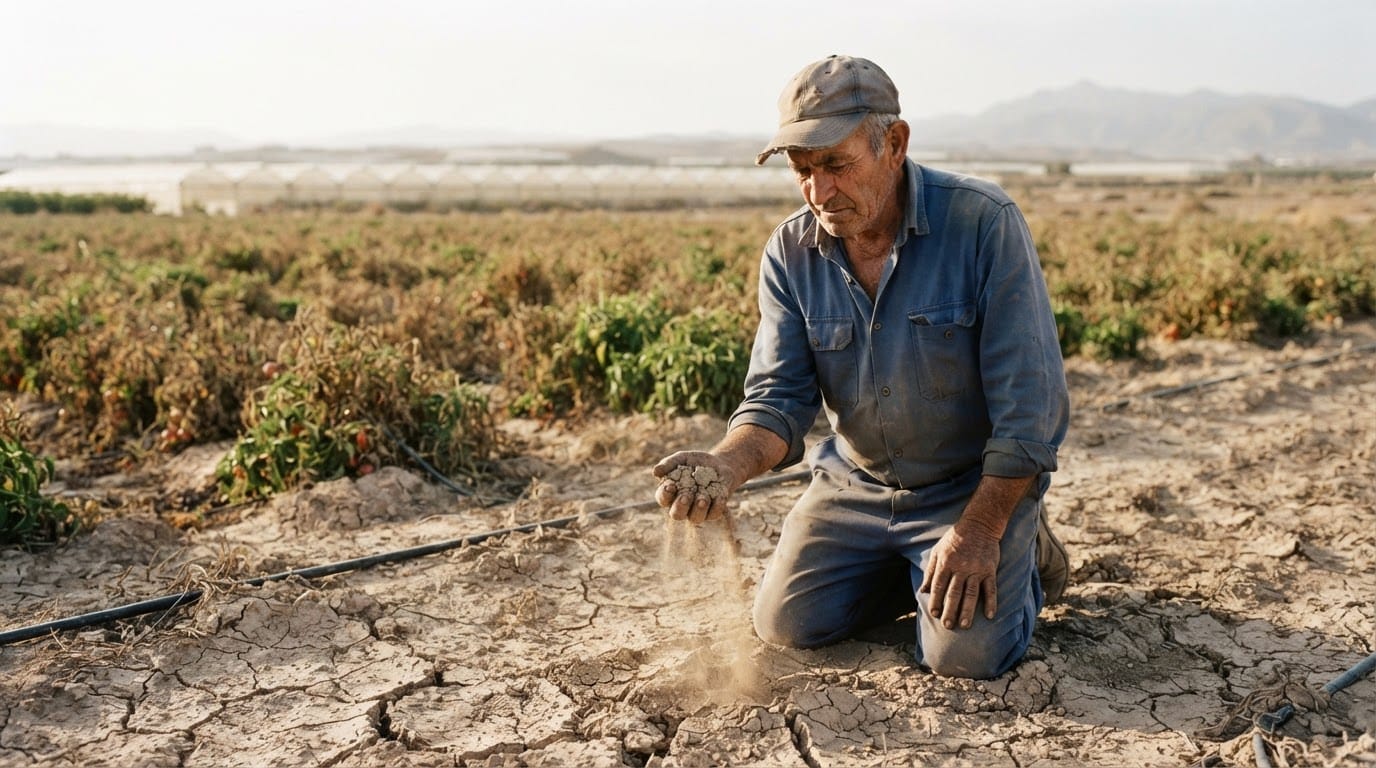
Vast seas of plastic greenhouses and manicured citrus groves across southern and eastern Spain supply supermarkets from London to Berlin with fresh produce throughout the winter. Yet this economic engine faces an unprecedented threat from diminishing water reserves. Years of prolonged drought, combined with rising temperatures and decades of intensive irrigation, have pushed the country's hydrographic systems to a breaking point, raising sharp questions about the future of European food security.
Known widely as Europe's orchard, Spain produces one out of every four fresh fruits and vegetables consumed in the European Union. It is the bloc's leading agricultural exporter and accounts for roughly 25 percent of all citrus exports globally. However, the foundational resource required to keep those supply chains running is rapidly vanishing. Reservoirs in key agricultural basins have repeatedly plunged well below historical averages, and subterranean aquifers are becoming dangerously depleted or contaminated by seawater.
Decades of Expansion Collide With Shifting Climate Realities
The rise of Spain as an agrarian powerhouse took shape over the past half-century through massive public investment in infrastructure and export-oriented industrial farming. The country boasts roughly four million hectares of officially irrigated land, representing nearly 20 percent of its total agricultural footprint. In provinces like Almería, an arid coastal plain was transformed into a 30,000-hectare landscape of intensive greenhouse production, generating billions in export revenue by providing out-of-season tomatoes, peppers, and cucumbers to colder northern neighbors.
This growth model relied on regular replenishment from rainfall, river basins, and snowmelt from mountain ranges like the Sierra Nevada. That hydrological equation has fundamentally changed. Weather patterns across the Mediterranean basin are increasingly characterized by acute, multi-year dry spells punctuated by extreme heat waves. Climate projections indicate Spain could lose up to 40 percent of its available natural water resources by the middle of the century. At the same time, regional water reserves in Andalusia and Catalonia have frequently operated at emergency levels, triggering official curbs on farm usage.
The strain extends beyond surface reservoirs. In coastal zones, over-pumping has created significant groundwater deficits. In parts of southern Spain, excessive extraction allows the Mediterranean Sea to infiltrate deeper soil layers, salinizing underground freshwater supplies and rendering them unusable for both drinking and crop irrigation.
Mounting Costs for Farmers and Continental Consumers
The economic fallout of water distress is already rippling through supply networks. In recent growing seasons, dry conditions have caused agricultural losses totaling billions of euros. Traditional non-irrigated staples, including grain, olives, and almonds, have suffered steep harvest reductions alongside irrigated fruit crops. When domestic yields plummet, the effects cross European borders almost immediately.
Countries such as Germany, France, and the United Kingdom rely heavily on Spanish agricultural output. Germany alone imports the majority of its fresh produce, possessing a self-sufficiency rate of less than 40 percent for vegetables and roughly 20 percent for fruits. When Spanish growers must scale back planting or spend heavily on emergency trucking and alternative water sources, European consumers absorb the shock through grocery store inflation.
Rising costs are also reshaping daily farm operations. Growers face ballooning energy bills to pump remaining water from deeper underground, alongside the high capital expenses of installing modern drip systems. Smaller family operations often struggle to finance such investments, leading to industry consolidation and the abandonment of marginal farming plots in inland areas.
The Ecological Toll and Underground Tensions
Intensive agricultural demands have placed severe pressure on natural ecosystems, creating growing friction between farming associations and environmental regulators. The most visible flashpoint is the Doñana National Park, a UNESCO World Heritage site and critical wetland for migratory birds situated in western Andalusia.
The lagoon network of Doñana has shrunk dramatically, driven by both climate patterns and extensive water withdrawals for neighboring commercial soft-fruit farms, which grow much of Europe's supermarket strawberries. Official and non-governmental estimates suggest that alongside licensed irrigation, thousands of unauthorized boreholes draw millions of cubic meters of water without legal oversight. Environmental groups warn that the loss of biodiversity in these fragile habitats may soon be irreversible.
Tensions over water allocation regularly emerge between competing regions as well. Water transfers that pump supply from central Spanish rivers to the drier agricultural zones of Murcia and Valencia are routinely contested by upstream communities facing their own localized shortages. The debate pits regional economic development against basic ecological river flows, leaving policymakers caught between agricultural interests and sustainability mandates.
Adaptation Strategies and the Search for Solutions
To avert a permanent crisis, authorities and growers are investing in high-tech water management, though each option carries clear limitations. Desalination plants along the Mediterranean coast now supply substantial volumes of water to coastal farmlands. However, the desalination process requires significant electricity, elevating operational expenses and generating brine waste that must be managed to protect marine environments.
Wastewater recycling has also expanded rapidly. Spain is now one of the leading nations in Europe for treating municipal effluent and redirecting it toward agricultural uses. Modernization programs funded by European recovery grants focus on sensor-based precision irrigation, pipeline repairs to eliminate transport leaks, and the deployment of closed-loop greenhouse systems designed to recycle every drop.
Agronomists point out that technological efficiency alone cannot resolve structural imbalances. Long-term stability may require shifting away from thirstier crops in arid sectors, reducing overall irrigated acreage, and strictly cracking down on unlicensed wells.
The Future of the Mediterranean Food Basket
Spain's water predicament represents an early warning for the broader European economy. For decades, northern consumers have enjoyed year-round access to inexpensive fresh produce by outsourcing the water demands of food cultivation to southern regions.
As natural hydrologic limits are breached, that system faces fundamental restructuring. Balancing agricultural livelihoods, consumer demand, and environmental protection requires difficult choices about resource management and national priorities. If Spanish agriculture cannot secure a sustainable path forward, Europe as a whole may be forced to re-evaluate the costs and dietary assumptions behind its food supply.