Finland Seizes Vessel Amid Escalating Concerns Over Baltic Sea Undersea Cable Security
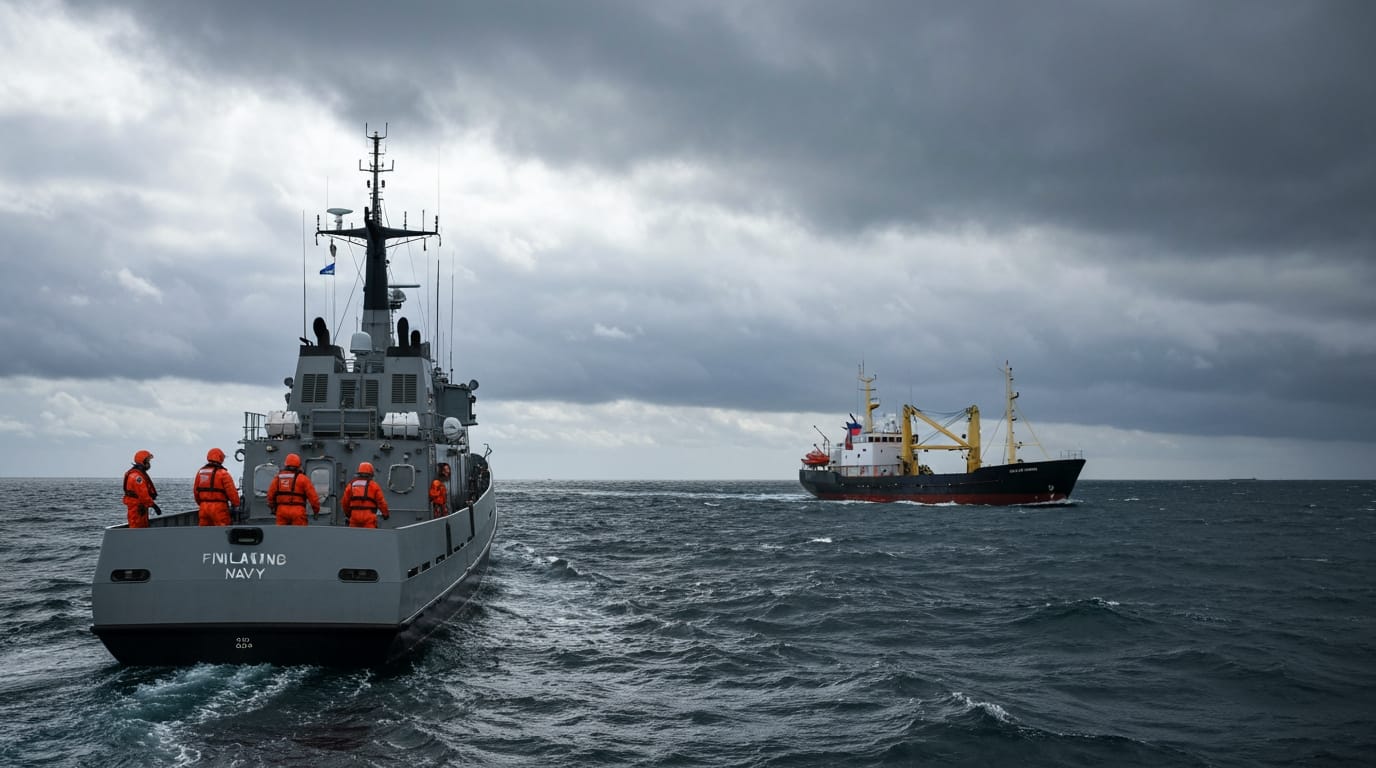
HELSINKI, Finland – Finnish authorities have today seized a cargo vessel, the Fitburg, suspected of damaging a critical submarine telecommunications cable in the Gulf of Finland. This latest incident, involving a cable operated by Finnish telecom giant Elisa, marks a concerning escalation in a series of disruptions to vital undersea infrastructure across the Baltic Sea, fueling fears of deliberate interference and prompting urgent calls for enhanced regional security measures. The seizure underscores Finland's assertive stance in protecting its crucial maritime networks amidst a volatile geopolitical landscape.
The Latest Disruption in the Gulf of Finland
The damage to the Elisa telecommunications cable, which connects Helsinki and Tallinn, was detected early Wednesday, December 31, 2025, leading to immediate investigations. Finnish Border Guard patrols, supported by air surveillance, quickly located the Fitburg, a vessel flagged to Saint Vincent and the Grenadines, within Finland's exclusive economic zone (EEZ). Observations revealed the ship's anchor chain was lowered into the sea, strongly suggesting its involvement in the cable damage. Following these findings, the Finnish Border Guard instructed the vessel to halt and raise its anchor, subsequently ordering it into Finnish territorial waters where it was officially seized.
Police have launched a criminal investigation into the incident, examining potential charges including aggravated criminal damage, attempted aggravated criminal damage, and aggravated interference with telecommunications. While the exact location of the cable damage lies within Estonia's EEZ, Finnish authorities are coordinating closely with Estonian counterparts and the Office of the Prosecutor General to navigate the legal complexities of the international waters incident. This swift action highlights the growing determination of Nordic and Baltic nations to secure their undersea lifelines against both accidental and potentially deliberate threats.
A Troubling Pattern of Undersea Incidents
This recent seizure is not an isolated event but rather the latest in a troubling pattern of incidents impacting critical undersea infrastructure in the Baltic Sea over the past two years. The region, a vital hub for energy and data flows, has experienced multiple disruptions that have prompted a reassessment of maritime security.
One significant incident occurred in October 2023, when the Balticconnector gas pipeline, linking Finland and Estonia, was severely damaged. This event also impacted three telecommunications cables, including the EE-S1 connecting Sweden with Estonia, the Finland Estonia Connection, and the Baltika subsea cable. Finnish investigators quickly focused on the Hong Kong-flagged container ship NewNew Polar Bear, whose movements coincided precisely with the time and location of the damage. Evidence, including a broken anchor found near the pipeline with matching paint traces, firmly linked the vessel to the damage, which was attributed to its anchor dragging along the seafloor for an extensive distance. In August 2024, Chinese authorities acknowledged that the NewNew Polar Bear caused the damage, albeit characterizing it as an accident due to a strong storm, a claim met with skepticism by some Finnish and Estonian officials given the sheer distance the anchor was reportedly dragged. Further developments saw the captain of the NewNew Polar Bear, Wan Wenguo, arrested in Hong Kong in May 2025, facing charges of criminal damage and violations of marine by-laws.
Adding to the list of disruptions, November 2024 saw two communication cables – the BCS East-West Interlink between Lithuania and Sweden, and the C-Lion 1 connecting Finland and Germany – severed. The Chinese bulk carrier Peng 3 (also referred to as Yi Peng 3) was identified as the suspect in this incident.
Most recently, on Christmas Day, December 25, 2024, Finnish authorities seized the Cook Islands-flagged oil tanker Eagle S. This vessel was suspected of damaging the Estlink 2 power transmission cable between Finland and Estonia, along with four additional undersea internet cables. Finnish police and border guards boarded the vessel and initiated a criminal investigation into what they termed "aggravated criminal mischief." Finnish President Alexander Stubb remarked on the increasing frequency, stating, "Three cases in one year cannot be a coincidence." The Eagle S is believed to be part of a "shadow tanker" fleet, raising further questions about its activities.
Geopolitical Implications and Regional Security
The Baltic Sea has emerged as a focal point for geopolitical tensions, particularly since Russia's full-scale invasion of Ukraine in 2022. The repeated damage to critical undersea infrastructure, which includes gas pipelines, power transmission cables, and high-capacity data cables responsible for carrying 99% of global internet traffic, has profound implications for regional stability and connectivity.
Experts and political leaders increasingly view these suspected cable sabotages as part of a potential "hybrid war" aimed at disrupting Western economies and societies. The shallow waters and high traffic volume of the Baltic Sea make its subsea cables particularly vulnerable to both intentional and unintentional damage. Concerns are heightened by accusations of increased Russian activity in the region, including mapping undersea infrastructure and conducting military exercises near critical installations. While China maintains that the NewNew Polar Bear incident was accidental, the reluctance of the crew to cooperate with investigators and the vessel's subsequent evasive maneuvers have fueled suspicions of deliberate action or severe negligence.
NATO and the European Union have recognized the gravity of these threats. Following the Estlink 2 incident, a NATO Summit of Baltic Sea Allies was co-hosted in January 2025, leading to the launch of the Baltic Sentry mission. This mission aims to deter attempts to damage critical undersea infrastructure through expanded patrols and increased deployment of unmanned systems and sensors. There are also calls for a more robust interpretation of maritime law and greater information sharing among international partners to enhance the protection of these vital networks.
Ongoing Investigations and the Path Forward
Investigations into these multiple incidents remain active, with Finnish authorities cooperating extensively with national and international bodies, including Estonian officials and Chinese authorities. The complexities of establishing intent versus accident, particularly in international waters, pose significant challenges to attribution and prosecution. The Hong Kong arrest of the NewNew Polar Bear's captain represents a rare breakthrough in holding individuals accountable for such damage.
The damage to the Balticconnector pipeline, which entered commercial use in 2020, has already necessitated costly repairs, estimated at approximately €35 million, completed in spring 2024. The financial and logistical burdens of repairing damaged cables and pipelines, coupled with the potential for prolonged disruptions to energy and communication services, underscore the urgent need for a unified and proactive approach to infrastructure protection.
As Finland continues its investigation into the Fitburg incident, the focus remains firmly on reinforcing the resilience of critical undersea networks. The repeated disruptions serve as a stark reminder of the vulnerabilities of modern infrastructure and the increasing importance of maritime security in an era of complex geopolitical rivalries. The international community watches closely as Baltic Sea nations strive to safeguard the digital and energy lifelines that underpin their societies and economies.


