France Seeks NATO Exercise in Greenland Amid Surging Geopolitical Rivalry
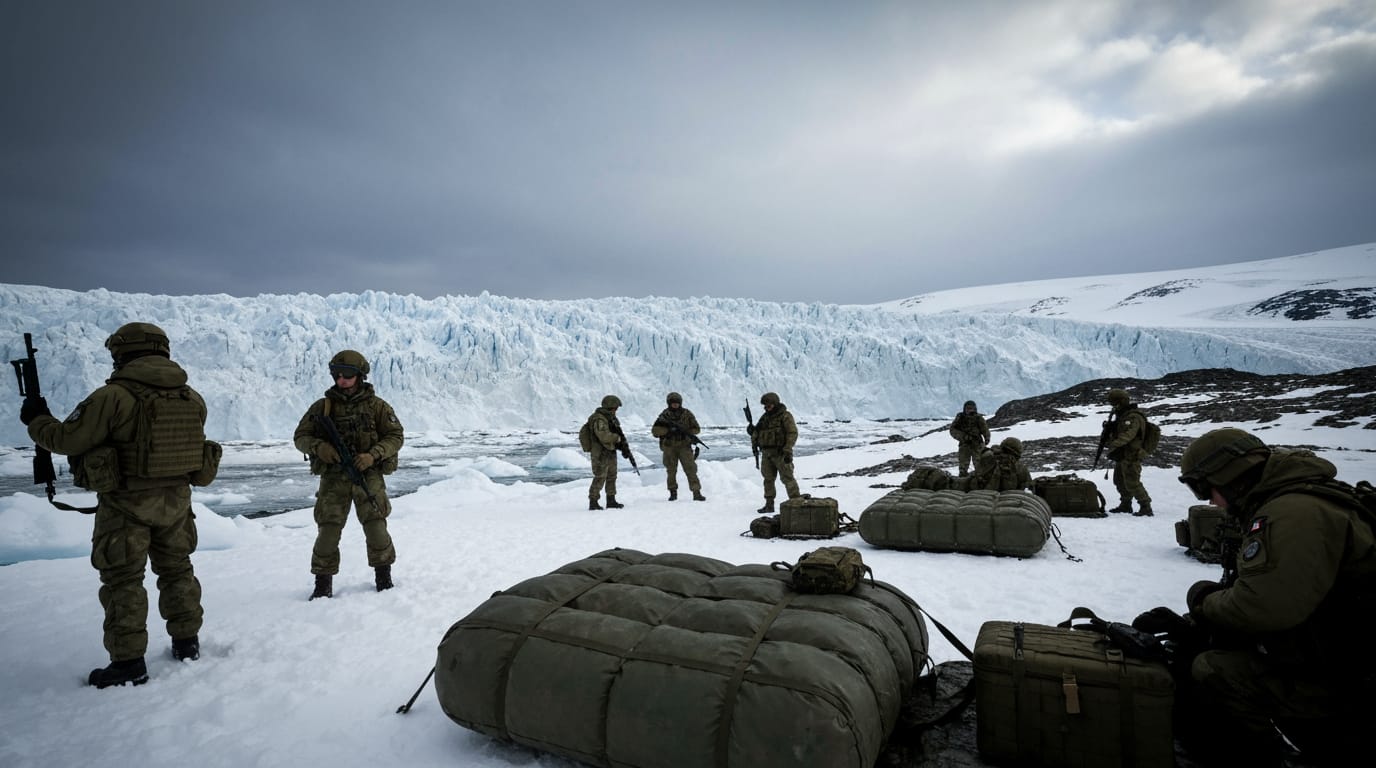
Nuuk, Greenland – In a move reflecting heightened anxieties over Arctic security and strained transatlantic relations, France has formally proposed that NATO conduct a military exercise in Greenland, with Paris signaling its readiness to actively participate. The call comes amidst a backdrop of renewed United States interest in acquiring the vast Arctic island, a proposition that has fueled diplomatic tensions and underscored Greenland's critical geopolitical significance. French President Emmanuel Macron has emphasized that this initiative aims to bolster collective defense and reaffirm NATO's crucial role in safeguarding Arctic stability.
The French proposal, announced on January 21, 2026, directly responds to recent remarks by former U.S. President Donald Trump, who has reiterated his controversial ambition to purchase Greenland, even alluding to potential economic pressure on European allies to achieve this goal. Macron, speaking from the World Economic Forum in Davos, warned against a global order descending into "a world without rules," framing the exercise as a means to ensure that international law and multilateral cooperation, rather than unilateral power politics, dictate the future of strategically vital regions like the Arctic. This bold diplomatic maneuver by France seeks to reframe the dispute over Greenland from a bilateral U.S.-Europe confrontation into a broader alliance security matter, reinforcing the principle of collective, rules-based security in the High North.
A Catalyst for Collective Action
France's advocacy for a NATO exercise in Greenland is deeply rooted in its evolving Arctic policy, which prioritizes environmental protection, scientific research, and regional military security. Paris views events in the Arctic as having global repercussions, as outlined in its 2022 Polar Strategy, "Equilibrium in Extremes." This strategy balances environmental diplomacy with growing military considerations, acknowledging the region's increasing strategic importance. French officials have stressed that a NATO-led exercise would firmly anchor responsibility for Greenland's security within the alliance framework, potentially limiting the scope for unilateral actions and reinforcing multilateral decision-making. Such an exercise would also align with France's long-standing involvement in Arctic military cooperation, including participation in NATO exercises in Norway.
The timing of France's request is particularly salient, coinciding with ongoing high-level discussions regarding Greenland's future and security. Danish and Greenlandic officials have unequivocally rejected any notion of a sale, asserting the island's territorial integrity and the self-determination rights of its people. However, they have simultaneously undertaken significant steps to enhance their military presence and readiness in the region, in close collaboration with NATO allies. This proactive stance by European nations underscores a collective determination to manage Arctic security through established alliances and international norms.
Greenland: The Arctic's Geopolitical Locus
Greenland, the world's largest island, is a semi-autonomous territory within the Kingdom of Denmark, yet its strategic importance extends far beyond its administrative ties. Its geographical position, bridging North America and Europe, places it at the nexus of potentially transformative maritime routes, including the Northwest Passage and the Northern Sea Route. As Arctic ice recedes due to climate change, these routes become increasingly navigable, promising significant reductions in shipping times and costs between global markets.
Beyond its maritime significance, Greenland boasts abundant critical resources, including rare earth elements, oil, and gas, which are vital for global energy markets and high-tech manufacturing. This wealth of untapped resources, made more accessible by thawing ice, positions Greenland as a highly coveted strategic asset for major global powers.
The United States has a long-standing military presence on the island, notably through Pituffik Space Base (formerly Thule Air Base), which plays a crucial role in missile defense, space surveillance, and monitoring Russian naval and air activity in the North Atlantic. This historical presence, established through a 1951 treaty with Denmark, highlights Greenland's enduring value in transatlantic security architecture, particularly during the Cold War. The renewed U.S. interest, characterized by President Trump as a strategic necessity to counter Russian and Chinese influence, has however, created fissures within the alliance, with European leaders viewing it as a challenge to foundational NATO principles.
Bolstering the Northern Flank: Denmark, Greenland, and NATO's Evolving Role
Greenland operates with significant autonomy over its internal affairs, but Denmark retains ultimate responsibility for its defense and foreign policy. Despite this formal division of power, the Greenlandic government, which has the right to self-determination and even independence, actively engages in discussions concerning its security landscape. Greenland's Minister for Foreign Affairs and Research, Vivian Motzfeldt, has publicly affirmed that strengthening defense and security in cooperation with NATO allies is a core priority. To facilitate this, a joint contact committee for foreign, security, and defense policy was established in 2021 between Denmark, Greenland, and the Faroe Islands, ensuring structured information exchange and coordinated dialogue.
In response to the escalating geopolitical tensions, Denmark and Greenland have already committed to increasing their military presence and exercise activities. This includes deploying aircraft, vessels, and soldiers, with contributions from various NATO allies such as Germany, Sweden, and France. The stated purpose of these enhanced activities is to train operational capabilities in Arctic conditions and to strengthen the alliance's footprint in the region, benefiting both European and transatlantic security.
NATO itself has significantly recalibrated its strategic posture towards the Arctic. Historically, the alliance adopted a "High North – Low Tension" approach following the Cold War, but 21st-century geopolitical shifts, climate change, and increased activity by Russia and China have necessitated a strategic adaptation. The recent accessions of Finland and Sweden have dramatically expanded NATO's presence and expertise in the region, bolstering its "Regional Plan North," which focuses on cohesive transatlantic defense, strategic deterrence, and ensuring freedom of navigation. Regular NATO and Danish-led exercises in Arctic waters already underscore this commitment to regional defense.
A Complex Geopolitical Chessboard
The situation in Greenland epitomizes the broader geopolitical shifts occurring in the Arctic, transforming it into a focal point of great power competition. The "Greenland crisis," as some observers term it, serves as a profound stress test for Europe's capacity to safeguard its sovereignty, coordinate internally, and assert strategic autonomy. The challenge comes not solely from external adversaries but, in this instance, also from rhetoric emanating from within the transatlantic alliance, questioning NATO's founding principle that no member should threaten the territorial integrity of another.
The implications extend to the delicate balance of power in the Arctic, where Russia maintains a robust military presence and China actively seeks to expand its economic and strategic influence through investments and new maritime routes. As climate change continues to open up new pathways and unlock vast resources, the potential for increased militarization and rivalry grows. European leaders recognize that NATO may remain militarily indispensable, but the recent events underscore the need for Europe to assume greater responsibility for its own deterrence and geopolitical resilience.
In conclusion, France's call for a NATO exercise in Greenland is more than just a military proposal; it is a clear diplomatic signal to all actors that the future of the Arctic must be governed by cooperation, international law, and collective security mechanisms. As the region continues to thaw, both literally and figuratively, the choices made today by key international players will determine whether the Arctic becomes a new arena for confrontation or a model for multilateral stewardship in a rapidly changing world.


