Franco-German Unity Emerges at EU Retreat Amid Global Pressures
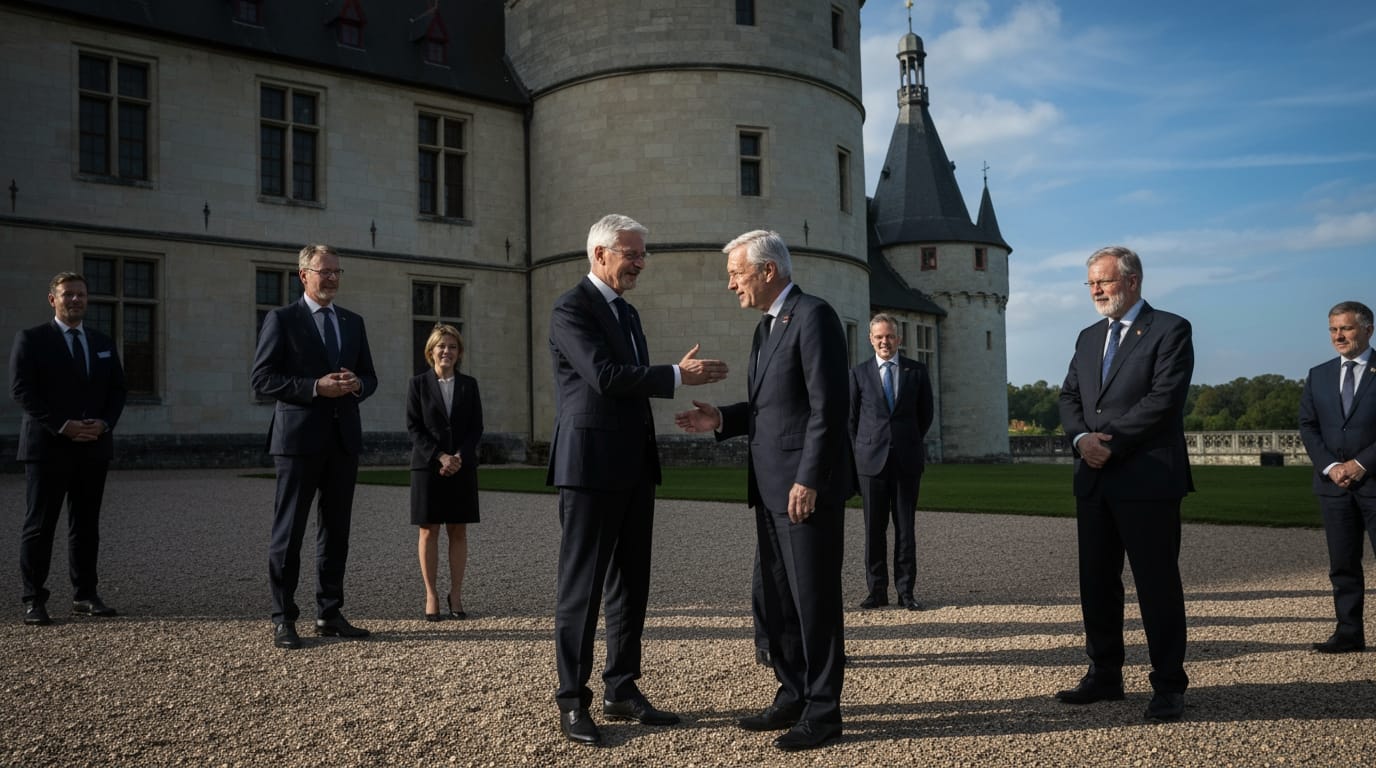
BILZEN-HOESELT, Belgium – Against a backdrop of increasing geopolitical turbulence and economic headwinds, French President Emmanuel Macron and German Chancellor Friedrich Merz projected a visible image of unity this week at an informal European Union leaders' retreat in the historic Alden Biesen castle. Their joint arrival at the 16th-century Belgian fortress underscored a renewed Franco-German commitment to tackling the formidable challenges confronting the 27-nation bloc, even as underlying strategic differences persist.
The gathering on Thursday, February 12, 2026, brought together EU heads of state and government to strategize on bolstering Europe's economic competitiveness and strengthening its global standing. This critical dialogue unfolds as the EU grapples with external pressures ranging from the potential resurgence of protectionist policies from a future U.S. administration under Donald Trump, aggressive economic tactics employed by China, and continued hybrid threats emanating from Russia. Internally, the bloc faces the persistent challenge of lagging productivity and innovation compared to the United States, coupled with high energy costs that burden European industries.
A United Front in a Divided World
The symbolism of Macron and Merz crossing the Alden Biesen drawbridge together was not lost on observers. It represented a deliberate effort to project cohesion between the two traditional powerhouses of the EU, particularly after periods of publicly divergent strategic positions. Both leaders articulated a shared "sense of urgency" for Europe to take decisive action. Chancellor Merz emphasized the imperative to make the European Union "faster" and "better," with a primary focus on ensuring competitive industry across the continent. President Macron, in turn, reiterated his call for the EU to leverage common borrowing mechanisms, akin to "Eurobonds for the future," to facilitate large-scale investments and to challenge the dominance of the dollar in global finance. This renewed partnership is viewed by many as essential for driving the EU agenda and providing leadership in times of crisis, a role the Franco-German axis has historically fulfilled since the signing of the Élysée Treaty in 1963.
The retreat, hosted by Belgian Prime Minister Bart De Wever and chaired by European Council President Antonio Costa, served as a "strategic brainstorming session" aimed at shaping proposals for a more formal summit slated for late March. European Commission President Ursula von der Leyen and European Parliament President Roberta Metsola were also present, alongside former Italian Prime Ministers Mario Draghi and Enrico Letta, whose influential 2024 reports on competitiveness and the single market provided a framework for many discussions.
Navigating Economic Priorities and Geopolitical Realities
Central to the discussions was the overarching theme of enhancing EU competitiveness in a rapidly changing global landscape. Leaders explored avenues to deepen the single market, foster a capital markets union, and reduce regulatory burdens that have been identified as hindering growth. The ongoing war in Ukraine, coupled with the broader implications of great power competition, has compelled a fundamental re-evaluation of Europe's economic and strategic autonomy.
However, beneath the surface of proclaimed unity, different philosophies on achieving these goals were evident. A significant fault line emerged between those advocating for deregulation and closer alignment with Washington, led by Chancellor Merz and Italian Prime Minister Giorgia Meloni, and those championing greater "strategic autonomy" for the bloc, spearheaded by President Macron. The Merz-Meloni "non-paper" presented at the retreat called for significant cuts to EU red tape and an ambitious trade policy, including deals with blocs like Mercosur, which France has previously resisted due to domestic agricultural concerns. Conversely, Macron's vision of strategic autonomy emphasizes reduced dependence on external powers, advocating for European-sourced defense procurement and increased military spending within the continent. This divergence highlights the ongoing struggle to balance national interests with a unified European strategy, particularly in sensitive areas like defense, energy, and trade.
The Enduring Franco-German Dynamic
The Franco-German relationship, often described as the "engine" of European integration, has weathered periods of strain, marked by differing national priorities on issues such as defense spending, energy policy, and fiscal approaches. Recent years have seen tensions over issues like Germany's unilateral €200 billion energy relief package and differing views on defense procurement, including the use of American equipment for a European missile shield. These points of contention have, at times, led to a perceived "clash of strategic visions" within the core of the EU.
Despite these historical and contemporary divergences, the imperative for Franco-German cooperation remains undeniable. Their ability to find common ground has frequently been crucial in breaking deadlocks and providing essential political leadership within the EU. The visible display of solidarity at Alden Biesen castle signaled a renewed intent to bridge these gaps and present a united front to the world, recognizing that a fragmented Europe would be ill-equipped to navigate the complex geopolitical and economic landscape of the mid-2020s.
Looking Ahead: Action Beyond Aspiration
While the Alden Biesen retreat focused on strategic discussions rather than immediate concrete decisions, the momentum generated by the Franco-German alignment is expected to influence the direction of future EU policy. The collective acknowledgment of the urgency to act, coupled with a renewed commitment to compromise, sets the stage for a critical period leading up to the late March summit. European leaders, including Belgian Prime Minister Bart De Wever, have expressed a desire to move beyond mere discussion to tangible action, recognizing that public trust and the bloc's global standing depend on its ability to deliver effective solutions.
The path forward will undoubtedly require continued difficult negotiations and a willingness to transcend national interests for the collective good of the Union. However, the visible display of Franco-German unity at the Alden Biesen castle provides a crucial foundation, signaling that Europe's two largest economies are prepared to work in tandem to address the multifaceted crises of the present and secure a more resilient future for the European project.


