French Farmers Drive Tractors into Paris as Mercosur Deal Looms
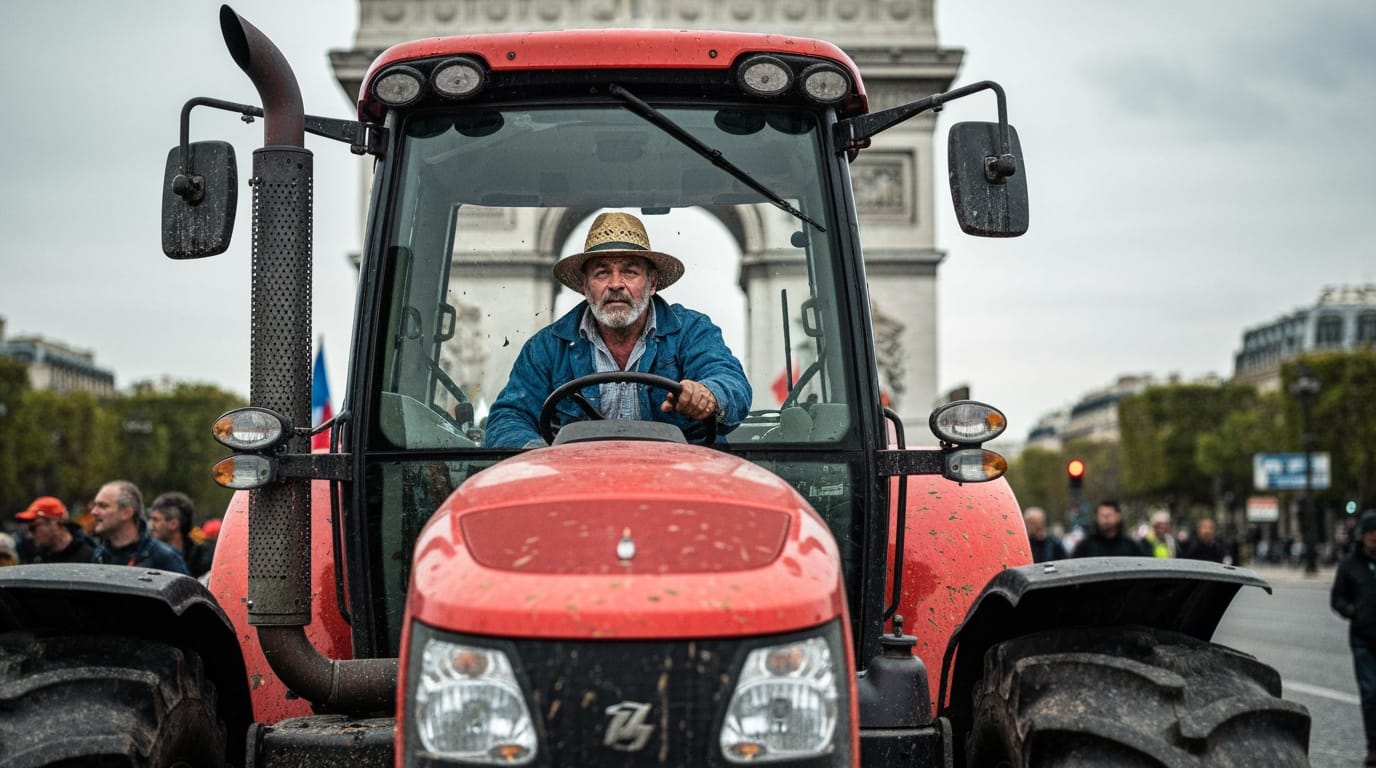
PARIS, France – French farmers, driven by deep-seated fears over the impending European Union-Mercosur trade deal and exasperation with domestic agricultural policies, brought their grievances directly to the heart of the capital today. On Thursday, January 8, 2026, around one hundred tractors, many adorned with protest banners, converged on Paris, disrupting traffic and drawing attention to what they describe as an existential threat to their livelihoods.
The demonstration, primarily organized by the Rural Coordination union, saw convoys bypass police blockades and reach iconic landmarks such as the Arc de Triomphe and the Eiffel Tower, despite official bans on their entry into the city center. Their presence underscored a growing agricultural revolt across France and other European nations, highlighting the potent blend of economic anxieties and regulatory burdens facing the sector.
A Convoy of Discontent: The Paris Protest Unfolds
The day began in the pre-dawn hours as farmers from various regions steered their heavy machinery towards Paris. By morning, around one hundred tractors had navigated into the metropolitan area, with approximately 20 managing to penetrate the city center itself, reaching areas near the Arc de Triomphe and the Eiffel Tower. Other contingents of farmers established blockades at key traffic arteries marking Paris's limits, causing significant disruption to commuters. Signs such as "No To Mercosur" were prominently displayed, clearly articulating the central message of the protest.
The Rural Coordination union, which orchestrated the protest, explicitly aimed to exert pressure on the French government to intensify its opposition to the Mercosur agreement. José Perez, president of the Rural Coordination in the Lot-et-Garonne region, emphasized the symbolic importance of bringing their demands directly to those in power in Paris. Beyond the trade deal, farmers also voiced anger over domestic government sanitary measures, particularly a mandated cull of cows implemented to contain the spread of a bovine disease known as lumpy skin disease. This dual set of grievances—external competition and internal regulation—has fueled a wave of agricultural unrest across the country.
The Mercosur Deal: A Quarter-Century in the Making
The proposed EU-Mercosur free trade agreement, which has been under negotiation for over two decades, aims to establish one of the world's largest free-trade areas, encompassing a combined population of nearly 780 million people. Negotiations began in 1999, with an agreement in principle reached in 2019. If ratified, the deal would gradually reduce import duties on 91-92% of exports over a 15-year period for both blocs, while increasing import quotas for various products.
For the EU, proponents argue the deal would boost industrial exports such as vehicles, machinery, chemicals, pharmaceuticals, wine, and spirits, and provide access to critical raw materials. Conversely, Mercosur nations, including Brazil, Argentina, Paraguay, Uruguay, and since 2024, Bolivia, would gain increased access to European markets for agricultural goods, notably beef, poultry, sugar, ethanol, rice, and maize. A key point of contention is the provision that would allow up to 99,000 tonnes of beef per year from Mercosur countries to enter the EU at a significantly reduced tariff rate of 7.5%.
Farmers' Deep-Rooted Concerns: Unfair Competition and Standards
The primary concern among French, and indeed many European, farmers revolves around the perceived threat of unfair competition. They contend that agricultural imports from Mercosur countries, particularly beef and poultry, are produced under less stringent environmental, social, and animal welfare standards than those mandated within the EU. This discrepancy, farmers argue, leads to lower production costs for South American goods, enabling them to undercut European producers who must adhere to rigorous and often costly regulations.
Specific fears highlighted include the use of pesticides and active substances banned in Europe, concerns over deforestation linked to agricultural expansion in Mercosur nations, and weaker labor standards. Farmers and critics also point to a lack of full traceability in some Mercosur countries, particularly for beef, which raises questions about origin and potential links to deforested areas. The French Agriculture Minister, Annie Genevard, has publicly stated that the deal "threatens the production of beef, chicken, sugar, ethanol and honey, among other sectors" in France. Even proposed EU safeguards and a €45 billion package of funding for farmers are viewed by many as insufficient, mere "crumbs" that fail to address the core issues of unfair competition and divergent production standards.
Political Divides and the Path Forward
The EU-Mercosur agreement has created significant political divides within the European Union. Strong proponents, led by countries like Germany and Spain, see the deal as a vital economic and geopolitical opportunity to boost exports, reduce reliance on China, and strengthen alliances in a time of global uncertainty. However, France, along with Poland, Hungary, and initially Italy, has voiced strong opposition, demanding more robust guarantees to protect their agricultural sectors.
The French government, backed by widespread farmer protests, has consistently opposed the deal in its current form, seeking a strong safeguard clause, "mirror measures" to ensure imported products meet EU environmental and health standards, and enhanced sanitary controls. Despite France's firm stance, renewed internal negotiations have been underway within the EU, with speculation that a deal could be signed in Paraguay as early as January 12. The European Commission has made efforts to appease critics, proposing accelerated access to €45 billion in EU funding for farmers and cutting import duties on some fertilizers. However, for French farmers, these concessions have not alleviated their deep-seated concerns.
Conclusion: A Crossroads for European Agriculture
The tractor protest in Paris serves as a stark reminder of the immense pressure facing European, and particularly French, agriculture. The EU-Mercosur trade deal, positioned by some as a landmark economic opportunity, is seen by many farmers as a direct threat to their livelihoods, environmental standards, and the very fabric of European food production.
As the EU pushes towards a potential finalization of the agreement, the protests highlight a critical juncture for policymakers. They must navigate the complexities of international trade ambitions against the legitimate concerns of a vital domestic industry. The outcome of the Mercosur deal, and the response to the farmers' demands for fair competition and robust protections, will undoubtedly shape the future landscape of European agriculture and its relationship with global trade.


