G20 Summit in South Africa Grapples with Unprecedented Absences, Germany's Merz Champions Multilateralism
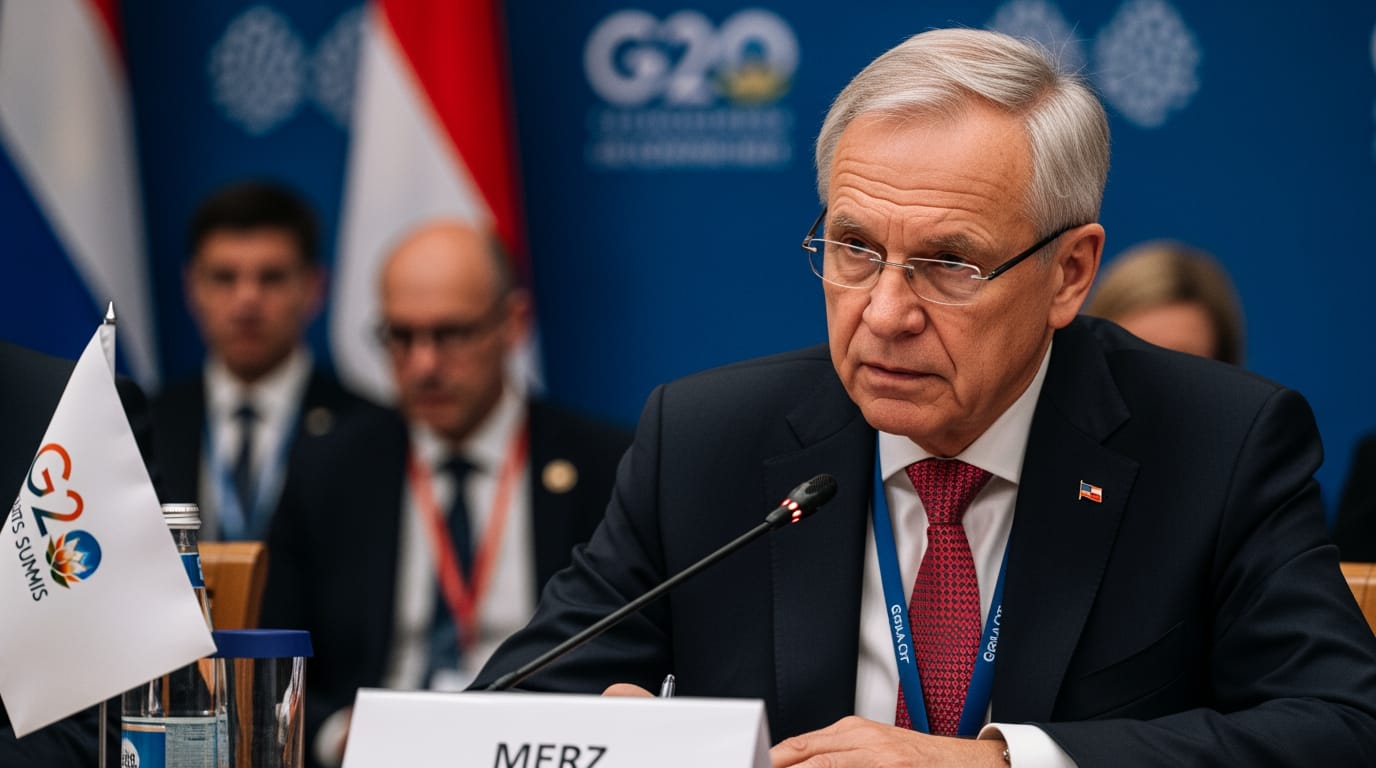
JOHANNESBURG, South Africa — The Group of Twenty (G20) summit, held in Johannesburg from November 22 to 23, 2025, convened under an unprecedented cloud of high-profile absences, raising fundamental questions about the future of global multilateralism. For the first time in its history, the leaders of the United States, China, and Russia — Donald Trump, Xi Jinping, and Vladimir Putin, respectively — were all conspicuously missing from the annual gathering of the world's major economies. Amidst this diplomatic vacuum, German Chancellor Friedrich Merz emerged as a vocal proponent of international cooperation, emphasizing the enduring importance of the G20 as a forum for dialogue in a rapidly reordering world.
The Shadow of Non-Attendance
The absence of three of the world's most influential heads of state cast a long shadow over the Johannesburg summit, the first ever hosted on the African continent. U.S. President Donald Trump's boycott was perhaps the most pointed, with the American leader not only declining to attend but also refusing to send a representative. Trump justified his decision by citing unsubstantiated claims of "white genocide" against Afrikaners in South Africa, a narrative he termed a "disgrace" to the host nation. He further fueled diplomatic tensions by subsequently stating that South Africa would not be invited to the next G20 summit, which the U.S. is scheduled to host.
China's President Xi Jinping also skipped the summit, sending Premier Li Qiang in his stead. While Beijing did not offer a public explanation for Xi's absence, his non-attendance contributed to the perception of a growing disconnect among global powers. Russian President Vladimir Putin's absence was more predictable, driven by an outstanding International Criminal Court (ICC) arrest warrant related to the conflict in Ukraine. As South Africa is a signatory to the Rome Statute, Putin's physical presence would have compelled the host nation to execute the warrant. Russia was instead represented by Deputy Chief of Staff Maksim Oreshkin. Beyond these major players, leaders from Argentina, Mexico, Saudi Arabia, and Indonesia also either did not attend or sent lower-level representatives, further thinning the ranks of top-tier leadership.
Germany's Stand for Global Cooperation
In stark contrast to the conspicuous absences, German Chancellor Friedrich Merz played a prominent role at the summit, actively engaging in discussions and diplomatic efforts. Having taken office in May 2025, this G20 summit marked a significant international outing for Merz, who was also slated to continue to Angola for a European Union-African Union summit. Merz openly criticized President Trump's decision to boycott, asserting that it was "not a good decision on the part of the American administration" and that the U.S. was "needlessly giving up influence" in a crucial part of the world.
The German Chancellor underscored the fundamental value of the G20 as a platform for rules-based cooperation and multilateral dialogue, especially in a period of complex global shifts. He expressed his intent to lobby President Trump to ensure all G20 members, including South Africa, are invited to the next summit, emphasizing the need to preserve the integrity of such vital international forums. Germany's priorities at the Johannesburg summit included strategically expanding partnerships with African nations, strengthening the international order, and engaging in crisis diplomacy. Merz's proactive engagement positioned Germany as a key advocate for sustained global dialogue amidst increasing geopolitical fragmentation.
South Africa's Pivotal Presidency
As the first African nation to host the G20 summit, South Africa's presidency, which ran from December 1, 2024, to November 30, 2025, aimed to center discussions around the theme of 'Solidarity, Equality, Sustainability'. Host President Cyril Ramaphosa and his government endeavored to champion issues critical to the Global South and developing nations. Key agenda items included strengthening disaster resilience, ensuring debt sustainability for low-income countries, mobilizing finance for a just energy transition, and responsibly harnessing critical minerals for inclusive growth.
Despite the high-profile boycotts and underlying diplomatic tensions, particularly with the U.S. over certain agenda points and the invitation of non-member states, South Africa maintained its stance, asserting that "the world could move on with or without the US." The summit successfully managed to produce a Leaders' Declaration, a testament to the efforts of host President Ramaphosa to navigate complex geopolitical currents and foster consensus. The U.S. boycott even led to the cancellation of the customary symbolic handover ceremony of the G20 presidency from South Africa to the United States.
A Forum at a Crossroads
The Johannesburg G20 summit undeniably highlighted a significant juncture for global governance. The collective absence of several major world leaders, particularly the U.S., China, and Russia, was widely perceived as a blow to the G20's legitimacy and effectiveness. Analysts questioned the organization's efficacy and even its long-term continuity, suggesting that the dynamics witnessed in Johannesburg signaled a "reordering" of global power and the formation of new alliances, with traditional powers sometimes playing a diminished role.
Yet, the summit also demonstrated a resilience among the remaining members to continue addressing pressing global challenges. Discussions on inclusive growth, climate resilience, artificial intelligence governance, and debt reform for developing nations progressed. The German Chancellor's steadfast advocacy for multilateralism, alongside the determination of the South African presidency, underscored a commitment by many nations to preserve and strengthen platforms for international cooperation, even when faced with significant geopolitical headwinds. The ability to reach a Leaders' Declaration, despite the fractures, offered a glimmer of hope that collaborative action remains possible.
In conclusion, the 2025 G20 Summit in Johannesburg will likely be remembered as a pivotal moment, exposing the deep fissures within the international system while simultaneously revealing a resolve among many nations to keep avenues for global dialogue open. The unprecedented absences served as a stark reminder of the challenges facing multilateral institutions, forcing a re-evaluation of their relevance and operational dynamics in an increasingly multipolar world. However, the determined efforts of countries like Germany, alongside the host nation South Africa, to steer the agenda and reach common ground, signaled that the pursuit of shared global solutions, though difficult, remains a collective imperative.


