German AI Drones Transform Ukraine's Front Lines, Reshaping Modern Warfare
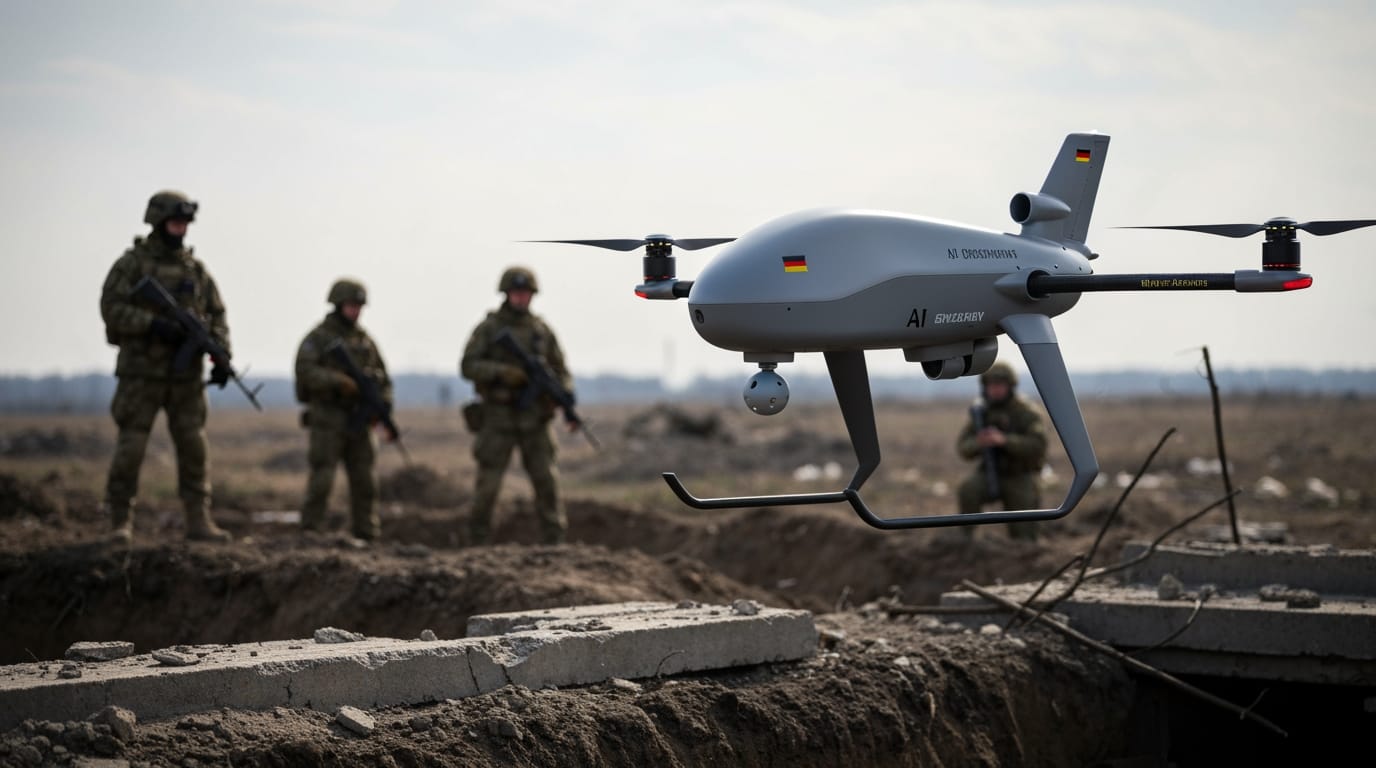
KYIV, Ukraine – The ongoing conflict in Ukraine has become an unprecedented proving ground for advanced military technology, with German-made artificial intelligence (AI) drones emerging as a pivotal force reshaping battlefield dynamics. These autonomous systems, ranging from sophisticated reconnaissance units to agile kamikaze drones, are not only enhancing Ukraine's defensive capabilities but also catalyzing a fundamental shift in defense industrial cooperation and military doctrine. The integration of German AI technology is providing Ukrainian forces with a critical edge, offering capabilities like autonomous target recognition, enhanced electronic warfare resistance, and the ability to operate effectively in GPS-denied environments. This strategic partnership is demonstrating a new model for wartime innovation, driven by rapid feedback from the front lines directly influencing technological development.
The Dawn of AI-Powered Battlefield Systems
The deployment of AI-powered drones marks a significant evolution in modern warfare, moving beyond traditional remotely piloted aircraft to systems capable of complex decision-making with limited human intervention. Germany has become Ukraine's most crucial drone technology partner since February 2022, delivering over 900 advanced reconnaissance and strike drones and establishing full manufacturing facilities within Ukraine. This level of wartime industrial cooperation is unmatched in recent history, aimed at providing both strategic autonomy for Germany and sustainable industrial capacity for Ukraine. Companies such as Quantum-Systems and Helsing are at the forefront of this technological transfer, with their innovations being continuously refined based on real-world combat experience in Ukraine. The development cycles for these systems have compressed from years to months, showcasing an agile, innovation-focused approach to defense.
German Innovation: Vector, Twister, and HX-2 Spearhead the Charge
Key to this transformation are specific German drone models exhibiting cutting-edge AI capabilities. Quantum-Systems has delivered nearly 500 Vector reconnaissance drones through German government funding, alongside establishing a complete manufacturing ecosystem in Ukraine. The Vector, along with its counterpart the Twister, are more than mere surveillance tools; they are equipped with onboard neural networks that enable real-time acoustic detection of enemy artillery, GPS-denied navigation, and specialized electronic warfare resistance. These drones can identify artillery positions by sound before shells even land, significantly shortening the intelligence-to-action cycle. Their design allows them to withstand damage and return for repair, earning them the moniker "A-10 of ISR drones" (Intelligence, Surveillance, and Reconnaissance). Ukrainian facilities, like the one inaugurated by German Economy Minister Robert Habeck, now produce 1,000 units annually, transferring technology and enhancing local manufacturing capabilities.
Further enhancing Ukraine's arsenal is Helsing's HX-2, an AI-enabled kamikaze drone configured with an "X-wing" design, sometimes referred to as "Karma." Weighing approximately 12 kilograms and reaching speeds of up to 220 kilometers per hour, the HX-2 boasts a range of up to 100 kilometers and carries swappable payloads for various targets. Its true power lies in its AI, which provides resistance to jamming and the ability to find, re-identify, and engage targets even when communication with a human operator is severed. Prototypes of the HX-2 have been tested in eastern Ukraine, with improvements based on battlefield results. Helsing has committed to delivering 10,000 AI-enabled strike drones, including 4,000 plywood-constructed HF-1 systems for their radar-transparent properties and 6,000 next-generation HX-2 drones with swarm coordination capabilities. Production of these systems utilizes Helsing's "Resilience Factories" concept, aiming for an initial monthly capacity of 1,000 units, with full delivery expected within 2025. This distributed manufacturing model is designed to provide European production capacity and resilience against supply chain disruptions.
Tactical Impact and Strategic Implications
The introduction of these advanced German AI drones is profoundly impacting the conflict. They have contributed to successful Ukrainian operations, including "Operation Spider's Web" in June 2025, which reportedly destroyed over 40 Russian aircraft. Helsing's HF-1 drones have successfully engaged high-value Russian assets, such as Pantsir-S1 and Buk-M3 air defense systems, up to 50 kilometers behind enemy lines. The radar-transparent construction and AI guidance systems of these drones contribute to their remarkable survivability in contested environments, with German systems maintaining approximately 67% survival rates despite intensive Russian electronic warfare efforts.
The AI capabilities in these drones, such as real-time acoustic detection of artillery fire and autonomous target acquisition, significantly shorten the "sensor-to-shooter" loop, allowing for faster counter-battery responses. This speed and precision fundamentally challenge traditional military doctrines that rely on massed artillery and armored columns. The Ukrainian experience is also providing Germany with invaluable real-world battlefield data, reshaping its own military doctrine, industrial policy, and defense investment priorities. German defense officials now recognize that drones are responsible for 60-70% of equipment destruction in modern warfare, validating a pivot towards distributed manufacturing, human-machine teaming, and precision mass production. Ukraine and Germany have also signed an agreement for joint analysis of combat experience and the development of military technologies, including refining AI models based on live war data.
The Ethical Frontier of Autonomous Warfare
While the operational advantages are clear, the increasing autonomy of AI drones raises significant ethical questions concerning the future of warfare. The debate over "human-in-the-loop" versus fully autonomous systems is intensifying, particularly regarding the delegation of lethal authority to algorithmic systems. Concerns include the ability of AI to accurately distinguish between combatants and non-combatants, the principle of proportionality, and ultimately, accountability when an autonomous system makes an erroneous or ethically questionable decision.
Although current German systems, and many others, are designed with an "operator-first" approach where the final decision rests with a human, the technological advancements push the boundaries of this principle. Reports of AI-controlled drones potentially making independent lethal decisions without direct human oversight on the battlefield have surfaced, marking a watershed moment in military technology. Experts warn that fully indiscriminate systems could put civilians in harm's way, challenging international humanitarian laws. The United Nations Secretary-General has called for an international ban on lethal autonomous weapon systems, underscoring the urgency of establishing clear moral and legal standards for these evolving technologies.
The deployment of German AI drones in Ukraine highlights a critical juncture in military technology. It showcases the transformative power of AI in enhancing battlefield effectiveness and accelerating defense innovation. This strategic partnership not only bolsters Ukraine's resilience but also provides real-world data crucial for the future development of AI in defense. However, as these machines gain greater autonomy, the ethical and legal frameworks governing their use must evolve in tandem to ensure human oversight and accountability remain paramount in the theater of war. The lessons learned on Ukraine's front lines will undeniably shape the trajectory of AI in global defense for decades to come.


