German Industrial Titans Forge Ahead into the AI Era, Redefining Global Manufacturing
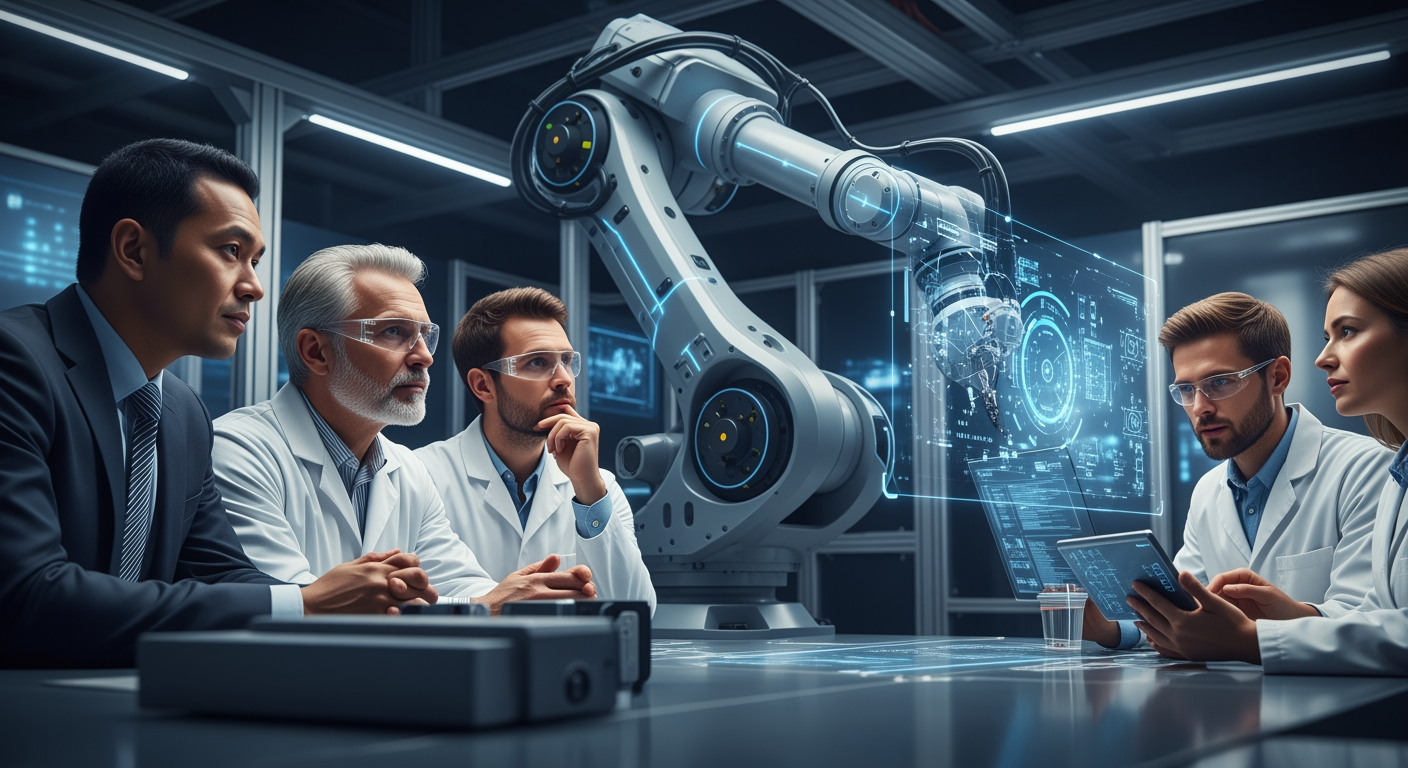
Germany's venerable industrial landscape, long a bastion of precision engineering and manufacturing prowess, is undergoing a profound transformation as its leading companies aggressively adopt artificial intelligence (AI). Driven by intense global competition and the imperative for enhanced efficiency, giants like Bosch, Volkswagen, BMW, Siemens, and ThyssenKrupp are integrating AI across their operations, from the factory floor to supply chain management, signaling a pivotal shift in the nation's economic strategy. This embrace of advanced AI technologies is not merely an incremental upgrade but a strategic maneuver to revitalize productivity, cut costs, and secure Germany's position as a leader in the global industrial arena.
The Imperative: Bolstering Competitiveness and Efficiency
For years, Germany has faced scrutiny over slow productivity growth and declining competitiveness in a rapidly evolving global market. The strategic integration of AI has emerged as a critical response, with more than 40% of German firms now utilizing AI in their business processes, a significant increase within a short period. This move is seen as indispensable for the nation's future as an industrial hub, helping to address challenges such as skilled worker shortages and maintaining a competitive edge against lower-wage economies. AI is recognized as a formidable driver of innovation, capable of optimizing processes, reducing operational costs, and significantly boosting productivity across sectors. Companies actively investing in AI anticipate tangible benefits, including increased turnover, enhanced automation, reduced expenses, and higher productivity. Economic projections suggest that widespread AI adoption could elevate Germany's annual GDP growth by 0.8 percentage points and contribute an additional 4.5 trillion euros to the economy by 2040.
Automotive Powerhouses Drive AI Innovation
Germany's automotive sector, a cornerstone of its industrial might, is at the forefront of AI adoption. Leading manufacturers are deploying sophisticated AI solutions to revolutionize production, logistics, and quality control.
Volkswagen, for instance, is making substantial commitments, planning to invest up to one billion euros in AI expansion by 2030. This investment focuses on AI-supported vehicle development, industrial applications, and the enhancement of its high-performance IT infrastructure. The company leverages its proprietary Digital Production Platform (DPP), a "factory cloud" that interconnects over 40 sites globally, to deploy AI applications designed to optimize complex vehicle assembly processes, improve energy and material usage, and reduce CO2 emissions. Volkswagen currently employs more than 1,200 AI applications throughout its operations, extending far beyond the immediate production lines. A notable success includes an AI application at its Poznań plant, which led to a 12% reduction in energy costs. The company is also utilizing AI for predictive maintenance, automated quality control, and streamlined production workflows, with systems like 'KI4UPS' capable of pinpointing electronic faults in vehicles within seconds across 13 plants, dramatically cutting troubleshooting times.
BMW has seamlessly integrated AI into its manufacturing processes since 2019, striving for optimized production efficiency, elevated quality control, and enhanced supply chain management. The automaker's AI-driven "Factory Genius" acts as a maintenance assistant, significantly reducing troubleshooting times across its global manufacturing network and forming a core component of its overarching iFactory and AIonic strategies. The AIonic platform serves as a centralized framework, consolidating all AI and data-driven applications across the company, facilitating knowledge sharing and consistent deployment. BMW utilizes AI-powered robotics for precise component placement, with AI systems capable of correcting misplaced studs automatically during assembly. Its AIQX platform, equipped with 26 cameras and sensor technology, automates quality processes, meticulously detecting issues and anomalies in real-time. Furthermore, BMW's innovative Car2X technology allows vehicles on the production line to communicate their assembly status and report errors, such as faulty plug connections, ensuring immediate rectification and minimizing rework. The company also employs acoustic analytics for audio-based quality checks, analyzing driving noises to ensure superior product quality, and uses AI to eliminate "pseudo-defects" by learning from real images, thus refining quality control processes.
Industrial Engineering and Tech Giants Lead the Charge
Beyond the automotive industry, other German industrial powerhouses are equally committed to integrating AI into their core operations.
Bosch, a diversified technology and services company, has nearly half of its plants already utilizing AI in manufacturing, primarily for production scheduling, monitoring, and control. The company is piloting generative AI to produce synthetic images for optical inspection, a groundbreaking initiative expected to drastically cut the time required for AI application rollout from several months to just a few weeks. Bosch's AI-based system for anomaly detection and malfunction identification is deployed across 50 plants and 2,000 production lines. The company's Machine Vision AI enhances optical inspection, effectively detecting minute defects like scratches on components. In its wafer fabs, AI optimizes production scheduling, leading to improved throughput and capacity utilization. A notable achievement includes an AI-based energy management system at its Changsha plant, which reduced electricity consumption by 18% and CO2 emissions by 14%. Bosch is making substantial investments, committing over 2.5 billion euros to AI by the end of 2027. The company is also pioneering Agentic AI, where AI systems can make decisions and execute actions autonomously, with multi-agent systems already monitoring devices, predicting maintenance needs, and optimizing personnel scheduling.
Siemens, a global leader in industrial automation, is leveraging AI to boost operational efficiency and productivity across manufacturing and infrastructure. In collaboration with Microsoft, Siemens is developing an Industrial Foundation Model (IFM) that will process 3D models, 2D drawings, industrial data, and technical specifications, redesigning the human-machine collaboration. Siemens' CEO, Roland Busch, has underscored the strategic importance of leveraging Germany's extensive industrial data to drive AI development and innovation, viewing it as crucial for strengthening the country's global competitive edge. The company has partnered with NVIDIA to advance AI-powered manufacturing systems and integrates AI directly into Programmable Logic Controller (PLC) systems to enhance automation and decision-making capabilities. Siemens is particularly focused on developing "industrial-grade AI," systems designed to meet the rigorous standards and reliability requirements of demanding industrial environments.
Even in traditional heavy industry, such as steel production, AI is making significant inroads. ThyssenKrupp utilizes AI to improve product quality and enhance production reliability. Its AI-based models for quality assurance, especially in packaging steel, employ deep learning to detect and classify defects, thereby elevating quality control. The company also leverages data analytics to predict material properties and set tolerances more precisely. ThyssenKrupp's "pacemaker®" system, driven by AI, optimizes supply chains for greater sustainability and cost-efficiency, and its smart.processing software provides instant price quotes while optimizing material usage.
Navigating the AI Frontier: Challenges and Investments
Despite the enthusiasm, German industries encounter significant hurdles in their AI journey. A prevalent issue is what analysts term "pilot purgatory," where companies successfully experiment with AI projects but struggle to scale them into core operations due to legal complexities, safety concerns, and insufficient change-management capabilities. A critical challenge is Germany's pronounced shortage of AI-skilled talent, a barrier that demands substantial investment in upskilling and recruitment. High upfront costs for advanced IT infrastructure also pose a considerable challenge.
Furthermore, regulatory uncertainty, particularly surrounding the comprehensive EU AI Act, is a major concern, with many viewing the legislation as overly complex and strict. German leaders, including Siemens CEO Roland Busch, advocate for regulatory reforms to enable European companies to compete more effectively with their U.S. counterparts. Cultural resistance and a general risk-averse mindset within some industrial firms also present barriers to a rapid and widespread AI transformation. Moreover, the energy demands of next-generation AI data centers pose a substantial burden on Germany's energy infrastructure, which already faces high energy prices. The adoption rate among small and medium-sized enterprises (SMEs), which form the backbone of the German economy, also lags behind that of larger corporations.
Nonetheless, significant investments are underway to address these challenges. Over half of German companies (53%) plan to increase their investments in generative AI over the next 12 months, with more than half of these projecting increases of 40% or more. The German federal government has launched an AI Action Plan, dedicating resources to expanding computing capacity and establishing AI centers of excellence, such as the Innovation Park Artificial Intelligence (IPAI) in Heilbronn, and allocating 1.75 billion euros to support AI startups. Regional initiatives are also robust, with Bavaria, for instance, investing over 2 billion euros and establishing 100 new AI professorships. Major tech players are bolstering Germany's AI infrastructure, with AWS planning a 7.8 billion euro investment in its European Sovereign Cloud and Microsoft committing three billion euros to data centers in Germany. A landmark partnership between NVIDIA and Deutsche Telekom is set to launch the Industrial AI Cloud in early 2026, a platform powered by up to 10,000 NVIDIA GPUs, offering secure and scalable compute capacity for manufacturing, robotics, healthcare, and energy sectors. This initiative is expected to be utilized by industrial giants like Siemens, Mercedes-Benz, and BMW. In a collective effort, over 60 leading German companies, including Siemens, are investing 100 billion euros into new projects aimed at driving innovation and strengthening industrial capacity.
Shaping the Future: Economic and Societal Impacts
The widespread adoption of AI is poised to profoundly reshape Germany's economic and societal fabric, particularly its labor market. Recent studies indicate that while the total number of jobs in Germany is likely to remain stable by 2040, a significant structural realignment is anticipated, with approximately 1.6 million positions either disappearing or being newly created. More than a quarter of German companies (27.1%) foresee job cuts due to AI in the next five years, with this figure rising to 37.3% in the industrial sector. Conversely, sectors like IT and information services are expected to gain around 110,000 new jobs, reflecting the escalating demand for digital infrastructure and advanced technical roles. Experts highlight that AI is not merely a tool for rationalization but also a catalyst for the emergence of new job profiles, emphasizing that AI is designed to complement human work rather than eliminate it.
Beyond employment, AI promises to bolster Germany's global standing. By embracing AI, the nation aims to fortify its economic resilience and enhance competitiveness on the world stage. Germany's robust industrial foundation and strong research infrastructure are seen as solid bases for future AI leadership within the European Union. The country's rigorous regulatory framework for AI, which prioritizes ethical progress and data protection, is also positioned to potentially set global standards for responsible AI development and deployment.
In conclusion, Germany's industrial titans are navigating a transformative period, recognizing AI as an essential force for innovation and sustainability. While significant challenges remain, particularly in talent development and regulatory adaptation, the concerted investments and strategic collaborations underscore a clear commitment to leveraging AI to ensure Germany's continued industrial leadership in the digital age. This proactive embrace of AI signals a profound evolution, cementing the nation's dedication to remaining a global manufacturing powerhouse.
Sources
- toolhunt.io
- trade.gov
- cerpro.io
- kpmg.com
- meinbavaria.de
- volkswagen-group.com
- volkswagen-group.com
- digitaldefynd.com
- 5dvision.com
- automotivemanufacturingsolutions.com
- aiexpert.network
- aicadium.ai
- boschmediaservice.hu
- yolegroup.com
- bosch-presse.de
- metrology.news
- aigantic.com
- automation-mag.com
- ainvest.com
- autogpt.net
- siemens.com
- twice.com
- thyssenkrupp-steel.com
- thyssenkrupp.com
- thyssenkrupp.com
- steelradar.com
- medium.com
- linvelo.com
- americangerman.institute
- marc-airc.com
- ifo.de
- dig.watch
- ifo.de
- scaile.tech
- beaumont-capitalmarkets.co.uk
Related Articles


The Regulatory Maze: Why Taming Social Media Harms Remains an Elusive Quest
The digital public square, once heralded as a beacon of connection and information, has increasingly become a battleground rife with misinformation, hate speech, cyberbullying, and threats to mental health. Despite...

Gamescom 2026: Industry Thrives Amid Record Success, Grapples with AI's Transformative Power
COLOGNE, GERMANY – Gamescom 2026, the world's largest video game trade fair, concluded its latest edition with resounding success, demonstrating the enduring vitality and economic strength of the global gaming industry....

Volkswagen's Defining Moment: Restructuring Talks Poise to Reshape German Automotive Landscape
Wolfsburg, Germany – Europe's largest automaker, Volkswagen, stands at a critical juncture, facing what its CEO, Oliver Blume, has termed a "more than critical" situation. Intense internal discussions, dubbed "crunch...