Germany Grapples with Calls to Abolish Controversial Law on Insulting Politicians
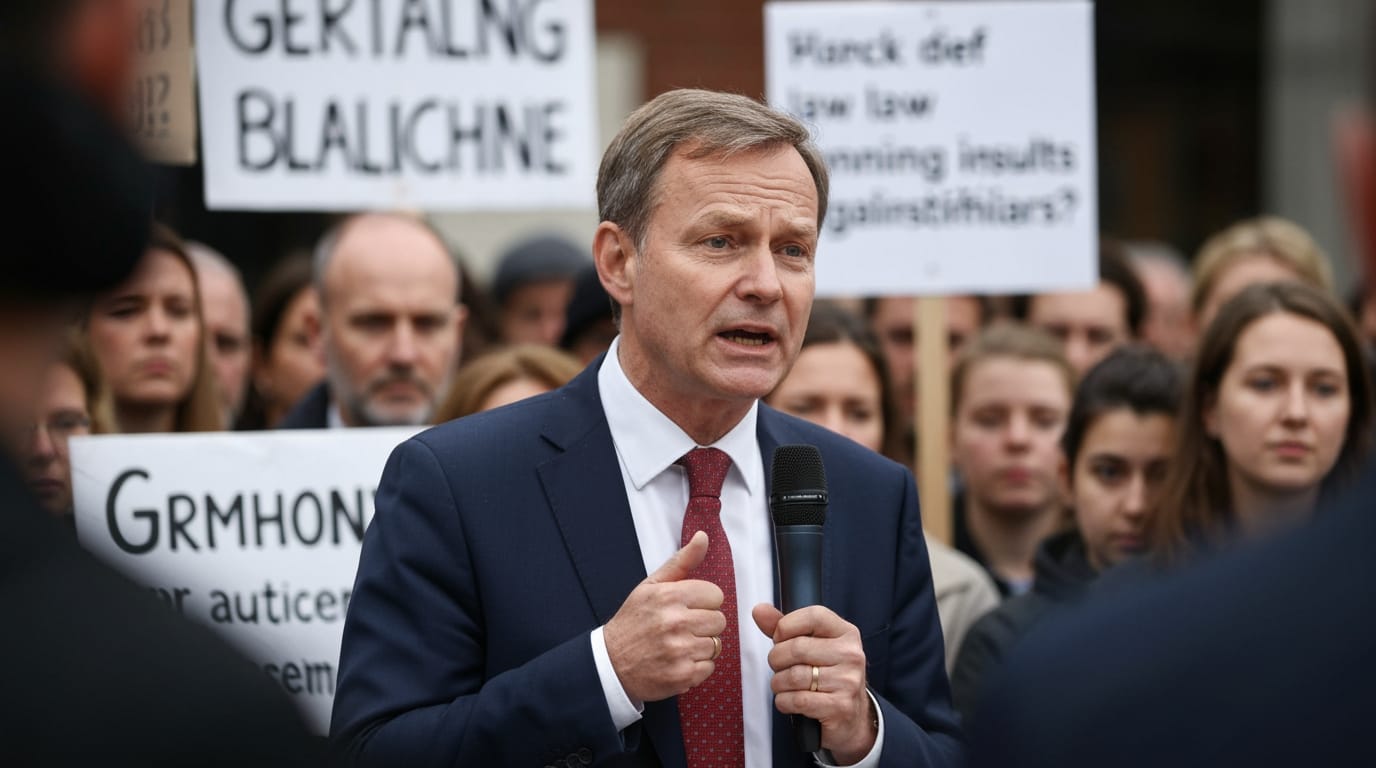
Berlin, Germany – A simmering debate over freedom of expression and the legal protections afforded to public officials has intensified in Germany, with growing calls to repeal a contentious law that criminalizes insults against politicians. Critics argue the statute, Section 188 of the German Criminal Code, stifles democratic discourse and creates a "two-class justice" system, while proponents contend it is essential to safeguard democratic institutions from escalating hate speech and online harassment. The discussion comes amid a dramatic surge in investigations under the law and a recent UN report advocating for its abolition.
The focal point of the controversy is Section 188 of the German Criminal Code (StGB), which specifically addresses defamation, libel, and slander directed at individuals involved in public political life. Unlike the general insult provision (§185 StGB) that applies to all citizens, Section 188 carries significantly harsher penalties, including imprisonment from three months to five years, if the offense is deemed capable of substantially impeding a politician's public activities. This specialized protection for politicians was introduced in 2020 and further strengthened in 2021, notably allowing public prosecutors to initiate investigations independently, without requiring the affected politician to file a complaint.
Historical Roots and Evolving Application
Germany's legal framework against insults has deep historical roots, tracing back to Roman law and the 18th-century Prussian criminal code, with the current criminal code largely based on the German Empire's 1871 statute. Historically, these laws aimed to protect personal honor and maintain public civility. The general insult law, Section 185 StGB, punishes acts of disrespect or contempt, whether verbal, written, or even through gestures, with penalties ranging from fines to up to two years in prison for public offenses.
The introduction and subsequent tightening of Section 188, however, marked a distinct shift, creating a heightened legal shield for those in political office. Proponents at the time argued that special measures were necessary to combat the rising tide of online harassment and hate speech targeting politicians, which they viewed as a direct threat to democratic stability.
Mounting Criticism and the "Chilling Effect"
Despite its stated intent, Section 188 has drawn increasingly sharp criticism from various quarters. A key concern is the potential for a "chilling effect" on free speech, where citizens may self-censor their political opinions online for fear of legal repercussions. This apprehension is fueled by numerous high-profile cases where seemingly minor criticisms have led to criminal proceedings. For instance, citizens have faced fines exceeding €2,000 for calling a politician a "liar" or a "moron," and some instances have reportedly involved police raids following social media comments. One widely reported case involved a pensioner investigated for allegedly depicting Chancellor Friedrich Merz as "Pinocchio" on Facebook.
The argument for "two-class justice" is also prominent. Saxon Justice Minister Konstanze Geiert, a member of the CDU, has openly criticized the law, stating that it affords politicians special protection not extended to other public servants, such as emergency workers or train conductors, who also face significant public abuse. Geiert advocates for a unified insult law that applies equally to all citizens, arguing that while politicians should be protected, this protection should not elevate their status above others. This sentiment is echoed by the UN Special Rapporteur on Freedom of Expression, who in June 2026 called for the repeal of Section 188, asserting that elected officials should enjoy the same rights as ordinary citizens to protect their reputation, and that increased protection for politicians currently restricts freedom.
The statistical evidence further underscores the rising controversy. Official figures show a rapid escalation in investigations under Section 188, with cases more than tripling in recent years. There were 1,404 cases in 2022, rising to 2,598 in 2023, and 4,439 in 2024. In 2025, investigations reached a record 4,792. Quarterly referrals to prosecutors have also quadrupled in just over a year, from 468 in the first quarter of 2024 to 1,528 in the second quarter of 2025. Critics point out that some prominent government politicians, including former Vice-Chancellor Robert Habeck and Chancellor Merz, have reportedly filed hundreds of complaints under the statute, further intensifying public scrutiny.
A Divided Public and Political Landscape
Public opinion appears largely aligned with calls for reform or abolition. An INSA poll conducted in June 2026 revealed that a plurality (43%) of Germans desire the complete abolition of Section 188, perceiving it as an infringement on free speech, while only 32% believe it should be maintained. Support for abolition is particularly strong among voters of the AfD, FDP, BSW, and Linke parties.
Despite the widespread public dissatisfaction and growing calls for change, the legislative path to repeal remains complex. In January 2026, the German parliament rejected a proposal by the right-wing Alternative for Germany (AfD) party to abolish Section 188. All parliamentary groups, with the exception of the AfD, voted against the motion. This outcome occurred even as some members of mainstream parties, such as Jens Spahn of the CDU, publicly questioned the regulation's appropriateness, only for their party's parliamentary group to vote against its abolition. Opponents of repeal argue that the law is a necessary bulwark against the increasing aggression in political discourse and the rise in politically motivated violence, linking "bloodthirsty words" to "murderous acts." They maintain that the law protects politicians and ensures their ability to function without undue intimidation, thereby protecting the integrity of democratic processes.
Conclusion: A Test of Free Speech in the Digital Age
Germany finds itself at a critical juncture, navigating the delicate balance between protecting its public figures and upholding the fundamental right to freedom of expression. The debate over Section 188 highlights broader societal challenges in the digital age, where the line between legitimate criticism and criminal insult can appear increasingly blurred. While the parliament recently reaffirmed its commitment to the existing law, the mounting pressure from civil society, public opinion, and international bodies like the UN suggests that the discussion is far from over. The future of Section 188 will serve as a significant test of how Germany intends to reconcile its historical legal traditions with contemporary demands for robust, uninhibited public discourse.


