Germany's Chancellor Merz Navigates Arctic Security and Space Ambitions in Crucial Norway Visit
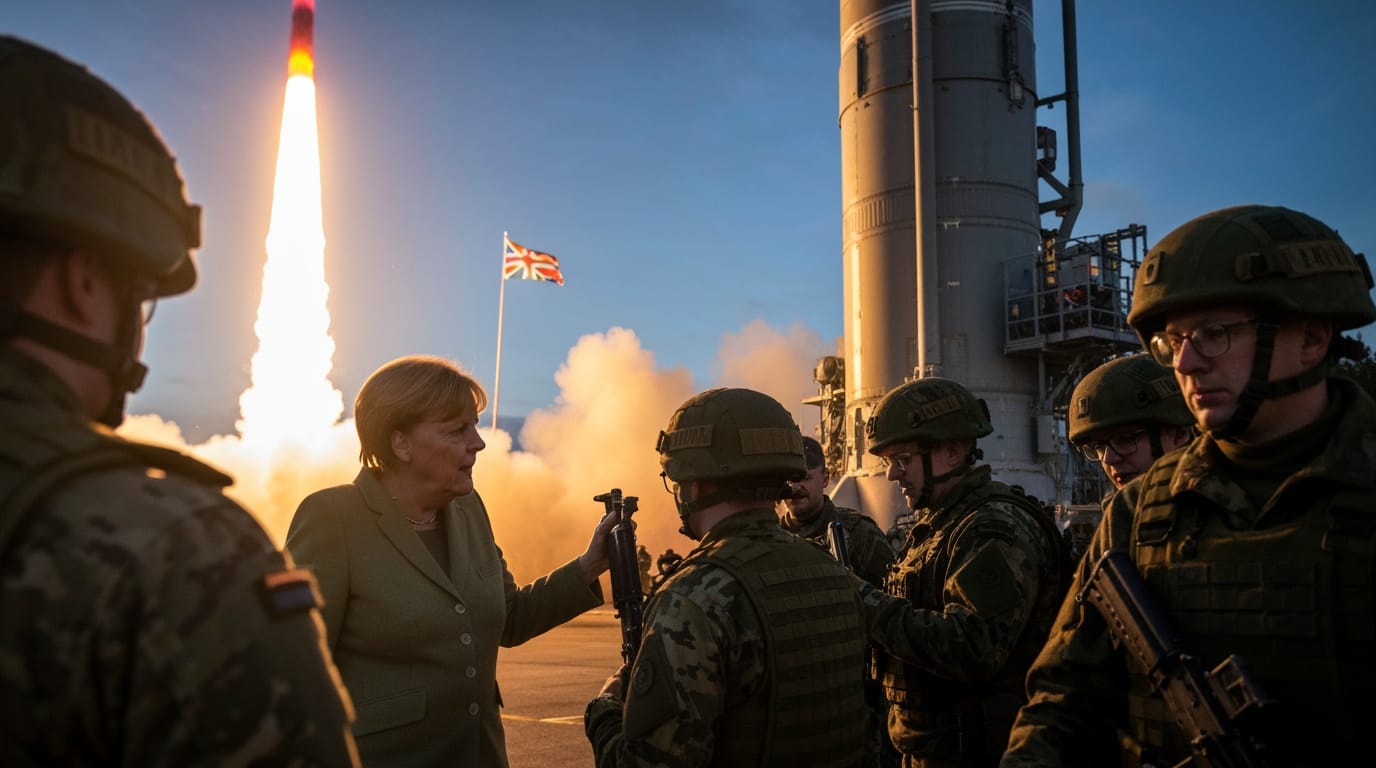
OSLO, Norway – German Chancellor Friedrich Merz concluded a pivotal two-day visit to northern Norway, underscoring Germany's deepening commitment to European security and its burgeoning role in the commercial and strategic space sector. The trip, marking Merz's first official visit to Norway since assuming the Chancellorship in May 2025, featured observations of a large-scale NATO military exercise in the Arctic and discussions on advanced space technologies, signaling a strategic convergence of defense and innovation in Berlin's foreign policy.
The Chancellor's itinerary, which included engagements with Norwegian Prime Minister Jonas Gahr Støre and Canadian Prime Minister Mark Carney, highlighted the increasing geopolitical significance of the High North and the critical importance of secure space infrastructure. Accompanied by German Defense Minister Boris Pistorius and Research Minister Dorothee Bär, Merz's presence at these distinct yet interconnected events projected a clear message of Germany's intent to shoulder greater responsibility within NATO and to champion technological self-reliance for Europe.
Arctic Resolve: Observing NATO's Cold Response 2026
The frigid landscapes of northern Norway provided the backdrop for a significant portion of Chancellor Merz's visit as he observed elements of NATO's "Cold Response 2026" exercise. This biennial military drill, involving approximately 32,000 soldiers from 14 allied nations, including 1,600 German armed forces personnel, is designed to enhance collective defense capabilities and train forces in extreme winter conditions. The exercise's focal points span northern Norway, Sweden, and Finland, extending into their respective airspaces and sea areas, emphasizing the defense of NATO's newly expanded northern flank.
The decision for Merz to witness the maneuvers firsthand underscores the heightened attention paid to Arctic security in the wake of evolving geopolitical dynamics. The region, warming three to four times faster than the rest of the planet, is opening up new access to resources, such as oil, gas, minerals, and fish, as well as new shipping routes, intensifying strategic rivalries. The exercise serves as a powerful demonstration of NATO's readiness to operate and defend its interests in this challenging environment, particularly against the backdrop of Russia's asserted military presence, which has included scrambling F-35 fighter jets to intercept Russian military aircraft in international airspace north of Norway. Merz reiterated the shared conviction among European NATO allies to do more to secure the High North, emphasizing its common transatlantic interest. Beyond the immediate military implications, discussions also reportedly touched upon broader security policy issues relating to the Arctic region, emphasizing comprehensive strategic coordination.
Germany's Leap into Orbit: Andøya Space Port and Strategic Autonomy
Prior to the military exercise observations, Chancellor Merz, alongside Prime Minister Støre, visited the Andøya Space Port in Andenes. This facility, which has facilitated rocket launches since the 1960s, is set to become a launchpad for Germany's burgeoning commercial space ambitions. A key focus of the visit was the imminent attempt by the German group Isar Aerospace to launch its Spectrum carrier rocket from Andøya. A successful launch would mark a historic milestone as the first successful flight of a European microlauncher, a development seen as crucial for bolstering European strategic autonomy in space access.
The visit to Andøya and the discussions surrounding it are integral to Germany's recently unveiled "Space Safety and Security Strategy," adopted in November 2025. This strategy aims to ensure Germany's long-term ability to operate in space across both civilian and military sectors, integrating space into national and collective defense. Key objectives include protecting German space systems, developing military space operations capabilities, and reducing reliance on non-European actors for critical space infrastructure. The strategy outlines a planned investment of €35 billion over five years for space security, targeting capabilities such as a global sensor network for space situational awareness and potential "counter-space capabilities," including agile spaceplanes and "bodyguard" satellites. Merz also engaged with Norwegian representatives on Germany's "Spock project," a planned constellation of radar satellites for the German Armed Forces, and the European Union's Iris2 project, further illustrating the multi-faceted approach to enhancing European space capabilities. A roundtable bringing together German and Norwegian space start-ups underscored the focus on collaborative innovation in this critical domain.
The Zeitenwende in Action: Reshaping German Defense and Diplomacy
Chancellor Merz's dual engagements in Norway are a tangible manifestation of Germany's "Zeitenwende," or "turning point," in foreign and security policy, initiated by Chancellor Olaf Scholz in 2022 following Russia's full-scale invasion of Ukraine. This paradigm shift involves a commitment to significantly bolster military capabilities and increase defense spending after decades of relative underinvestment.
Germany's defense budget has seen substantial increases, with the nation becoming the world's fourth-largest military spender in 2024, allocating $88.5 billion and reaching NATO's 2% GDP target for the first time since the pledge was made. This surge was largely facilitated by a €100 billion special fund established in 2022 to modernize the Bundeswehr, though concerns persist regarding a potential financing gap after this fund is projected to be depleted post-2027. Challenges in procurement processes and rebuilding capabilities after years of budgetary constraints remain. Beyond direct military investment, Germany has also emerged as the second-largest donor of military aid to Ukraine, providing $7.7 billion in 2024.
The Chancellor's visit, particularly with Defense Minister Pistorius, also included discussions on the German-Norwegian submarine cooperation through the U212CD project, highlighting broader industrial and defense partnerships aimed at strengthening allied interoperability and military capacity.
A United Front: Connecting Security and Innovation
The confluence of Merz's visits to a spaceport and a NATO drill illustrates a comprehensive approach to modern security, recognizing that capabilities in space are increasingly intertwined with conventional defense. Satellite technology is vital for communication, navigation, intelligence gathering, and early warning systems, all critical components of contemporary military operations and national resilience.
By actively engaging in both cutting-edge space technology development and robust military exercises, Germany, under Chancellor Merz, is signaling its determination to be a reliable and capable partner in safeguarding European security. The discussions in Norway, encompassing Arctic security, space cooperation, and defense industrial partnerships, reflect a Germany poised to translate its Zeitenwende rhetoric into concrete actions, fostering a more secure and technologically advanced European defense architecture in an increasingly unpredictable world.


