Germany's Unofficial Diplomacy: The Enduring 'Pizza Connection' Between Political Rivals
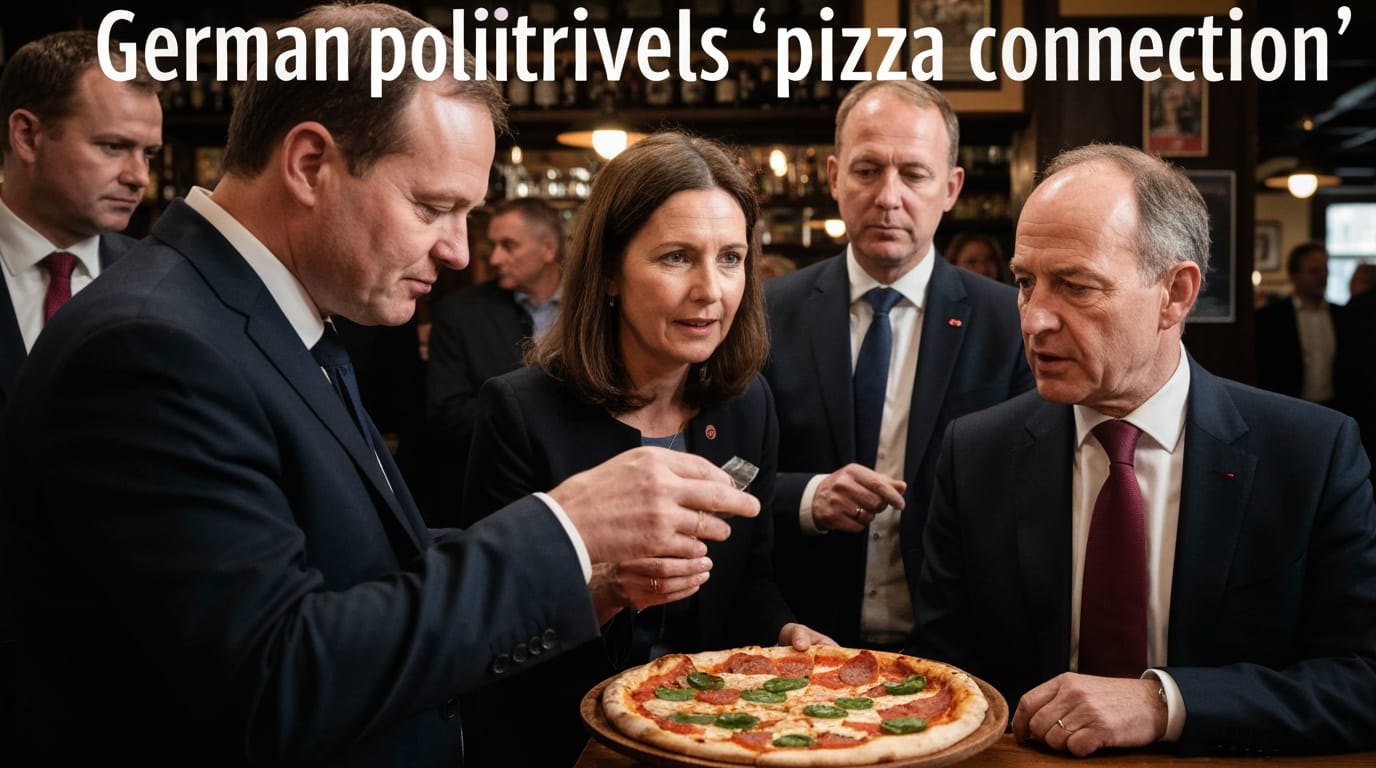
In the often-polarized landscape of German politics, where ideological divides can appear insurmountable, an informal tradition known as the "Pizza Connection" continues to serve as a quiet, yet persistent, bridge between ostensibly rival parties. This decades-old dialogue, involving young parliamentarians from the center-right Christian Democratic Union (CDU) and the environmentalist Alliance 90/The Greens, has reportedly been revived, or rather, sustained, demonstrating a pragmatic undercurrent beneath public political posturing. Even as party leaders publicly declare opponents, these behind-the-scenes meetings underscore a remarkable commitment to cross-party communication and relationship-building, shaping the contours of potential future coalitions and influencing the broader political discourse.
The Genesis of an Unlikely Dialogue
The "Pizza Connection" emerged in the mid-1990s as a series of clandestine gatherings between an unlikely pairing of political adversaries: junior members of the CDU/CSU and The Greens. At a time when CDU, under the leadership of Helmut Kohl, maintained staunchly conservative stances, and The Greens were often characterized as radical "left-wing rabble-rousers," any form of collaboration was seen as taboo. The informal meetings, initially held at the Italian restaurant Sassella in Bonn, then the seat of the German parliament, were born out of a desire for genuine exchange rather than immediate strategic alignment.
The distinctive moniker, "Pizza Connection," was coined by CSU General Secretary Bernd Protzner in 1995, who critically remarked that the informal group would be "kept under observation." The name, ironically, invoked the infamous Sicilian-American drug trafficking ring, though participants were quick to point out that the Italian eatery primarily served pasta, not pizza. Despite the initial skepticism and even condemnation from within their own parties, these young politicians, many of whom had studied together, found common ground and a shared understanding that transcended ideological boundaries. Among the early participants were figures who would later rise to prominence, including Armin Laschet, Peter Altmaier, Norbert Röttgen from the CDU, and Cem Özdemir and Katrin Göring-Eckardt from The Greens. These meetings fostered trust and established personal connections that would prove invaluable in subsequent political developments.
Evolution and Persistent Revival
The "Pizza Connection" was never a static entity; its activity waxed and waned with the shifting political tides, yet its spirit of dialogue repeatedly found new life. After the initial phase in the Bonn Republic, the meetings became less frequent following the government's relocation to Berlin. However, the concept proved too valuable to fade entirely. A brief revival occurred in 2007, initiated by Hermann Gröhe (CDU) and Margareta Wolf (Greens).
The group saw a more significant resurgence after the 2013 federal election, when exploratory talks between CDU/CSU and The Greens failed to form a government. This new iteration, sometimes dubbed "Pizza-Connection 2.0" or "Pasta-Connection," was notably coordinated by Jens Spahn (CDU) and Omid Nouripour (Alliance 90/The Greens). Its enduring nature was further highlighted in April 2023, when reports emerged of "Pizza-Connection 3.0," now reportedly led by Silvia Breher, deputy chairwoman of the CDU, and Claudia Müller, State Secretary in the Ministry of Agriculture for The Greens. Most recently, in November 2025, it was confirmed that the "Pizza Connection" continues its regular meetings, with Claudia Müller coordinating the gatherings for the Greens. This continuity is particularly noteworthy given the current political climate.
Dialogue Amidst Declared Rivalry
The continued existence and activity of the "Pizza Connection" gains particular significance in the contemporary German political landscape. Prior to the last federal election, and even more pointedly in recent times, CDU leader Friedrich Merz declared The Greens to be the Union's "main opponent". Such rhetoric typically signals a hardening of positions and a reduction in cross-party cooperation. Yet, beneath this public adversarial stance, the "Pizza Connection" thrives, providing a stark contrast between official party lines and the pragmatic realities of governance.
These informal gatherings offer a critical channel for communication, allowing parliamentarians to engage in substantive discussions away from the glare of cameras and the pressures of party discipline. They enable a deeper understanding of differing perspectives, foster personal relationships, and can subtly influence policy debates. While not directly negotiating coalition agreements, these dialogues lay crucial groundwork, building trust and exploring potential areas of compromise that might otherwise be impossible in formal settings. This unofficial diplomacy is especially vital in an era of increasingly fragmented electorates and the growing likelihood of multi-party coalition governments.
An Enduring Legacy of Pragmatism
The "Pizza Connection" is more than just a quaint anecdote in German political history; it represents an enduring commitment to dialogue and the recognition that complex modern challenges necessitate cooperation across the political spectrum. Its existence acknowledges that personal relationships and informal exchanges can be as crucial as official negotiations in shaping a nation's future. The initial meetings in the "enchanted cellar" of Sassella, where conservatives and environmentalists debated common ground, set a precedent for bridging divides that once seemed unbridgeable.
The restaurant itself, the original home of these historic meetings, has even seen a revival after temporary closures, symbolizing the persistent nature of this cross-party engagement. While the menu might feature pasta more often than pizza, the essence remains: creating spaces for elected officials to engage as colleagues rather than mere rivals. In a political era defined by rapid changes and often intense partisan competition, the "Pizza Connection" stands as a testament to the quiet power of pragmatism, personal connection, and sustained communication in German democracy. Its continued activity, even amidst declared political hostilities, underscores its fundamental role in facilitating the long-term political evolution of the nation.