Gold Shatters $5,000 Barrier Amidst Global Turmoil, Analysts Eye Further Ascent
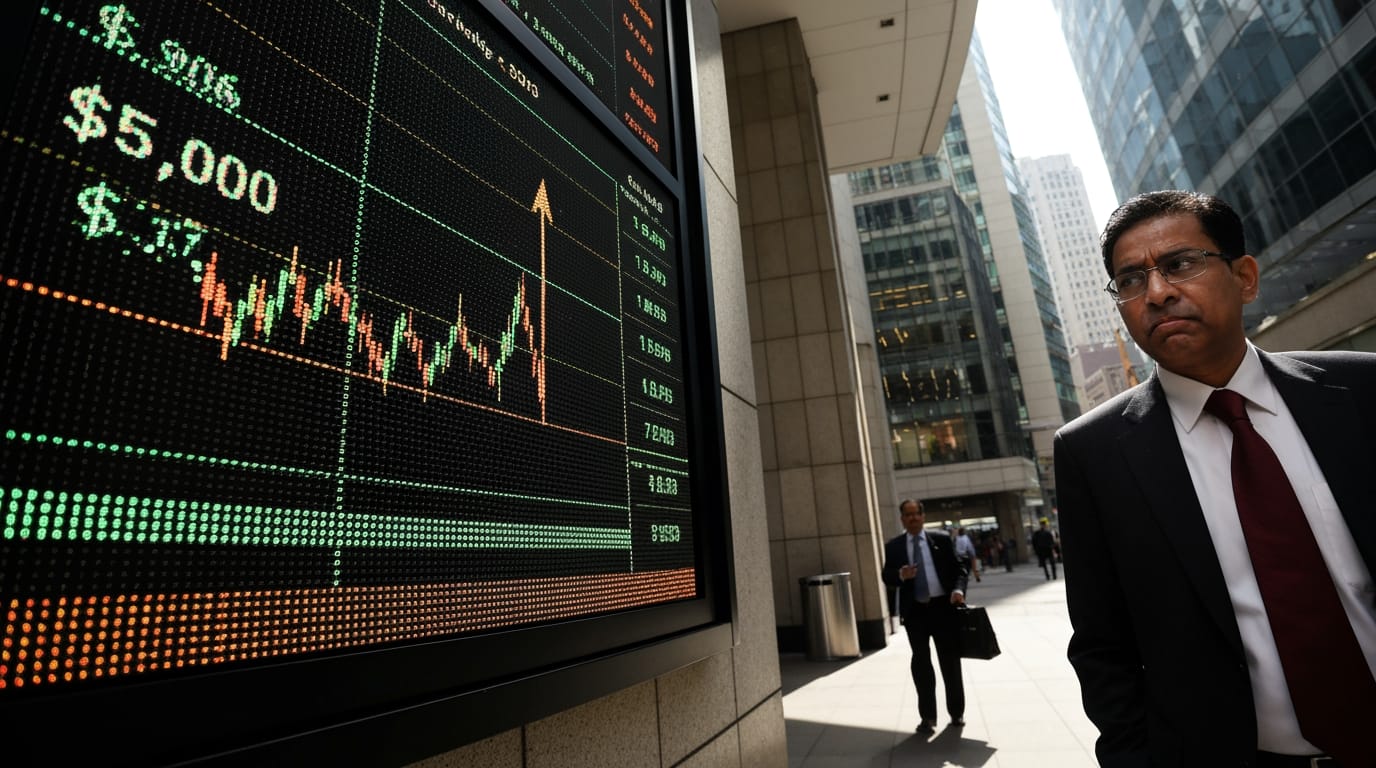
New York, NY – Gold, the perennial safe-haven asset, has surged past the unprecedented $5,000 per ounce mark, hitting fresh record highs in early trading Monday, January 26, 2026. This historic milestone follows a remarkable rally, with the precious metal climbing as much as 15% in the first 26 days of the new year, building on a staggering 65% increase throughout 2025 – its most significant annual gain since 1979. The monumental rise reflects a complex interplay of escalating geopolitical tensions, persistent economic uncertainties, a weakening U.S. dollar, and robust demand from central banks and investors alike, signaling a profound shift in global financial architecture.
The Unprecedented Ascent: A Surge Fueled by Fear and Fundamentals
The yellow metal's break above $5,000 per ounce arrived Monday, January 26, 2026, opening at $5,013.40 per troy ounce and touching highs like $5,080 and $5,100 throughout the day. This follows a period of continuous gains in 2025, during which gold surpassed $4,000 per ounce for the first time in October of that year. This dramatic rise underscores gold's enduring appeal as a store of value in turbulent times. Investors, seeking refuge from a volatile global landscape, have flocked to gold, viewing it as a reliable hedge against market instability. The current surge represents an 81.7% increase compared to this time last year, highlighting the accelerated pace of its appreciation. This sustained upward trajectory is widely seen by analysts as fundamentally supported rather than speculative, driven by tangible global conditions.
A Confluence of Catalysts: Geopolitical and Economic Undercurrents
Several interconnected factors are propelling gold's record-breaking run. Geopolitical instability stands out as a primary driver. Recent actions, including President Donald Trump's threats of 100% tariffs on Canadian goods over a potential trade deal with China, and previous tariff threats against European nations regarding Greenland, have injected significant unpredictability into global markets. Further contributions to market anxiety include stalled Russia-Ukraine peace talks and a military operation against Venezuela. These events foster an environment of heightened risk aversion, pushing investors towards traditional safe-haven assets like gold.
Simultaneously, persistent economic concerns are bolstering gold's appeal. Fears of a global economic slowdown, coupled with ongoing inflation concerns and expanding government deficits, are increasing gold's role as a protective asset. Gold acts as a hedge against inflation, safeguarding against the erosion of purchasing power, and also provides a safety net during periods of currency debasement and political instability. The correlation between gold prices and economic instability indicators has notably strengthened, indicating its consistent performance during uncertainty.
Central Bank Demand and Shifting Monetary Policies
A significant and increasingly influential factor in the gold rally is the sustained and substantial demand from central banks worldwide. These institutions are actively accumulating gold, driven by a strategic imperative to diversify their reserves away from the U.S. dollar and hedge against potential monetary system instability. Global central bank gold holdings now stand at nearly 36,200 tonnes, accounting for almost 20% of official reserves, a notable increase from 15% at the end of 2023.
Emerging market central banks, particularly those in Poland, Kazakhstan, Brazil, Turkey, and China, have been at the forefront of this buying spree. Data from the World Gold Council shows net purchases totaling 297 tons as of November 2025, demonstrating a continuous preference for gold as a traditional safe asset. While some analysts suggest that central bank buying is steady rather than a "frenzy," its cumulative impact creates a strong structural price support, operating independently of short-term market sentiment. This ongoing accumulation is altering how institutional capital approaches wealth preservation, reflecting concerns about currency stability and sovereign debt sustainability.
The outlook for U.S. interest rates also plays a crucial role. Expectations of further rate cuts by the Federal Reserve this year, following a period where lower interest rates traditionally increase the appeal of non-yielding assets like gold, contribute to its upward momentum. Gold typically exhibits an inverse relationship with real interest rates; as real rates decline, gold prices tend to appreciate.
The Dollar's Dance and Investor Sentiment
The weakening U.S. dollar further amplifies gold's attractiveness. Gold is globally priced in dollars, so a weaker dollar makes it less expensive for buyers holding other currencies, thereby stimulating demand. The greenback has started 2026 on a softer footing, with concerns swirling around the impact of tariffs, high government spending, and inflation on the U.S. economy. This prompts investors to recalibrate their exposure to U.S. assets, often shifting towards gold.
Investor sentiment remains largely bullish, with market analysts agreeing that the current rally is fundamentally sound, not a baseless bubble. Investment funds, including ETFs, have seen significant inflows, attracting approximately $12.3 billion in new assets year-to-date in 2025. This robust investor interest, combined with tight supply dynamics – gold mining production saw only a modest 0.6% increase in 2024, despite rising costs of production – reinforces upward price pressure.
Where Does It End? Analyst Outlook and Market Volatility
As gold scales new heights, market analysts are closely watching its trajectory. Projections from major financial institutions suggest that the rally has further room to run. J.P. Morgan Global Research, for instance, forecasts gold prices to average $5,055 per ounce by the final quarter of 2026 and could rise to $5,400 per ounce by the end of 2027.
Other aggressive forecasts include Goldman Sachs raising its end-2026 gold price prediction to $5,400 per ounce, while Bank of America anticipates gold could reach $6,000 per ounce by mid-2026. Société Générale analysts also predict gold reaching $6,000 by year-end. Independent analysts are even more bullish, with Ross Norman projecting a high of $6,400 per ounce this year, averaging $5,375. The London Bullion Market Association (LBMA) survey indicates some analysts foresee gold climbing towards $6,000 and potentially reaching as high as $7,150 in 2026. A hypothetical scenario involving just a 0.5% diversification of foreign U.S. asset holdings into gold could drive prices to $6,000 per ounce, according to J.P. Morgan.
The World Gold Council emphasizes that continued geoeconomic uncertainty will shape the 2026 outlook, with gold poised for moderate gains if economic growth slows and interest rates fall further, and performing strongly in the event of a more severe downturn. "The only certainty at the moment seems to be uncertainty, and that's playing very much into gold's hands," noted one independent analyst.
The ascent of gold to over $5,000 per ounce is not merely a number but a profound indicator of deep-seated shifts in the global economic and geopolitical landscape. Driven by a potent combination of geopolitical risk, inflationary pressures, central bank diversification, a softer dollar, and robust investor demand, gold's role as the ultimate safe haven has been powerfully reasserted. While its trajectory is subject to market dynamics and unforeseen global events, the consensus among experts suggests that the factors underpinning this historic rally remain firmly in place, pointing towards a sustained, albeit potentially volatile, bullish outlook for the precious metal in the foreseeable future.