Grand Arch Plans Filed for Washington, D.C., Sparking Monumental Debate
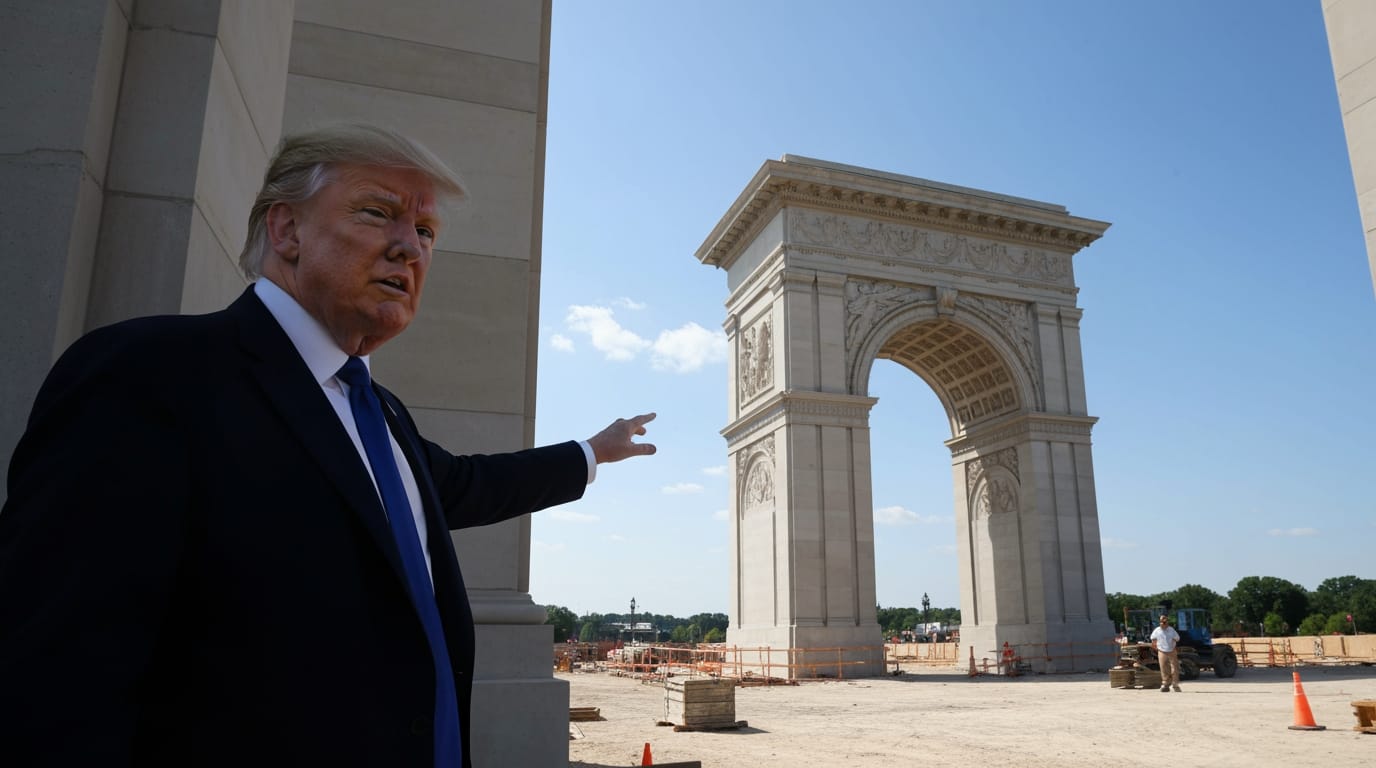
WASHINGTON, D.C. — President Donald Trump’s administration has formally submitted plans for a colossal, 250-foot-tall triumphal arch in Washington, D.C., to the Commission of Fine Arts, initiating the official review process for a project poised to dramatically alter the capital’s iconic skyline. Dubbed the "Independence Arch" or "Memorial Circle Arch," the proposed monument, intended to commemorate the 250th anniversary of American independence in July 2026, has ignited immediate debate over its scale, symbolism, and potential impact on the city's historic landscape. If constructed to President Trump's specifications, the arch would be the tallest triumphal arch globally, towering over many existing D.C. landmarks and surpassing Paris's renowned Arc de Triomphe.
The vision for this monumental structure, designed by Harrison Design, places it strategically on Columbia Island within Memorial Circle, a prominent traffic roundabout positioned between the Lincoln Memorial and Arlington National Cemetery. Renderings depict a gold-colored, winged Lady Liberty statue adorning its apex, flanked by two majestic eagles. Further patriotic inscriptions, "One Nation Under God" and "Liberty and Justice For All," would grace the arch’s sides, while four statues of lions would guard its base. President Trump has repeatedly expressed his desire for the arch to be the "biggest" and "most beautiful" in the world, asserting that it would reflect America's position as "the biggest, most powerful nation."
A Gateway to Grandeur: Purpose and Precedent
The concept of a grand triumphal arch serving as a ceremonial gateway to the nation’s capital has historical roots, with some architects noting that Washington D.C. is unique among major Western capitals in its absence of such a monumental structure. The project's proponents, including architect Nicolas Leo Charbonneau, who has been retained for the work, and art critic Catesby Leigh, suggest such an arch could provide a "noteworthy" and "beautiful" focal point at a key entrance to the city. The 250-foot height is explicitly linked by President Trump to the upcoming 250th anniversary of American independence, with the stated goal of creating a permanent tribute to the nation's history and its heroes. White House spokesman Davis Ingle stated the arch would "enhance the visitor experience at Arlington National Cemetery for veterans, the families of the fallen, and all Americans alike, serving as a visual reminder of the noble sacrifices borne by so many American heroes." The announcement of these formal plans on April 10, 2026, follows months of informal discussions and the unveiling of models by President Trump, including at a White House dinner in October 2025 where he showcased various scales of the arch to donors.
Navigating Regulatory and Aesthetic Hurdles
Despite the administration's enthusiasm, the proposed arch faces significant headwinds, including concerns from architectural experts, preservationists, and various regulatory bodies. The sheer scale of the 250-foot structure has drawn particular criticism. At more than twice the height of the 99-foot Lincoln Memorial and significantly taller than the 164-foot Arc de Triomphe, critics argue it would not only dwarf but also visually overwhelm existing, revered monuments. Art critic Catesby Leigh, who initially advocated for a more modest arch, has since expressed opposition to the proposed size at the chosen location, stating, "I don't think an arch that large belongs there." Architects and historic preservationists warn that such an imposing structure would "distort the intent of the existing memorials and obstruct pedestrians' views" of the Lincoln Memorial and Arlington National Cemetery.
The chosen site, Memorial Circle on Columbia Island, also presents numerous challenges. This land falls under the jurisdiction of the U.S. National Park Service and requires congressional authorization for significant new monuments. Furthermore, the location is situated directly along a flight path for nearby Reagan National Airport, raising potential concerns about aviation safety and requiring review from the Federal Aviation Administration (FAA). Military veterans have already initiated legal challenges, contending that the arch would negatively impact views of Arlington National Cemetery, a site of immense national reverence. The Commission of Fine Arts (CFA), which is scheduled to review the designs next week, finds itself in a politically charged position, particularly as President Trump replaced all six commissioners last year with appointees widely seen as loyalists.
Funding, Oversight, and a Pattern of Ambition
The financial framework for the Independence Arch remains a point of contention and scrutiny. While a final budget has not been disclosed, the administration anticipates a combination of public and private funding. Documents indicate that $2 million in special initiative funds and an additional $13 million in matching funds have been reserved for the arch through the National Endowment for the Humanities, signaling a commitment of taxpayer dollars. Critics have raised concerns about these spending priorities, particularly amidst other ongoing large-scale projects initiated by President Trump.
This proposal is not an isolated architectural endeavor. It aligns with a broader pattern of President Trump's efforts to leave a lasting physical imprint on Washington, D.C. The administration is currently engaged in the construction of a new East Wing ballroom at the White House, a project that itself has faced legal challenges and controversy. A federal judge previously halted construction on the ballroom due to a lack of congressional approval, a precedent that could foretell similar battles for the arch. Additionally, President Trump has championed the "National Garden of American Heroes," a proposed sculpture garden envisioned to feature 250 statues of notable historical figures. The repeated pursuit of such large-scale, symbolic projects underscores a presidential focus on monumental architecture and its role in shaping national identity and legacy.
Conclusion: A Looming Question Mark
The formal filing of plans for the Independence Arch marks a pivotal moment in President Trump's ambitious vision for Washington, D.C.'s future. Intended as a grand celebration of American independence and a testament to national power, the proposed 250-foot monument now enters a complex gauntlet of regulatory review, public debate, and potential legal challenges. While proponents envision a striking new landmark, critics fear an overbearing structure that could overshadow cherished memorials and disrupt the capital's carefully balanced aesthetic. As the Commission of Fine Arts prepares to deliberate, the question remains whether this towering symbol of national ambition will ultimately rise to reshape the nation's capital or become another chapter in the ongoing architectural dialogues of Washington, D.C.


