India and France Elevate Strategic Partnership with Focus on Rafale Deals and AI Innovation
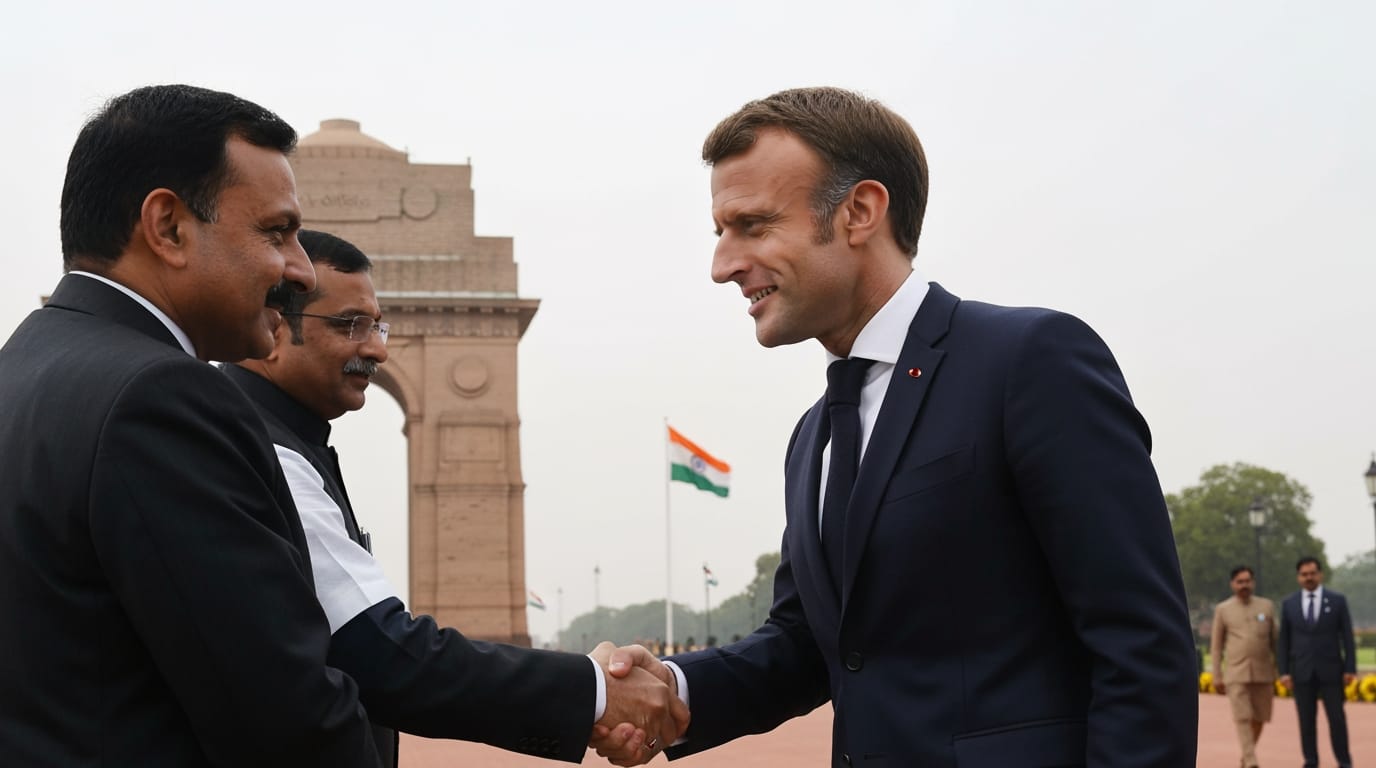
New Delhi, India – French President Emmanuel Macron concluded a significant three-day state visit to India this week, marked by robust discussions aimed at bolstering strategic ties, particularly in defense and emerging technologies like artificial intelligence. The visit, spanning from February 17 to 19, 2026, saw India and France elevate their bilateral relationship to a "Special Global Strategic Partnership," signaling a deepened commitment to cooperation across diverse sectors. The high-profile engagement culminated in 21 new agreements and a joint roadmap for future collaboration, emphasizing co-production and shared technological advancement.
President Macron's fourth visit to the South Asian nation underscored the growing importance of the India-France axis in a multipolar world. The leaders, including Indian Prime Minister Narendra Modi, unveiled the "India-France Year of Innovation," alongside an Innovation Network, laying the groundwork for intensified collaboration in research, technology, and entrepreneurship. This strategic alignment, building on the 25th anniversary of their Strategic Partnership in 2023 and the "Horizon 2047 Roadmap," is poised to reshape defense capabilities and foster a new era of technological prowess for both nations.
Deepening Defense Corridors: The Rafale Imperative
Central to the discussions was the ongoing trajectory of defense cooperation, with a particular focus on the advanced Rafale fighter jet. India has expressed a strong interest in acquiring an additional 114 Dassault Rafale multirole fighter jets, a deal that could be valued at approximately $36 billion. This potential acquisition is projected to be one of India's largest-ever military hardware procurements, designed to significantly enhance the Indian Air Force's combat capabilities amid regional security challenges.
Under the proposed arrangement, India plans to procure 18 of these jets in a fly-away condition, with the remaining aircraft slated for domestic manufacturing, reflecting India's "Make in India" initiative and a push for greater indigenous defense production. This approach involves significant technology transfer and the integration of Indian systems into the aircraft. The Indian Air Force currently operates 36 Rafales, which were delivered between early 2020 and December 2024 and have seen deployment in strategic operations. Furthermore, the Indian Navy is in the process of acquiring 26 Rafale-M (Marine) variants for its aircraft carriers. The ongoing collaboration also encompasses joint ventures, such as the agreement between Bharat Electronics Limited (BEL) and Safran to produce HAMMER missiles in India, and the inauguration of India's first H125 helicopter assembly line in Vemagal, Karnataka, a partnership between Tata Advanced Systems and Airbus. These initiatives underscore a concerted effort towards co-design, co-development, and co-production of advanced defense platforms.
Forging the Future: Artificial Intelligence and Critical Technologies
Beyond traditional defense, the visit placed a strong emphasis on advancing cooperation in critical and emerging technologies, with artificial intelligence at the forefront. President Macron participated in the AI Impact Summit 2026 in New Delhi, a significant event that built upon the AI Action Summit co-chaired by leaders in Paris in February 2025. Both nations reaffirmed their joint commitment to developing secure, trustworthy, and inclusive AI systems that serve public interest and global well-being. This includes a shared vision to democratize AI resources and bridge the global AI divide, ensuring that the benefits of this transformative technology are widely accessible.
Key outcomes in the AI sphere include the planned launch of an Indo-French Centre for AI in Health at AIIMS, New Delhi, and a Joint Declaration of Intent for the establishment of an Indo-French Centre for Digital Sciences and Technology. These centers aim to foster industrial partnerships, deepen research into broad and open language models that support linguistic diversity, and facilitate academic study on the societal implications of AI development. A notable dimension of this collaboration is its potential impact on Africa, positioning the emerging France-India AI partnership within a tripartite framework designed to support development across the Global South.
Strategic Convergence: Beyond Defense and Tech
The elevation to a "Special Global Strategic Partnership" extends beyond military hardware and AI. The visit produced a broader spectrum of agreements reflecting a comprehensive strategic alignment. An annual Foreign Ministers Dialogue will now be a fixture, ensuring regular reviews of the elevated partnership and the "Horizon 2047 Roadmap." Further cooperation was outlined in critical minerals and metals, vital for green energy transitions and high-tech industries.
Agreements also covered amendments to the Double Tax Avoidance Agreement, bolstering economic ties. India and France committed to fostering startup ecosystems, evidenced by a Letter of Intent between T-Hub and Nord France. Scientific collaboration between India’s Department of Science and Technology (DST) and France’s National Centre for Scientific Research (CNRS) received renewed emphasis. In the space sector, an existing Memorandum of Understanding between NewSpace India Limited (NSIL) and Arianespace SAS will continue to strengthen partnership on satellite launch missions, reflecting shared ambitions in the final frontier. The leaders also reiterated their shared vision for a free, open, and rules-based Indo-Pacific, underscoring the geopolitical dimension of their partnership and support for initiatives like the India-Middle East-Europe Economic Corridor (IMEC).
Conclusion: A Partnership for the Next Century
President Macron's recent visit to India has unequivocally solidified the burgeoning strategic relationship between the two nations, moving beyond transactional deals to a profound partnership rooted in co-development and shared vision. The elevation to a "Special Global Strategic Partnership" signals a future where India and France jointly address defense modernization, harness the power of artificial intelligence for inclusive growth, and strategically navigate a complex geopolitical landscape. With significant strides made in defense manufacturing, a renewed push for AI innovation, and a comprehensive framework for broader cooperation, this partnership is poised to become a cornerstone of both nations' foreign policy for decades to come, projecting influence and stability in an increasingly interconnected world.


