India Slams Pakistan at UN Over 'Fitna al Hindustan' Label, Calls it a 'Factory of Hate'
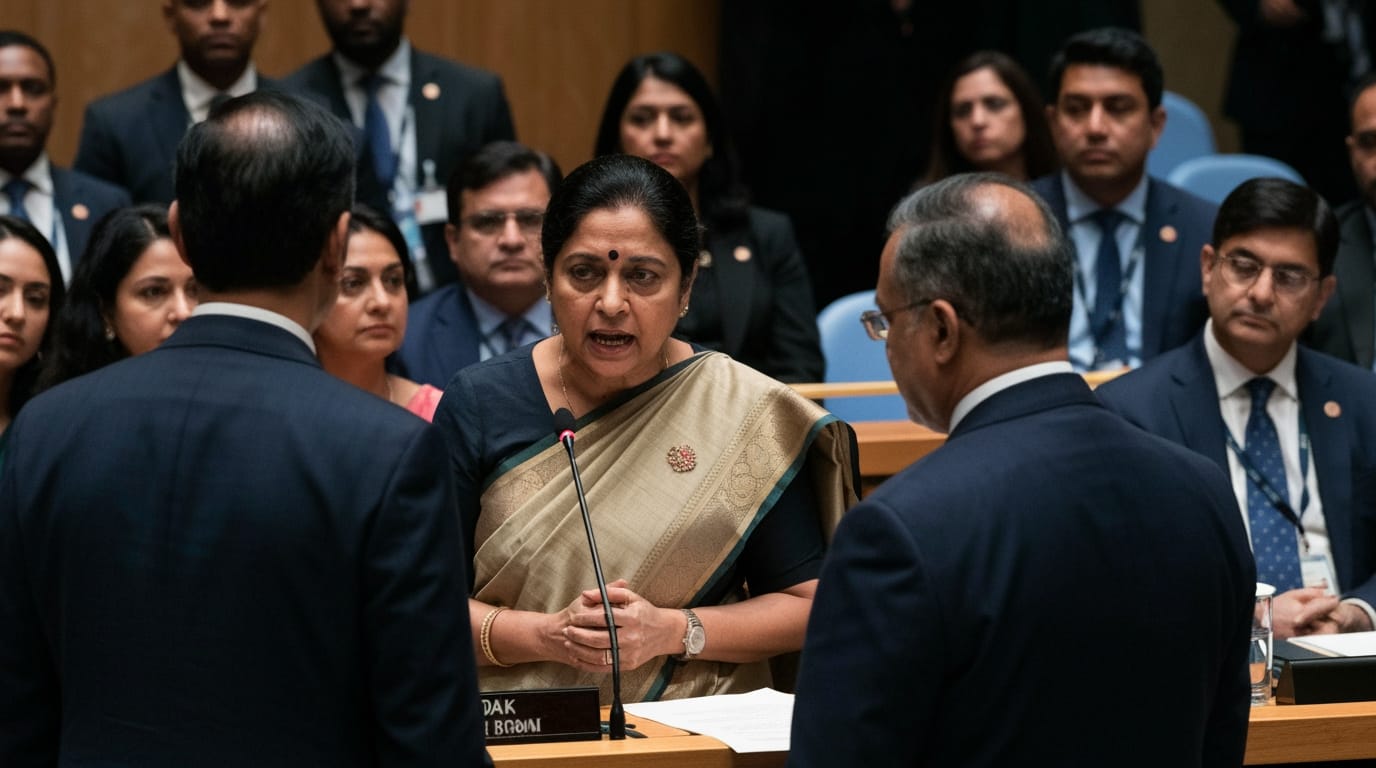
UNITED NATIONS – India has vehemently condemned Pakistan at the United Nations, accusing its neighbor of propagating state-sponsored misinformation by labeling militant groups operating within its own territory as 'Fitna al Hindustan.' The strong rebuke came during a United Nations Security Council session focused on the situation in Afghanistan, where India asserted that Islamabad was attempting to deflect blame and manufacture a false narrative to mislead both its own populace and the international community.
'Fitna al Hindustan': A Narrative of Blame
The diplomatic confrontation unfolded as India's Permanent Representative to the UN, Ambassador Parvathaneni Harish, addressed the Security Council. At the core of India's criticism was Pakistan's recent practice of officially designating anti-state and militant groups operating primarily in its Balochistan province as 'Fitna al Hindustan.' This Arabic-Persian phrase translates to "the turmoil or disorder of India," and its usage, according to New Delhi, is a deliberate attempt to falsely implicate India in Pakistan's internal security challenges. Pakistan had, in 2025, designated all terrorist groups in Balochistan with this label, alleging, without providing substantiating evidence, that these outfits were acting at India's behest. Ambassador Harish characterized this as "officially sponsored misinformation and disinformation dressed in religious terminology," designed to create a misleading narrative that lacked factual basis. India maintained that such tactics were part of a broader strategy by the Pakistani establishment to sustain animosity against India and divert attention from pressing domestic political and economic crises.
India's Powerful Rebuttal: An 'Organised Factory of Hate'
Ambassador Harish articulated India's firm rejection of Pakistan's 'Fitna al Hindustan' narrative, describing it as the product of an "organised factory of hate." He argued that this campaign serves to keep Pakistani citizens in a state of permanent hostility with India, thereby allowing the Pakistani deep state to perpetuate its power, control national resources, and distract from significant internal problems. The Indian envoy emphasized that such rhetoric was intentionally manufactured to deceive both the Pakistani public and the global community. India contended that Pakistan's actions reflected a long-standing pattern of blaming neighboring countries for its own internal shortcomings rather than addressing the root causes of those issues.
Deep State Influence and Regional Instability
Beyond the 'Fitna al Hindustan' controversy, India also directed criticism towards Pakistan's internal political dynamics and its impact on regional stability. Ambassador Harish pointed to the growing influence of Pakistan's military in governance, citing recent constitutional amendments as clear indicators of expanding military dominance over civilian institutions. He described the 27th Constitutional Amendment as a "de facto military coup," linking it to the appointment of General Asim Munir as Pakistan's first Chief of Defence Forces. This internal control, India suggested, contributes to Pakistan's external policies, including its alleged disinformation campaigns. The Indian representative asserted that Pakistan has a protracted track record of holding its neighbors responsible for its own internal difficulties, further fueling regional instability.
Afghanistan: A Confluence of Crises
The backdrop for this heated exchange was a UN Security Council session concerning the situation in Afghanistan, a region grappling with its own complex security challenges. India used the platform to condemn Pakistan's cross-border military operations in Afghanistan, holding Islamabad accountable for significant civilian casualties resulting from its aerial assaults. Ambassador Harish unequivocally stated that "dressing up a massacre as a military operation does not absolve the perpetrator. Killing, maiming and orphaning civilians is not counter-terrorism." He further criticized Pakistan's perceived hypocrisy, noting that Islamabad espouses high principles of international law and Islamic solidarity while allegedly carrying out airstrikes during the holy month of Ramadan. This strong condemnation came amid heightened tensions between Pakistan and Afghanistan, with UN records indicating that Pakistani airstrikes earlier this year resulted in numerous civilian deaths and displaced thousands, sparking severe border confrontations.
Conclusion: A Call for Accountability
The diplomatic showdown at the United Nations underscored the deep-seated mistrust and ongoing animosity between India and Pakistan. India's forceful rejection of the 'Fitna al Hindustan' narrative as state-sponsored disinformation highlighted its concerns over what it perceives as Pakistan's deliberate attempts to malign India and distract from its own internal and regional challenges. The broader allegations concerning Pakistan's military influence and its actions in Afghanistan further complicated the already fragile regional security landscape. As both nations continue to navigate their contentious relationship on international platforms, India's call for accountability and an end to what it terms an "organised factory of hate" signals a persistent demand for transparency and a cessation of rhetoric that it deems detrimental to peace and stability in South Asia.