Mercedes-Benz Workers Stage Nationwide Protests Against Cost-Cutting Measures
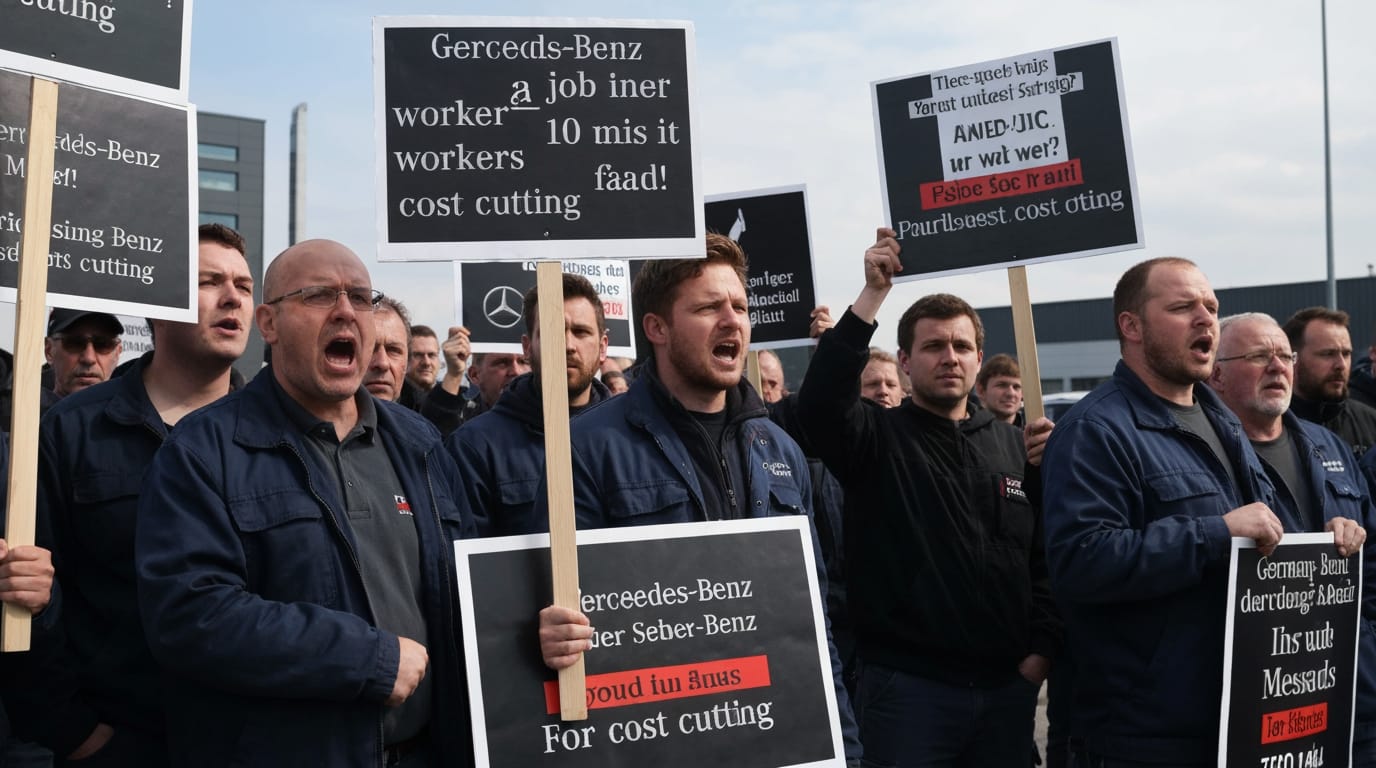
Stuttgart, Germany – Thousands of Mercedes-Benz employees across Germany are staging nationwide protests today, July 3, 2026, against the luxury automaker's intensified cost-cutting measures, which include postponing bonus payments and a controversial proposal to extend working hours without additional pay. The demonstrations, organized by Germany's powerful IG Metall union, signal a deepening conflict between management and labor over the future of the automotive industry as it navigates a challenging transition to electric vehicles and faces global economic headwinds.
The Spark of Discontent: Bonuses Delayed and Workloads Increased
The current wave of unrest was triggered by two primary cost-cutting measures announced by Mercedes-Benz affecting approximately 90,000 of its German employees. The first involves the postponement of the "transformation bonus," a special payment equivalent to 18.4% of an employee's monthly salary, which was initially slated for July 2026 but is now deferred until April 2027. The company has also indicated that this bonus could be canceled entirely if financial performance continues to decline. The second and arguably more contentious measure proposes extending the standard 35-hour workweek to 40 hours, without offering additional compensation or compensatory time off. This would effectively require employees to work an extra 260 unpaid hours annually.
IG Metall, Germany's largest industrial union, has vehemently opposed these proposals, arguing that they unfairly burden employees and erode hard-won collective bargaining achievements. Union representatives emphasize that the 35-hour workweek is a foundational element of labor agreements in Germany's metal and electrical industries, and any unilateral changes could trigger widespread labor disputes across the sector. Mercedes-Benz management, in a letter to employees, acknowledged the need to "continue to cut costs at full speed" to maintain competitiveness, stating that "the situation in Germany today is dramatic" and that the "cost per hour of work must come down."
Mobilization and Union Demands
Today's protests are taking place at numerous Mercedes-Benz sites across Germany, including key locations like Sindelfingen and Untertürkheim in Stuttgart, as well as Rastatt, Kuppenheim, Bremen, Berlin, Hamburg, Düsseldorf, Ludwigsfelde, and Germersheim. IG Metall leaders, including Christiane Benner, are participating in these rallies, signaling the union's strong commitment to resisting the company's austerity drive.
The union views these protests at Mercedes-Benz as merely the beginning of broader actions. IG Metall has declared that it will ensure a "hot summer and fall" for the automotive industry's executives if companies continue to prioritize job cuts and relocation over finding sustainable solutions to their challenges. The union claims that approximately 50,000 jobs were eliminated in the German automotive sector last year alone, and it asserts that employees are not to blame for the current economic difficulties. Union demands center on protecting collectively agreed social standards, defending the 35-hour workweek, preserving special payments, and safeguarding jobs and production sites.
Mercedes-Benz's Economic Pressures and Strategic Realignments
Mercedes-Benz management justifies its stringent cost-cutting measures by pointing to significant financial challenges. The company reported a 48.8% year-over-year decline in profits for 2025 and a 19.5% drop in sales within the crucial Chinese market during the same period. Further compounding these woes, first-quarter 2026 group earnings fell by 17.2%. Profits for 2025 nearly halved to €5.3 billion from €10.4 billion, following a deterioration in 2024.
The automaker attributes these financial setbacks to a confluence of factors, including tariffs, unfavorable currency exchange rates, intense competition in China, and the substantial costs associated with the transition to electric vehicles (EVs). Mercedes-Benz aims to reduce production costs by 10% by 2027 and by 20% by 2030, building upon a previous cost-reduction plan initiated between 2019 and 2025. To achieve these savings, the company plans to increase localized production in markets like China and the United States, while also considering shifting some model production to lower-cost regions such as Hungary, though it has stated no intention to shut down German plants. The workforce is also expected to shrink through natural attrition and voluntary redundancy packages. Mercedes-Benz also acknowledges that its EV strategy is being recalibrated due to declining electric vehicle sales, leading to a renewed focus on balancing its portfolio with combustion engine models.
Broader Implications for the German Automotive Sector
The dispute at Mercedes-Benz highlights the profound structural transformation underway in the German automotive industry. The costly and complex shift from internal combustion engines to electric powertrains poses significant challenges to employment. Electric vehicles typically require fewer moving parts and less labor-intensive assembly, leading to concerns about widespread job losses across the sector. Industry experts predict that the transition to EVs could result in the loss of up to 186,000 jobs by 2035 in Germany.
This scenario creates a mismatch between traditional manufacturing skills and the emerging demand for expertise in areas like software development, battery chemistry, and artificial intelligence. Labor unions and policymakers are increasingly apprehensive about the social and economic impact, particularly in regions heavily reliant on automotive production. The current standoff at Mercedes-Benz underscores a broader struggle within Germany's industrial landscape, where companies are seeking greater flexibility and cost efficiency to remain competitive globally, while unions are fighting to protect established labor rights and job security amidst an unprecedented industrial upheaval. The outcome of these negotiations and protests will likely set a precedent for future labor relations across the entire German automotive supply chain.
Conclusion: A Pivotal Moment for German Industry
The protests by Mercedes-Benz workers represent a critical juncture for both the iconic German automaker and the nation's broader industrial sector. As Mercedes-Benz grapples with declining profits and the immense financial demands of transitioning to electric mobility, its management is pushing for significant concessions from its workforce. Conversely, IG Metall and its members are fiercely resisting measures they perceive as an unfair transfer of economic burdens onto employees, threatening to escalate industrial action if their demands for job security and the preservation of collective bargaining achievements are not met. The ongoing negotiations and demonstrations highlight the tension between corporate imperatives for competitiveness and labor's fight for stability in an era of rapid technological change and global economic uncertainty. The resolution of this conflict will not only shape the future trajectory of Mercedes-Benz but will also offer a potent indicator of how Germany's historically robust industrial model adapts to the challenges of the 21st century.


