The AI Paradox: Tech Giants' Carbon Footprints Surge Amidst Sustainability Pledges
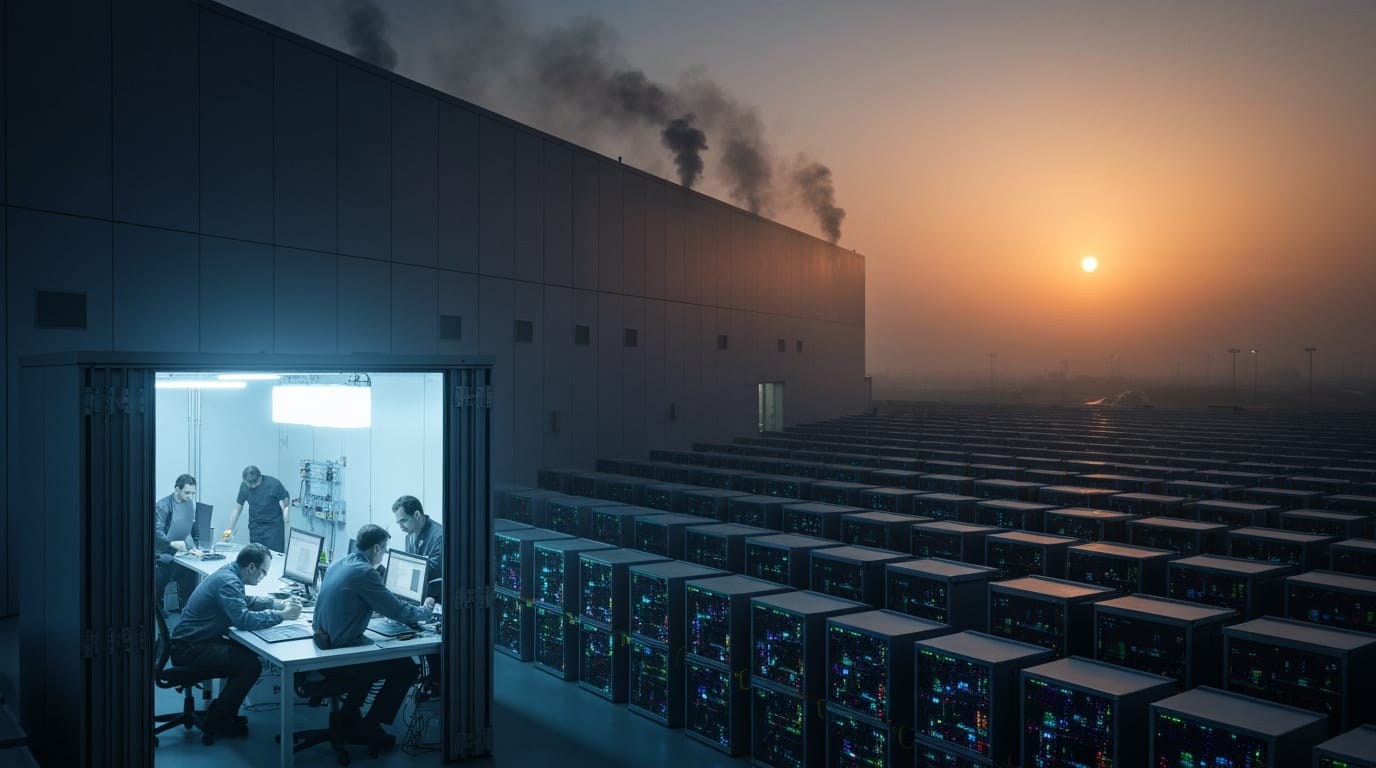
The relentless pursuit of artificial intelligence is driving a dramatic increase in the carbon emissions of technology behemoths Google and Amazon, challenging their ambitious net-zero commitments and highlighting a growing tension between technological advancement and environmental responsibility. Recent sustainability reports from both companies reveal significant upticks in their greenhouse gas outputs, largely attributed to the insatiable energy demands of AI-powered data centers. This surge comes as global data center electricity consumption is projected to double between 2022 and 2026, primarily fueled by the rapid expansion of AI technologies.
The Soaring Costs of Digital Intelligence
Google, a pioneer in AI research and deployment, reported its total greenhouse gas emissions rose by 13% in 2023, primarily driven by increased data center energy consumption and supply chain emissions. More recent figures for 2025 indicate Google's "ambition-based" emissions climbed 18% to approximately 14.5 million tons of CO2 equivalent, with absolute emissions reaching around 19 million tons. Its electricity use alone jumped by 37% in 2025. Critically, Google's Scope 1 emissions, stemming from its own direct operations excluding purchased electricity, increased 20% compared to 2024 due to its expanding data center infrastructure. The company's Scope 3 emissions, which encompass indirect pollution from purchased goods and services like hardware manufacturing and data center construction, also saw a substantial 25% rise from 2024, effectively doubling since 2019.
Amazon, a leader in cloud computing through Amazon Web Services (AWS) and a global retail giant, also saw its carbon footprint expand. After two years of modest declines, Amazon's absolute carbon emissions grew by 6% in 2024, reaching 68.25 million metric tons of CO2 equivalent. This trend accelerated in 2025, with emissions rising 16% to approximately 81 million tons of CO2e, a figure roughly equivalent to the annual emissions of 19 million gasoline-powered cars. Amazon's emissions from purchasing electricity alone increased by 34% in 2025. The company acknowledged that this increase was primarily driven by the construction of new data centers and the fuel consumed for its extensive delivery operations. Since 2019, when Amazon pledged to achieve net-zero emissions by 2040, its emissions have tripled.
These figures underscore a central dilemma for tech companies: the immense computational power required for AI models translates directly into soaring energy consumption. As International Energy Agency (IEA) projections suggest, global data center electricity demand is on track to exceed 945 TWh by 2030, with AI workloads being the primary catalyst for this growth.
Data Centers: The Powerhouses of the AI Revolution
The core of this escalating energy demand lies within data centers, the physical infrastructure supporting the digital world and, increasingly, the AI boom. These facilities house vast arrays of servers, storage systems, and networking equipment, which all require significant electricity to operate and, crucially, to keep cool. Data centers currently account for 1% to 2% of the world's total energy consumption, a figure that experts warn could swell to 21% by 2030 if AI integration continues at its current pace.
The transition from text-based AI models to more complex systems capable of processing images and videos has amplified energy needs. For instance, a single ChatGPT query consumes an estimated 2.9 watt-hours of electricity, significantly more than the 0.3 watt-hours needed for a typical Google search. Training advanced AI models demands even more substantial power, with a single training session capable of consuming thousands of kilowatt-hours. The training of GPT-3, for example, is estimated to have consumed 1.29 GWh of electricity, while the larger-scale GPT-4 required over 50 GWh, a consumption equivalent to nearly 0.1% of New York City's annual electricity usage.
The proliferation of high-performance accelerated servers, essential for AI processing, is projected to increase their electricity consumption by 30% annually. Moreover, the cooling systems necessary to prevent these powerful machines from overheating typically account for 30-40% of a data center's electricity usage, with IT equipment itself often exceeding 60% in AI-intensive facilities. This profound energy hunger is not just pushing up utility bills; it is also accelerating investments in fossil fuel infrastructure, such as natural gas power plants, to ensure a consistent and reliable energy supply for these critical operations.
Sustainability Pledges Versus Reality
Both Google and Amazon have established ambitious sustainability targets. Google aims for net-zero emissions across its operations and value chain by 2030, while Amazon has committed to achieving net-zero by 2040. However, the recent increases in emissions present a formidable challenge to these goals. Google explicitly stated in its report that its path to net zero "will not be linear," acknowledging that its AI infrastructure buildout is currently accelerating faster than the grid can decarbonize.
While both companies are investing heavily in renewable energy, the scale of AI's energy demands is making it difficult to offset their growing carbon footprints entirely. Amazon, for its part, reported matching 100% of its electricity use with clean power sources in 2023 and sustaining that in 2024. Yet, critics point out that matching energy use on paper with clean power purchases does not always equate to actual operations running on clean energy, as the grid may still rely on fossil fuels. Furthermore, Amazon's emphasis on declining "carbon intensity" (emissions per dollar of sales) can obscure the reality of rising absolute emissions, as its business continues to grow significantly.
The indirect emissions from the supply chain, particularly the manufacturing of specialized AI hardware, concrete, and steel for data center construction, also present a substantial hurdle. These "Scope 3" emissions are difficult to control and track, yet contribute significantly to the overall environmental impact.
Navigating the Path Forward
Recognizing the urgency, tech giants are exploring various strategies to mitigate AI's environmental impact. This includes initiatives like the Data Center Innovation Initiative, where Amazon, Google, Meta, and Microsoft are collaborating with investors to accelerate the development of sustainable data center technologies. These efforts focus on areas such as energy storage for clean power, advanced electrical systems for efficiency, novel cooling methods to reduce energy and water use, and the adoption of low-carbon building materials. Amazon is also actively investigating nuclear solutions as a low-carbon energy source.
Beyond these large-scale investments, companies are implementing more immediate efficiency measures. Google's data centers, for instance, are designed to be 1.8 times more energy efficient than typical enterprise data centers. The company also leverages AI itself to enhance sustainability, such as using AI-powered fuel-efficient routing, which has reportedly led to 2.9 million metric tons of greenhouse gas reductions, equivalent to removing 650,000 cars from the road. Amazon has expanded its fleet of electric delivery vans and is working to reduce plastic packaging.
The rise in emissions underscores a critical juncture for the technology sector. While AI promises transformative benefits, its growing environmental footprint demands innovative solutions that reconcile technological progress with climate imperatives. The industry faces the complex task of continuing to develop groundbreaking AI capabilities while simultaneously accelerating the deployment of renewable energy, improving energy efficiency across its operations, and developing sustainable supply chains. The success of these efforts will determine whether the AI revolution can truly be sustainable or if it will inadvertently deepen the global climate crisis.


