Moscow's Victory Day Parade: A Stripped-Down Display Amidst Lingering Conflict
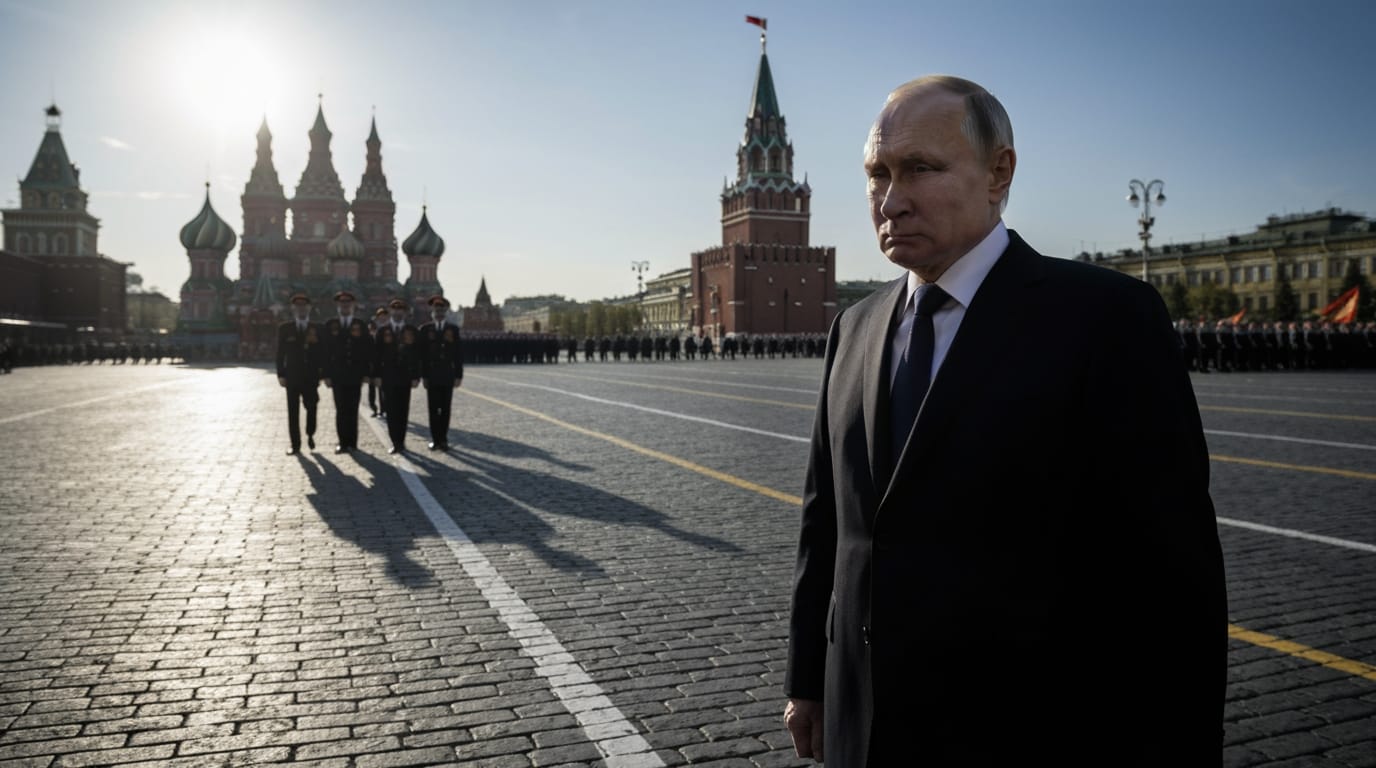
Moscow's iconic Red Square, typically a stage for a thunderous exhibition of military might on Victory Day, hosted a notably scaled-back parade this Saturday, May 9, 2026. President Vladimir Putin presided over a ceremony that, for the first time in nearly two decades, largely omitted heavy weaponry, underscoring the profound impact of the ongoing conflict in Ukraine and heightened security concerns. The pared-down spectacle contrasted sharply with previous years' lavish displays, reflecting the realities of a protracted war now in its fifth year.
The Leaner Procession on Red Square
The 2026 Victory Day parade presented a starkly different image from the grand processions of the past. Absent were the long columns of tanks, intercontinental ballistic missiles, and other heavy military hardware that have historically rumbled across Red Square. The notable exception was a traditional flyover of combat jets, a visual nod to air power that broke the pattern of ground equipment being largely withdrawn. This year's event saw marching soldiers, including veterans and contingents from various military branches, traversing the historic cobblestones. However, key components typically featured in the grand display were conspicuously missing, such as cadets from the prestigious Suvorov and Nakhimov military schools. The ceremony itself was also noticeably shorter, reportedly lasting just 45 minutes, approximately half the usual duration for such a significant national holiday.
This downscaling marks a significant departure from the norm, particularly when compared to recent years. For instance, the 2025 celebration, marking the 80th anniversary of Nazi Germany's defeat, was a much larger affair, featuring Chinese troops and numerous foreign leaders, including President Xi Jinping. Even the 2024 parade, while featuring only one T-34-85 tank, still included a range of modern military vehicles, missile launchers, artillery, and an aerial display. The trajectory since the full-scale invasion of Ukraine in February 2022 has seen a gradual reduction in the parade's scale, with the 2023 event also being significantly scaled back, lacking a flyover and showcasing only 51 vehicles, compared to 197 in 2021.
Heightened Security and Official Justifications
The primary reason cited by the Kremlin for the drastic reduction in this year's parade was the "current operational situation" and the persistent "terrorist threat" from Ukraine. Russian authorities explicitly pointed to the risk of Ukrainian drone attacks as a major concern, leading to extensive security measures in Moscow. In a tangible manifestation of these fears, mobile internet services were reportedly cut off in Moscow during parade rehearsals and on Victory Day itself, a measure intended to disrupt potential drone navigation.
Kremlin spokesperson Dmitry Peskov reiterated that "all measures are being taken" to minimize danger, emphasizing the perceived need for caution in the face of what Moscow describes as Kyiv's "full-scale terrorist attack." The apprehension was not entirely unfounded; Ukrainian President Volodymyr Zelenskyy had previously issued a tongue-in-cheek decree "allowing" Russia to hold its May 9 military parade, adding that Ukrainian weapons would not target Red Square. This sarcastic gesture underscored the underlying tension and the very real threat perceived by Russian authorities. The decision to remove heavy military equipment was also reportedly influenced by fears that such machinery, potentially needed for frontline operations, could become a target.
A Shifting Image of Strength
President Putin, in his address, maintained a defiant posture, invoking the sacrifices of World War II to rally support for his troops in Ukraine. He asserted that Russia's "moral strength, courage and valor," and its "unity and ability to endure anything and overcome any challenge" would ensure victory, claiming that "Victory has always been and will be ours." He also drew parallels between the historical struggle against Nazi Germany and the current conflict, stating that Russian troops "face an aggressive force that is armed and supported by the entire bloc of NATO."
Despite the resolute rhetoric, the scaled-back parade itself sent a different message. For years, the Victory Day parade served as a powerful symbol of Russian military might and national pride, a "military spectacle" designed to project power and unity. The absence of its most formidable hardware, however, has been interpreted by some as a visual representation of the strain the protracted war has placed on Russia's military and economy. With victory in Ukraine proving "elusive" more than four years into the conflict, the diminished parade could symbolize Moscow's challenges rather than its strength. Reports suggest a wave of anxiety in Moscow regarding the war's ultimate outcome, with the conflict having led to hundreds of thousands of casualties and significant economic drain.
Geopolitical Implications and International Reception
The guest list for this year's parade also underscored Russia's increasing international isolation. While previous years, especially major anniversaries, drew numerous world leaders, the 2026 event saw a noticeably smaller contingent of foreign dignitaries. In 2024, presidents from Belarus, Kazakhstan, Kyrgyzstan, Tajikistan, Turkmenistan, Cuba, Laos, and Guinea-Bissau were in attendance. However, the contrast with the 2025 80th-anniversary parade, which hosted 29 foreign leaders, including Xi Jinping, was stark, highlighting the geopolitical shifts impacting Russia. Even some traditional allies in Central Asia have begun to reposition the holiday within their own national narratives, rather than solely aligning with Moscow's political script.
Adding another layer to the complex event was the announcement of a three-day ceasefire between Russia and Ukraine, brokered by former U.S. President Donald Trump, coinciding with Victory Day. This temporary cessation of hostilities, which included a proposed exchange of 1,000 prisoners, offered a brief respite amidst the ongoing violence, although Ukrainian officials initially dismissed earlier unilateral ceasefire proposals as cynical. Russia also restricted foreign media access to the parade, citing format changes "due to the current situation," further controlling the narrative surrounding the event.
Conclusion
The 2026 Victory Day parade on Red Square, scaled back to an extent not seen in decades, served as a potent symbol of Russia's current predicament. While President Putin utilized the occasion to project resolve and draw on deeply rooted historical narratives of triumph, the absence of military hardware and the palpable security concerns betrayed the strains of the ongoing war in Ukraine. The event, traditionally a showcase of national power and unity, instead highlighted the geopolitical challenges facing Russia and the profound impact of the conflict on its strategic outlook and domestic image. The reduced spectacle underscored that even on its most revered national holiday, Russia is navigating a new and uncertain reality.


