Munich Prepares for Oktoberfest 2026 as Global Travelers Plan for the World's Largest Folk Festival
Munich is setting the stage for Oktoberfest 2026, welcoming millions of visitors from across the globe to the sprawling festival grounds of the Theresienwiese for a sixteen-day celebration of Bavarian heritage. The event begins at noon on Saturday, September 19, and runs through Sunday, October 4, continuing a tradition that blends centuries-old customs with modern hospitality. Known locally as the Wiesn, the festival remains the standard for international folk celebrations, drawing travelers, families, and locals together in the Bavarian capital.
Opening Ceremonies and the Festival Calendar
The festival calendar follows precise guidelines established by municipal authorities. By tradition, Oktoberfest commences on the Saturday following September 15 and concludes on the first Sunday of October. In years where the first Sunday falls on October 1 or 2, the schedule extends to incorporate German Unity Day on October 3. Because October 4 serves as the first Sunday in October 2026, the standard sixteen-day duration remains intact.
The opening sequence begins on the morning of September 19 with the parade of festival landlords and breweries. Horse-drawn wagons carrying ornate wooden barrels roll through downtown Munich toward the festival meadow. The official start occurs at midday inside the Schottenhamel tent. With the traditional strike of a mallet and the declaration of "O'zapft is!"—signifying that the first keg is tapped—the mayor opens service across the entire grounds. Prior to that signal, vendors cannot serve beer.
On Sunday, September 20, the Traditional Costume and Marksmen’s Parade proceeds along a seven-kilometer route through central Munich. The procession features roughly 9,000 participants representing regional clubs from across Germany, Austria, and neighboring alpine regions. Midweek programming features dedicated Family Days on September 22 and September 29, offering reduced fares on rides and fairground concessions. The middle weekend, spanning September 25 through September 27, traditionally draws large contingents of visitors from northern Italy, while the festival concludes on October 4 with a brass gun salute beneath the bronze statue of Bavaria.
Navigating the Tents, Reservations, and Grounds
Theresienwiese spans more than forty hectares and hosts seventeen large festival halls alongside twenty-one smaller tents, each operating with distinct menus and cultural themes. The major structures accommodate thousands of seated guests at once, supported by live brass bands during daylight hours and contemporary party ensembles after dark.
Securing a seat requires careful timing. While tent operators begin accepting table reservations through their individual booking portals early in the year, visitors without pre-booked vouchers can still access seating. Municipal regulations mandate that large tents reserve substantial portions of their indoor and outdoor areas for walk-in traffic. During weekends and peak evening hours, these non-reserved benches fill rapidly, often causing security staff to restrict tent entry before noon. Conversely, weekday mornings and early afternoons generally provide open access without wait times.
General operating hours are uniform across the meadow. On opening day, tents open doors at 9:00 a.m., with beverage service commencing at noon. On standard weekdays, halls open at 10:00 a.m. and cease beer service at 10:30 p.m., with final closing at 11:30 p.m. Weekend and public holiday schedules open operations at 9:00 a.m. Specialized venues like Käfer Wies'n-Schänke and Kufflers Weinzelt operate extended late-night hours until 1:00 a.m.
Beyond the commercial avenues lies the Oide Wiesn, a fenced section situated at the southern end of the grounds. Established originally during the 2010 bicentennial, this heritage area charges a nominal entry fee and showcases historical fairground amusements, folk dancing exhibits, and traditional brass instrumentation at lower acoustic volumes.
Cultural Traditions and Festival Etiquette
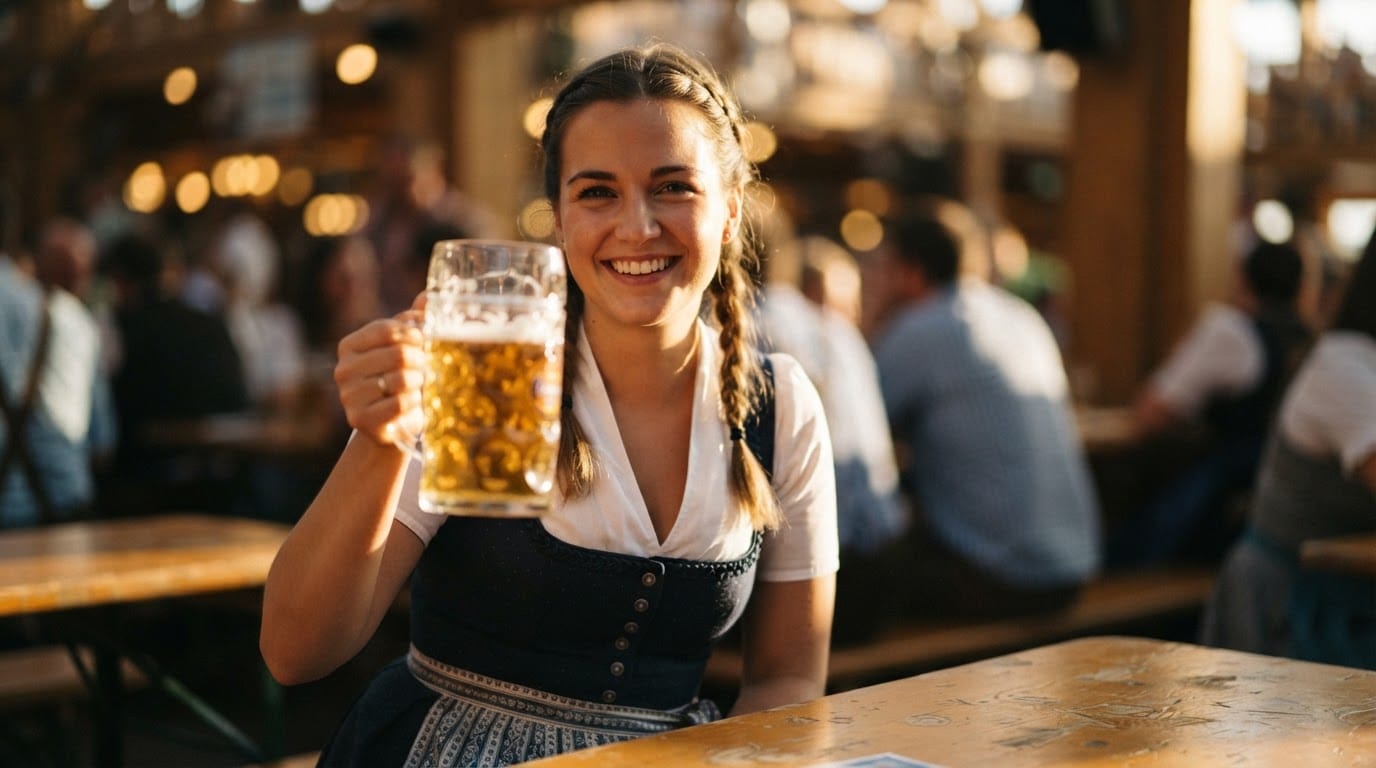
Attending Oktoberfest involves well-defined social norms grounded in regional tradition. A major aspect is the wearing of traditional regional garments: Tracht. Men typically wear leather breeches (Lederhosen) paired with checkered shirts, woolen jackets, and regional socks. Women often wear the Dirndl, a three-piece ensemble comprising a bodice, blouse, and apron. Local custom dictates the tying of the apron knot: tied on the wearer’s right, it indicates marriage or a serious relationship, whereas a knot tied on the left signals that the wearer is single. While traditional attire is widely encouraged, casual everyday dress is common among international travelers. Inexpensive costume replicas made of synthetic materials, however, are broadly discouraged by locals.
Beverage service is restricted to breweries that brew within Munich city limits, including Augustiner, Hacker-Pschorr, Hofbräu, Löwenbräu, Paulaner, and Spaten. The beer is brewed under the strict specifications of the Bavarian Purity Law of 1516 (Reinheitsgebot), which permits only water, malt, hops, and yeast. Brewed specifically for the festival, the Märzen-style lager carries an alcohol content ranging between 5.8 and 6.3 percent, noticeably stronger than typical light lagers. Drinks are served primarily by the Maß, a sturdy one-liter glass mug. Food offerings focus on hearty Bavarian fare, such as rotisserie chicken (Hendl), roasted pork knuckles (Schweinshaxe), soft pretzels (Brezn), and assorted sausages.
Economic and Logistical Impacts on Munich
The festival represents a massive economic force for Munich and the surrounding state of Bavaria. Over the course of the run, the event consistently attracts over six million visitors, who consume millions of liters of beer along with hundreds of thousands of meals. The influx generates economic activity exceeding one billion euros across the hospitality, transportation, and retail sectors.
This scale introduces considerable logistical complexity. Hotel rooms within Munich often reach maximum capacity months prior to opening, prompting room rates to double or triple compared to standard seasonal averages. Many visitors arrange accommodations in outlying towns connected by the regional S-Bahn rail system, such as Augsburg, Rosenheim, or Freising.
The city deploys an extensive public transit infrastructure to move hundreds of thousands of daily passengers. The Munich underground (U-Bahn) stations at Theresienwiese and Goetheplatz manage high passenger flows through dedicated crowd-control corridors, while regional transit authorities add special train connections during late-night hours. On the grounds, safety regulations enforce strict perimeter checks, prohibiting large backpacks and glass bottles, while maintaining dedicated medical stations to assist patrons throughout the day.
A Balance of History and Modernity
Oktoberfest originated on October 12, 1810, as a public festival celebrating the royal wedding of Crown Prince Ludwig of Bavaria to Princess Therese of Saxe-Hildburghausen. The initial gathering centered on agricultural exhibits and a horse race, taking place on the open fields that still bear the bride’s name. The event proved so popular among citizens that royal organizers made it an annual recurrence, gradually lengthening the schedule and shifting the start into late September to take advantage of longer, warmer autumn days.
More than two centuries later, the festival functions as both a vital repository of Bavarian folk customs and a commercial gathering of global significance. The event relies on a balance between local patronage—Bavarians comprise roughly seventy percent of attendees—and the arrival of international visitors. With dates set and operational frameworks organized, Munich's 2026 celebration continues this shared tradition of Bavarian culture on the open fields of the Theresienwiese.