New Golf Ball-Sized Blue Octopus Discovered in Galápagos Deep-Sea Reveals Ocean's Hidden Wonders
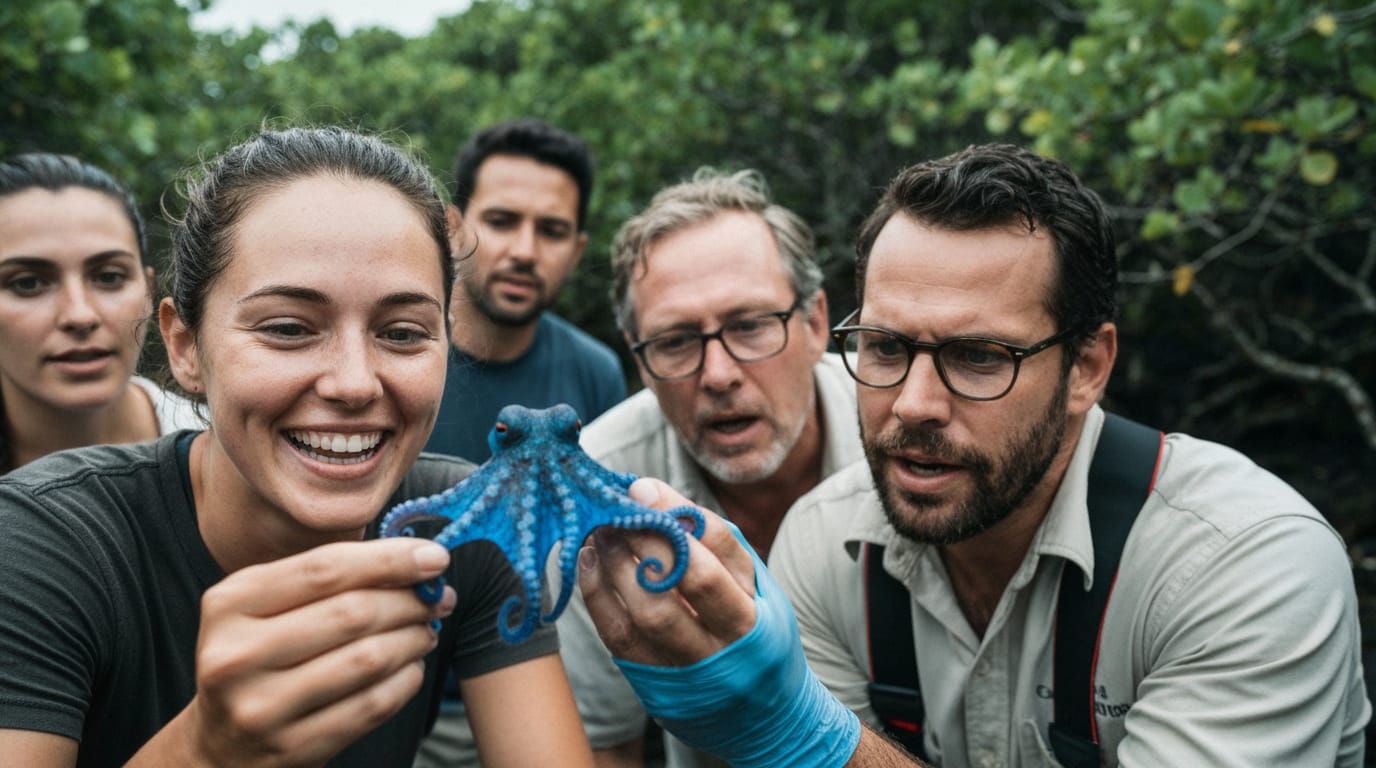
GALÁPAGOS ISLANDS — Scientists have announced the discovery of a new species of tiny, vibrant blue octopus dwelling in the deep-sea trenches off the Galápagos Islands, an area renowned for its unparalleled biodiversity. Named Microeledone galapagensis, this captivating cephalopod, no larger than a golf ball, signals the vast, unexplored mysteries that still lie beneath the ocean's surface, particularly in critical ecosystems like the Galápagos archipelago. The find, published recently, underscores the profound importance of deep-sea exploration and conservation as humanity continues to uncover life in Earth's most extreme environments.
Unveiling the Deep-Sea Enigma
The journey to discovering Microeledone galapagensis began in 2015 during a deep-sea expedition near Darwin Island, part of the remote Galápagos archipelago. Researchers from the Charles Darwin Foundation and the Galápagos National Park Directorate utilized a remotely operated vehicle (ROV) to explore the ocean floor nearly 1,800 meters (5,900 feet) below the surface. As the ROV's camera traversed the abyssal landscape, a flash of blue caught the scientists' attention. Initial footage captured excited exclamations from the team: "He's tiny! It's blue!". This initial encounter led to the careful collection of one specimen, which would later prove to be an entirely new species to science. Salome Buglass, a marine scientist formerly with the Charles Darwin Foundation, noted how this tiny blue octopus fascinated the researchers when sorting through specimens from the expedition.
A Jewel of the Deep: Characteristics and Classification
The newly identified Microeledone galapagensis is distinguished by several unique features. Its most striking characteristic is its diminutive size, roughly comparable to a golf ball, and its ability to curl up in the palm of a hand. While it appeared a vivid blue under the ROV's artificial lights, its actual coloration is a light blue on its dorsal surface, transitioning to a "very deep purple" underneath. This dual coloration is not merely aesthetic; scientists believe this pattern aids in defense, suggesting the octopus might use its dark underside to conceal light emitted by captured prey, thereby avoiding attracting predators. Furthermore, the octopus possesses stubby arms adorned with a single row of suckers, setting it apart from many other known octopus species.
The formal classification of the new species presented a unique scientific challenge. Octopus expert Janet Voight, a curator at the Field Museum of Natural History in Chicago, was tasked with identifying the strange specimen. Traditionally, describing a new octopus species involves dissecting the specimen to examine internal structures like the mouth, beak, and teeth. However, with only a single preserved specimen of Microeledone galapagensis, Voight was reluctant to cause any damage. Innovatively, the team at the Field Museum employed advanced CT scanning technology to generate thousands of X-ray images, compiling them into a detailed 3D model of the octopus. This non-invasive method allowed scientists to meticulously study its internal anatomy, providing crucial data for its classification without compromising the rare specimen. Stephanie Smith, head of the Field Museum's X-ray lab, expressed the profound nature of "spending the day looking at something no other human has ever seen". Initially, it was hypothesized to belong to the Thaumelodone genus, but the detailed CT scans led to its reclassification within the Microeledone genus.
A Tiny Giant in Marine Science
The discovery of Microeledone galapagensis holds significant implications for marine biology and our understanding of cephalopod evolution. The new species appears to be a smaller member, or "runt," of the Megaleledonidae family, a group whose other known members are typically much larger and primarily inhabit the frigid waters surrounding Antarctica in the Southern Ocean. This unusual geographical distribution suggests a fascinating evolutionary history and potentially long-distance dispersal events or relict populations. The closest known octopus with a similar body shape resides off the coast of Uruguay, across a different ocean, highlighting the unique nature of this find.
For Dr. Voight, who has dedicated four decades to studying octopus evolution, Microeledone galapagensis marks a career milestone as the first new octopus species she has officially led in describing. The Galápagos Islands themselves are a natural laboratory of evolution, having inspired Charles Darwin's theories. The addition of Microeledone galapagensis to its endemic species list reinforces the archipelago's status as a global biodiversity hotspot, hosting over a thousand plant and animal species found nowhere else on Earth. Each new discovery in this region provides invaluable pieces to the complex puzzle of life on Earth.
The Uncharted Depths: Implications for Exploration and Conservation
The identification of Microeledone galapagensis serves as a powerful reminder of the vast, unexplored frontiers within our own planet. The deep sea, in particular, remains largely uncharted, with new species frequently being discovered in these enigmatic realms. As Dr. Voight pointed out, "If you took all the land on Earth and pieced it together, you would not cover the Pacific Ocean," emphasizing the immense scale of undiscovered life. The deep ocean constitutes the largest biome on Earth, and discoveries like this highlight how much remains unknown about its inhabitants and ecosystems.
This finding also carries significant weight for conservation. The Galápagos Marine Reserve, where the octopus was found, is a protected area, but deep-sea ecosystems globally face increasing threats from human activities, including deep-sea mining, bottom trawling, and climate change. Each new species discovered represents a unique thread in the intricate web of marine life, underscoring the urgent need for continued deep-sea exploration, scientific research, and robust conservation strategies to protect these vulnerable and often unknown environments before they are irrevocably altered. The little blue octopus from the Galápagos reminds us that the ocean holds countless secrets, waiting to be revealed and safeguarded for future generations.


