Pakistan Accuses India of 'Weaponizing Water,' Raising Alarms Over Regional Stability
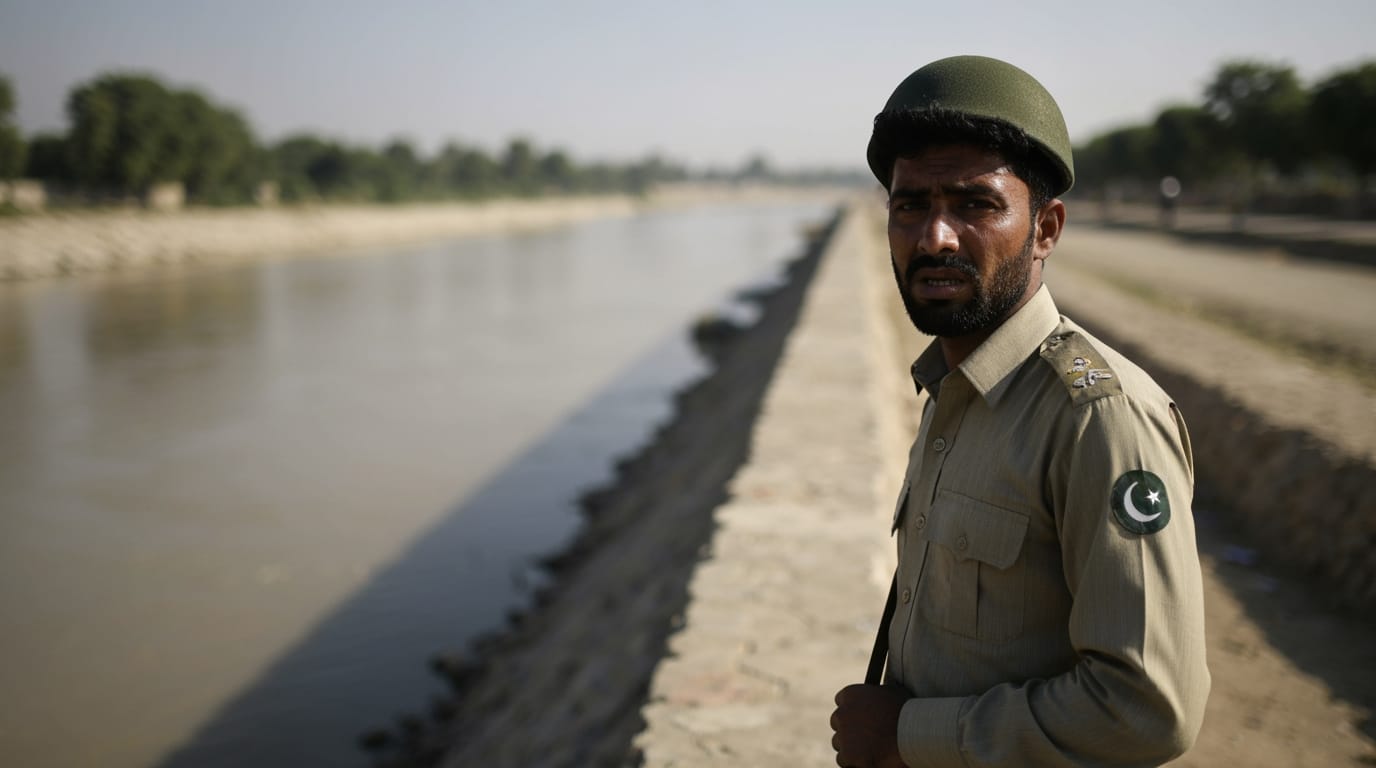
Islamabad, Dec. 19, 2025 — Pakistan has leveled grave accusations against neighboring India, alleging that New Delhi is "weaponizing water" by manipulating transboundary river flows, a move Pakistan contends violates a decades-old water-sharing treaty and threatens to trigger a humanitarian crisis. The charge marks a significant escalation in an already tense bilateral relationship, drawing international attention to the fragile management of vital shared water resources in South Asia.
Pakistan's Deputy Prime Minister, Ishaq Dar, articulated these concerns on Friday, asserting that India's actions, particularly irregular water releases from the Chenab River, are endangering the livelihoods of millions and undermining Pakistan's food and economic security. The allegations come amidst a backdrop of increasing water scarcity in both nuclear-armed nations, amplifying fears that control over shared rivers could become a flashpoint for conflict.
Escalating Tensions and Pakistan's Accusations
Deputy Prime Minister Dar specifically highlighted what he described as "unusual and abrupt" variations in the flow of the Chenab River, observed twice this year — between April 30 and May 21, and again from December 7 to 15. According to Dar, these irregular releases, allegedly without prior warning, are strategically timed to disrupt Pakistan's critical agricultural cycle. He warned that such "illegal and irresponsible conduct has the potential to trigger a humanitarian crisis in Pakistan."
Pakistan's Foreign Ministry had previously sought clarification from New Delhi regarding these events. Dar further claimed that India has ceased sharing advance hydrological data and joint oversight mechanisms, which are stipulated under the existing water-sharing agreement. This alleged lack of transparency, Pakistan argues, exposes the downstream nation to both flood and drought risks, exacerbating its already severe water challenges. Islamabad has informed the United Nations Secretary-General and the President of the U.N. General Assembly, urging their intervention to address the situation. Pakistan's National Security Committee had earlier this year declared that any attempt to stop or divert water flow to Pakistan would be considered an "act of war."
The Indus Waters Treaty: A Critical Lifeline Under Strain
At the heart of the dispute is the Indus Waters Treaty (IWT), a landmark agreement signed in 1960 and brokered by the World Bank. Considered one of the most successful international treaties, the IWT has historically managed to withstand multiple conflicts and periods of heightened tension between India and Pakistan, including wars in 1965 and 1971. The treaty meticulously divides the six rivers of the Indus River system. India was granted control over the Eastern Rivers — Ravi, Beas, and Sutlej — for unrestricted use. Pakistan, as the lower riparian state, was allocated control over the Western Rivers — Indus, Jhelum, and Chenab.
However, the IWT permits India certain "non-consumptive" uses of the Western Rivers, including domestic use, limited irrigation, and hydroelectric power generation, provided specific design parameters and operational constraints are adhered to. The treaty also established the Permanent Indus Commission (PIC), comprising a commissioner from each country, to facilitate cooperation and information exchange, and a three-tier mechanism for resolving disputes, involving a Neutral Expert and a Court of Arbitration for more complex disagreements.
The current flare-up follows India's unilateral suspension of the IWT in April, a decision made in response to a terrorist attack in Indian-controlled Kashmir that killed 26 tourists. While India cited "sustained cross border terrorism" for its decision, an international arbitration court, the Permanent Court of Arbitration in The Hague, recently ruled in June that the IWT does not allow for unilateral suspension by either party. This ruling reinforced the binding nature of the treaty and its compulsory third-party dispute settlement process.
India's Development Imperatives and Treaty Interpretations
India maintains that its water development projects on the Western Rivers are in full compliance with the provisions of the Indus Waters Treaty. Over the years, India has embarked on constructing several hydroelectric power projects on the Chenab and Jhelum rivers, including prominent ones like Salal, Baglihar, Dul Hasti, Pakal Dul, Ratle, Kiru, Kwar, and Sawalkote on the Chenab, and Kishanganga and Uri-I on the Jhelum. Many of these are run-of-the-river projects, designed to generate electricity using the natural flow of the river rather than significant water storage.
India views these projects as crucial for meeting its burgeoning energy demands and for enhancing its own water security, particularly in the northern states which are increasingly grappling with water scarcity. India faces an acute water crisis, with demand projected to surpass supply by 2050, driven by rapid population growth, industrialization, and uneven rainfall. Over-extraction of groundwater, pollution, and inefficient management practices further compound these challenges. From India's perspective, these projects are essential for its national development and water resource management, and they argue that they respect the treaty's limitations on water usage.
The Shadow of Scarcity and Geopolitical Fallout
The escalating water dispute between India and Pakistan is set against a grim backdrop of severe water scarcity plaguing both nations. Pakistan, identified as one of the most water-stressed countries globally, has seen its per capita water availability plummet dramatically since 1947, nearing absolute water scarcity thresholds. Over three-quarters of Pakistan's renewable water resources originate from outside its borders, making it highly vulnerable to upstream developments. Climate change is exacerbating this vulnerability, leading to unpredictable rainfall patterns, increased frequency of floods and droughts, and impacting glacial melt, which historically feeds the Indus system.
Similarly, India faces profound water challenges, with numerous states experiencing high to extreme water stress. The interplay of rapid population growth, industrial demand, and climate change effects, such as irregular monsoons, strains India's finite water resources.
The weaponization of water, whether actual or perceived, introduces an immensely destabilizing element into an already volatile region. Pakistan has explicitly warned that any major disruption to its water supply would have severe consequences for its agricultural sector and livelihoods for millions. The recent actions and counter-actions underscore a growing distrust that undermines the spirit of cooperation enshrined in the IWT. International law provides frameworks for peaceful resolution of transboundary water disputes, often emphasizing negotiation, mediation, and arbitration. The World Bank has historically played a facilitative role in these mechanisms, and there have been calls for renewed mediation to address the current deadlock and safeguard hydrological data sharing.
Conclusion
The current accusations by Pakistan regarding India's alleged "weaponization of water" mark a perilous moment in the protracted India-Pakistan relationship. The Indus Waters Treaty, a testament to diplomatic perseverance in a conflict-ridden region, is under unprecedented strain. While India emphasizes its developmental needs and adherence to treaty clauses for its hydroelectric projects, Pakistan views any unilateral changes in water flow or data sharing as a direct threat to its national security and humanitarian stability. The profound water scarcity facing both nations, intensified by climate change, elevates the stakes of this dispute beyond conventional geopolitical rivalry. A renewed commitment to the IWT's dispute resolution mechanisms, along with genuine dialogue and transparency, will be crucial to de-escalate tensions and prevent water from becoming a catalyst for further conflict in South Asia. The international community watches closely, recognizing that the future stability of the region hinges significantly on the cooperative and equitable management of its shared waters.


