Philippine House Impeaches Vice President Sara Duterte, Setting Stage for Senate Trial
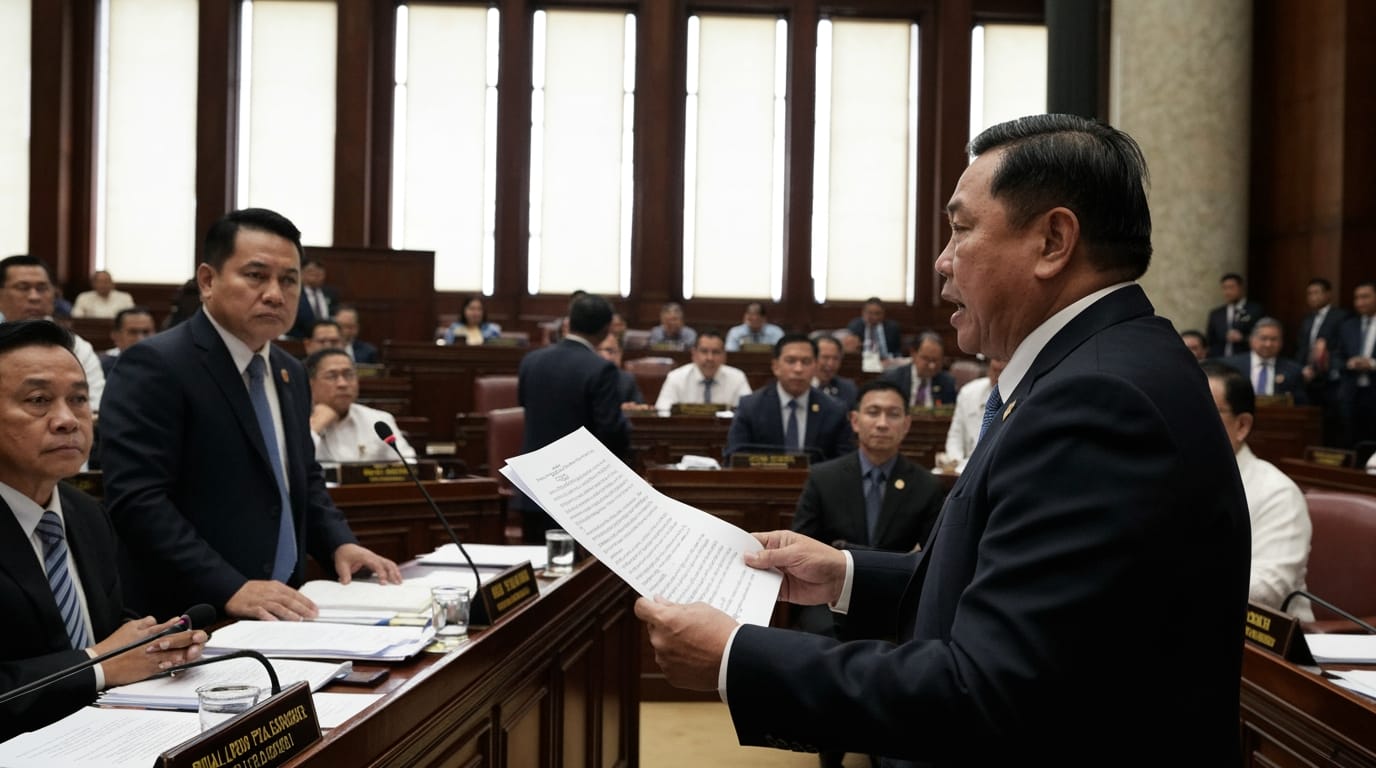
MANILA, Philippines – The political landscape of the Philippines is poised for a significant upheaval as the House of Representatives has voted to impeach Vice President Sara Duterte, the daughter of former President Rodrigo Duterte. The decisive vote on Monday, May 11, 2026, propels the high-stakes proceeding to the Senate, where a trial will determine the Vice President's political future and potentially reshape the contest for the 2028 presidential elections. The impeachment move underscores a deepening rift within the nation's ruling elite, particularly between the Marcos and Duterte dynasties, once formidable political allies.
The impeachment complaints against Vice President Duterte center on allegations of misuse of confidential funds, unexplained wealth, and grave betrayal of public trust. The House's overwhelming vote to impeach, with 255 of 318 lawmakers backing the measure, surpasses the one-third threshold required by the Philippine Constitution to advance the process to the Senate. This development follows months of escalating tensions and public scrutiny over her handling of public funds and her increasingly strained relationship with President Ferdinand Marcos Jr. and his allies.
The Charges: Confidential Funds, Unexplained Wealth, and Alleged Threats
At the heart of the impeachment proceedings are multiple serious allegations that collectively paint a picture of impropriety and abuse of authority. A key accusation revolves around the alleged misuse of confidential funds allocated to the Office of the Vice President (OVP) and the Department of Education (DepEd) during her tenure as Education Secretary. Specific concerns have been raised regarding ₱612.5 million in confidential funds, with some reports citing ₱254.9 million in "ghost expenses" for 2022 and 2023. The Commission on Audit (COA) reportedly flagged ₱112 million in confidential funds spent within 11 days in 2023, raising initial alarms. Manila Rep. Joel Chua, a proponent of the impeachment, cited audit findings including notices of disallowance for ₱73 million in confidential funds in late 2022 and ₱375 million for the first three quarters of 2023, noting that an appeal for the former had been denied due to insufficient justification of expenses.
Beyond the confidential funds, allegations of unexplained wealth have also surfaced. Lawmakers, including Rep. Chua, pointed to alleged discrepancies in Vice President Duterte's Statements of Assets, Liabilities, and Net Worth (SALN) when compared to her and her husband's bank transactions over two decades. Concerns were raised about millions in declared cash and bank deposits from 2007 to 2018 suddenly appearing as "zero" from 2019 to 2024, with the defense attributing this to consolidation under "others," an explanation that critics find unconvincing given the declared amounts. Additionally, SEC records reportedly showed businesses linked to Duterte and her husband either operating at a loss or with minimal earnings, further fueling questions about the source of their funds.
Perhaps the most startling allegation involves purported assassination threats made by Vice President Duterte against President Marcos Jr., First Lady Liza Marcos, and then-House Speaker Martin Romualdez, a cousin of the President. Rep. Gerville Luistro, who chairs the House Justice Committee, cited these threats, reportedly made during an online news conference in 2024, as a basis for impeachment, escalating the political disputes between the former running mates. Duterte has denied these specific allegations, categorizing the proceedings as politically motivated. Other charges include involvement in extrajudicial killings of drug suspects, mirroring accusations against her father, and a perceived failure to assert the Philippines' sovereignty in the West Philippine Sea dispute.
The Impeachment Process: A Constitutional Mechanism
The impeachment process in the Philippines is a two-stage constitutional mechanism designed to hold high-ranking officials accountable for serious offenses. It begins in the House of Representatives, which holds the exclusive power to initiate impeachment proceedings. A verified complaint can be filed by any House member, or by a citizen with the endorsement of a House member. For the process to advance, at least one-third (currently 102) of the House members must sign the complaint.
Once the complaint meets the numerical threshold, the House Committee on Justice reviews its sufficiency in form and substance. If deemed sufficient, the committee determines if probable cause exists. Following a finding of probable cause, the House of Representatives votes on the articles of impeachment. A vote of at least one-third of all members of the House is required to approve the impeachment resolution, which then transmits the articles of impeachment to the Senate. In this recent development, 255 lawmakers, well over the one-third requirement, voted to impeach Vice President Duterte.
Upon transmittal, the Senate convenes as an impeachment court, with its members acting as jurors. The House of Representatives appoints a panel of prosecutors to present the case, while the impeached official is represented by their chosen counsel. Conviction and removal from office require a two-thirds majority vote of all Senate members. If convicted, the official is not only removed but can also be permanently disqualified from holding future public office.
A Precedent and Political Ramifications
This is not the first time Vice President Duterte has faced impeachment efforts. A prior attempt in 2025 was ultimately declared unconstitutional by the Supreme Court due to the "one-year bar rule," which stipulates that no impeachment proceedings can be initiated against the same official more than once within a year. The current impeachment bid, however, is a renewed effort that commenced after the lapse of this constitutional provision, demonstrating persistent determination among her critics.
The impeachment proceedings unfold against a backdrop of intense political rivalry between the Marcos and Duterte families, who were once united by their successful 2022 election campaign. That alliance, often described as one of convenience, has visibly fractured, marked by public disagreements and a deepening animosity. This political rupture has significant implications for the 2028 presidential elections, where Vice President Duterte is widely considered a leading contender. Her removal from office, or even a sustained impeachment trial, could severely damage her political prospects and fundamentally alter the succession landscape.
President Marcos Jr. has largely distanced himself publicly from the impeachment proceedings, but the legislative actions by his allies in Congress speak to the shifting political alliances. The process could be viewed by some as an attempt to neutralize a formidable political opponent, thereby consolidating the power of the incumbent administration and its allies. Conversely, Vice President Duterte's supporters frame the impeachment as a politically motivated attack aimed at stifling her presidential ambitions. Public opinion on the impeachment has reportedly been lukewarm, with a February survey indicating that a minority of respondents supported it.
Conclusion: A Defining Moment for Philippine Politics
As the impeachment case now moves to the Senate, the nation watches closely. The upcoming trial is more than just a legal battle; it is a profound political test for the Philippines' democratic institutions. The outcome will not only determine the fate of Vice President Sara Duterte but could also set crucial precedents for accountability mechanisms, the use of confidential funds, and the balance of power within the government.
The proceedings are expected to intensify existing political rivalries and could either reinforce institutional accountability or deepen political polarization, depending on public perception of its fairness and transparency. Regardless of the final verdict, this impeachment saga has already highlighted the volatile nature of Philippine politics and the deep divisions within its leadership, promising to shape the country's political trajectory for years to come.


