Polish Jets Intercept Russian Spy Plane Over Baltic Amid Heightened Regional Tensions
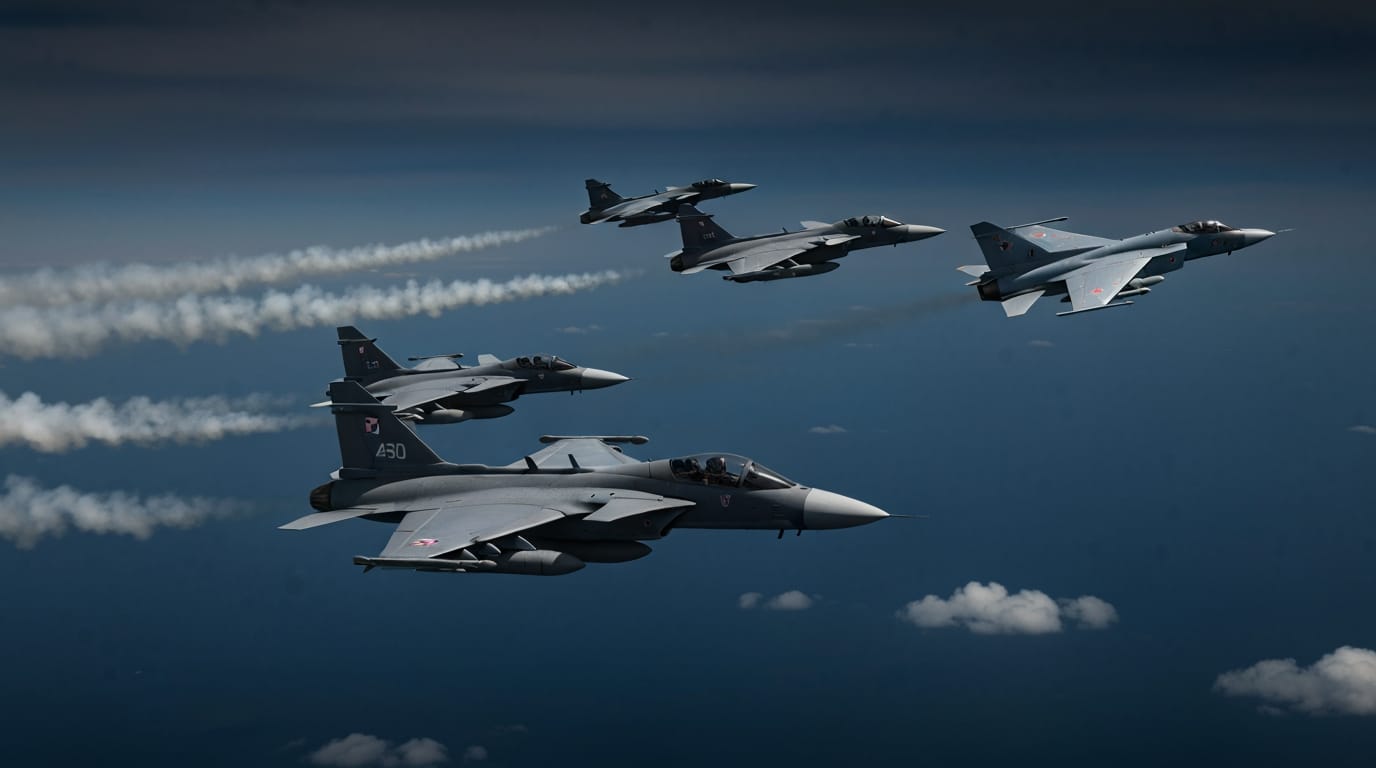
Warsaw, Poland – Polish fighter jets scrambled on Christmas Day to intercept a Russian reconnaissance aircraft flying near the nation's airspace over the Baltic Sea, an incident that underscores escalating tensions and the constant vigilance required on NATO's eastern flank. The interception coincided with a wave of unidentified objects, believed to be smuggling balloons, crossing into Polish territory from Belarus overnight, prompting Polish authorities to suggest a coordinated provocation during the holiday season.
The aerial encounter, which saw Polish pilots visually identify and escort the Russian aircraft, occurred over international waters, preventing any violation of Polish sovereign airspace. This event is the latest in a series of frequent incidents involving Russian military aviation operating in proximity to NATO borders, often without standard flight protocols, contributing to an increasingly unpredictable security environment in the Baltic region.
Christmas Day Scramble: A Routine Yet Significant Interception
On the morning of December 25, Polish fighter jets were dispatched in response to the detection of a Russian reconnaissance aircraft operating over the international waters of the Baltic Sea. The Polish military confirmed that its pilots successfully intercepted, visually identified, and subsequently escorted the Russian plane away from their area of responsibility, emphasizing that the aircraft did not infringe upon Polish airspace. Such missions are a routine but critical aspect of NATO's air policing efforts, designed to ensure the integrity and security of alliance airspace.
The Russian aircraft, typically an Ilyushin Il-20 reconnaissance plane or similar, often flies without a filed flight plan, with its transponder turned off, and without communicating with air traffic control – practices that NATO officials consistently describe as high-risk behavior. These flight patterns complicate identification and pose potential hazards to civilian air traffic, especially in a busy region like the Baltic Sea. The quick reaction of the Polish Air Force highlights the nation's commitment to maintaining airspace security, even during public holidays.
Coordinated Hybrid Threat: Balloons and Reconnaissance
Adding a layer of complexity and concern to the Christmas Day incident was the simultaneous report of numerous unidentified objects entering Polish airspace from neighboring Belarus during the preceding night. After detailed analysis, Polish authorities concluded these objects were most likely smuggling balloons, drifting with wind currents.
However, Poland's National Security Bureau pointed to the timing – during the special holiday season – the mass nature of the airspace violation, the Russian aircraft's activity in the Baltic Sea, and similar recent incidents in Lithuania as indicators of a potential "provocation disguised as a smuggling operation." This assessment aligns with concerns regarding "hybrid attacks" in the region, where unconventional tactics are employed to test NATO's defenses and create disruption. Lithuania has previously reported similar issues with smuggling balloons from Belarus, which have even forced temporary airport closures. As a precautionary measure, parts of the airspace over Poland's Podlaskie region, bordering Belarus, were temporarily closed to civilian air traffic to ensure public safety.
NATO's Enduring Vigilance on the Eastern Flank
The recent events underscore the ongoing need for NATO's robust air policing mission, particularly along its eastern flank. NATO member states, including Poland, operate under a constant state of readiness, with fighter aircraft and crews on duty 24/7 to respond to potential airspace violations and suspicious flights. The Baltic Sea region, strategically significant due to the Russian exclave of Kaliningrad, is a frequent flashpoint for such encounters. Russian military aircraft regularly fly from mainland Russia to Kaliningrad and vice versa, often intentionally bypassing international aviation safety norms.
In 2023 alone, NATO air forces across Europe scrambled well over 300 times to intercept Russian military aircraft approaching Alliance airspace, with the majority of these incidents occurring over the Baltic Sea. These intercepts are primarily in response to Russian aircraft operating unpredictably, often without transponder codes or flight plans. While most aerial encounters are reported as "safe and professional," the persistent pattern of unannounced flights and the recent incursions from Belarus maintain a heightened state of alert. NATO has substantially reinforced its air defenses and surveillance capabilities along its eastern border following Russia's full-scale invasion of Ukraine in 2022.
Broader Implications for Regional Security
The recurring nature of these incidents reflects the volatile geopolitical landscape in Eastern Europe, intensified by the ongoing conflict in Ukraine. Polish officials, including Defense Minister Władysław Kosiniak-Kamysz, have repeatedly highlighted the strategic importance of the Baltic Sea area and the necessity of protecting critical infrastructure and maintaining open communication and trade routes. Past incidents have seen Polish F-16s intercept Russian Il-20 reconnaissance aircraft and MiG-29s scramble to visually identify Russian planes operating without flight plans and transponders in international airspace. In May 2025, Polish fighter jets even intercepted a Russian Su-24 bomber described as performing "dangerous" maneuvers over the Baltic Sea.
The combination of direct military probes and more ambiguous "hybrid" tactics, such as the suspected smuggling balloons, presents a multifaceted challenge to NATO's collective defense. Western analysts suggest that Russia's flights near NATO borders are often aimed at probing Alliance resolve and readiness rather than direct combat power projection. Poland, sharing a border with both Ukraine and Belarus, remains a critical hub for NATO's presence and logistics, making its airspace a sensitive zone. The continuous monitoring and rapid response capabilities demonstrated by the Polish Air Force are vital in deterring potential aggressions and reassuring allies of NATO's unwavering commitment to collective security.


