Pop Art Meets Classical Titan: Warhol’s Beethoven Takes Center Stage in Bonn
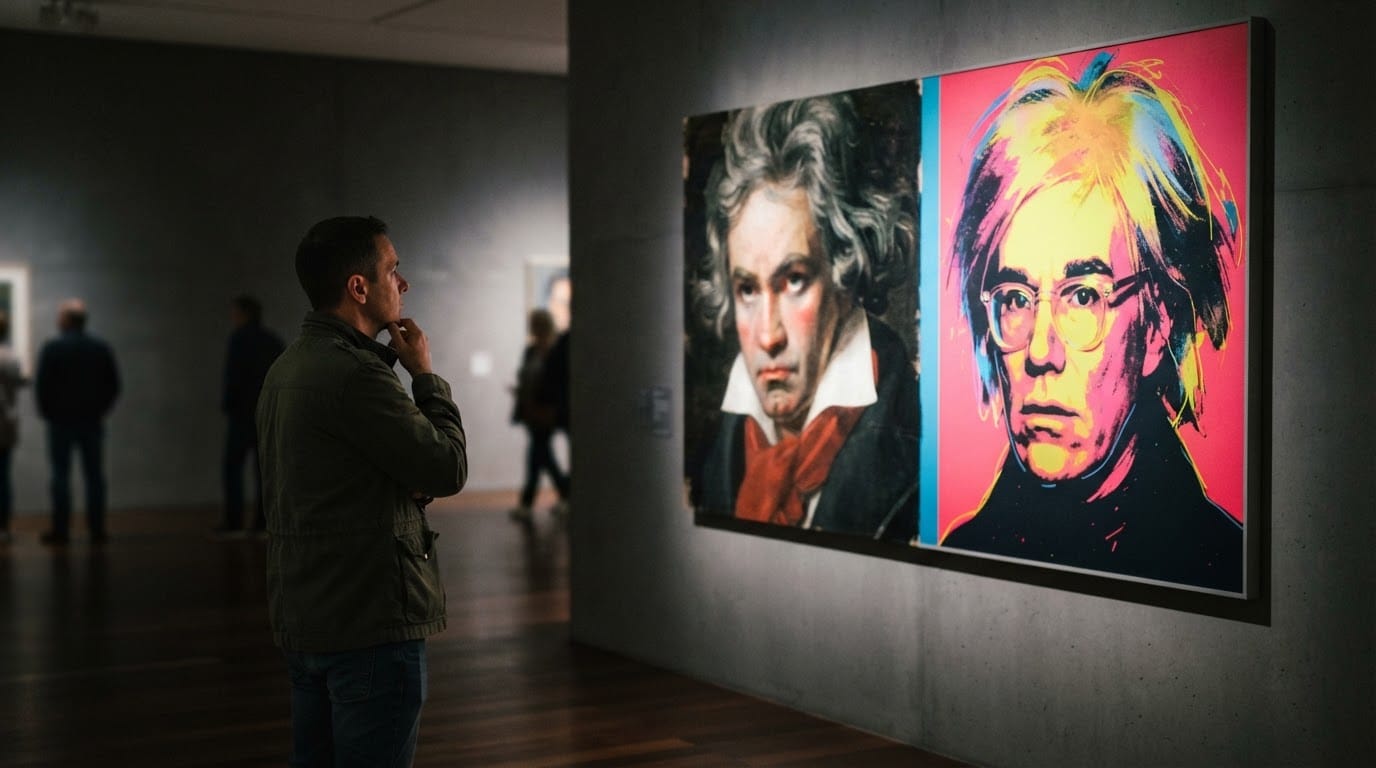
BONN, Germany — Two cultural mavericks separated by more than a century have converged in the former West German capital. A major special exhibition at the Beethoven-Haus in Bonn brings together the revolutionary spirit of classical composer Ludwig van Beethoven and the trailblazing vision of Pop Art pioneer Andy Warhol.
The presentation, titled "Beethoven by Warhol," marks a rare convergence of classical musical tradition and late-twentieth-century visual culture. Running through April 2027, the showcase highlights more than 100 works, many on view to the public for the first time. The timing is deliberately symbolic, serving as the official curtain raiser for an approaching double milestone: the 200th anniversary of Beethoven’s death and the 40th anniversary of Warhol’s passing, both occurring in 2027.
A Masterpiece Created in the Shadow of Mortality
At the core of the exhibition is Warhol’s famed 1987 silkscreen portfolio depicting Beethoven, finished mere weeks before the American artist died unexpectedly on February 22, 1987, at age 58. The series represents one of Warhol’s final printmaking endeavors and stands as the culmination of his celebrated body of portraiture.
Warhol was widely known for immortalizing consumer products and contemporary celebrities, ranging from Campbell’s soup cans to Marilyn Monroe and Elvis Presley. Turning his gaze toward Beethoven marked a deliberate shift. Rather than focusing on a Hollywood personality or political leader, Warhol tackled a figure whose face had become an enduring brand across centuries.
The visual foundation for Warhol’s series was the well-known 1820 portrait of Beethoven by Joseph Karl Stieler. In Stieler's original oil painting, the composer fixes his gaze forward, quill in hand, radiating intense concentration. Warhol transformed this familiar likeness by overlaying it with vibrant hues and silk-screened musical notation from the original manuscript of the "Moonlight Sonata" (Piano Sonata No. 14). In doing so, he stripped away the severe, unyielding image common in nineteenth-century busts and replaced it with an electric, modern aura.
The Cold War Rhineland Connection
The exhibition also illuminates a pivotal yet frequently overlooked cultural bridge that linked mid-century New York to the Rhineland during the era of the Bonn Republic. The idea to render Beethoven through Warhol’s lens did not originate in an American studio, but through the persistent efforts of prominent Bonn art dealer Hermann Wünsche.
Beginning in the 1970s, Wünsche established close personal and business ties with Warhol, repeatedly bringing the artist across the Atlantic to West Germany. Wünsche convinced Warhol to create commissioned portraits of several key German cultural and public personalities.
Their collaboration culminated in the Beethoven commission. Historical records and archival materials in the display reveal that Wünsche personally gathered source material for Warhol, securing reproduction rights and historical imagery directly from the Beethoven-Haus in Bonn. While Warhol completed the print run in early 1987, the completed portfolio was not unveiled to the public until 1989, when it premiered at the Beethovenhalle as part of the celebrations marking Bonn’s 2,000th anniversary.
Rare Archives and Forgotten Proofs
Beyond the widely recognized four-part screen print portfolio, the exhibition offers an exhaustive retrospective of the creative process behind the imagery. Visitors can examine roughly 100 objects, including experimental color trial proofs, early sketches, vintage record sleeves, and promotional materials.
Among the standout inclusions is a previously uncataloged Beethoven portrait on canvas, shown publicly for the first time. The exhibition demonstrates that Warhol experimented through at least 72 distinct variations of color and layering while refining how the musical stave notes of the "Moonlight Sonata" crossed Beethoven's countenance.
The presentation has taken over the whole museum complex, uniting Warhol's prints with original Beethoven relics, autographed scores, and personal artifacts. This direct physical juxtaposition allows museumgoers to trace how an archival sheet preserved inside the historic birth home evolved into an international pop icon.
A Dual Anniversary With National Backing
The cultural initiative has garnered considerable institutional support, framed as the opening salvo for Germany’s broader 2027 commemorative festivities. The federal government provided approximately 900,000 euros specifically to support the exhibition and its associated programming at the Beethoven-Haus. The sum forms part of an allocated 2.3 million euro federal package earmarked for national Beethoven anniversary initiatives leading up to 2027.
The project has also drawn substantial regional attention as the city of Bonn reaffirms its artistic heritage. After nearly ten years of extensive renovations, the nearby Beethovenhalle concert hall is returning to service, re-establishing a vital hub for festivals, touring orchestras, and visual art events. Organizers see the Warhol exhibition as a bridge to younger and more diverse audiences who might otherwise see eighteenth- and nineteenth-century classical music as static or remote.
Two Revolutionaries Bound by Cultural Myth
Ultimately, the exhibition reveals that Beethoven and Warhol were kindred spirits in disrupting their respective mediums. Beethoven shattered Classical conventions, expanding orchestral scale, harmonic tension, and expressive volume to pioneer the Romantic movement. Warhol radically challenged traditional ideas of artistic originality by adopting commercial print techniques and exalting mass production into high art.
Both figures attained an aura that often threatened to obscure their underlying artistry. By filtering Germany’s greatest symphonic rebel through the eye of America's master of mass culture, the Bonn exhibition demonstrates that great creative disruption remains timeless, regardless of whether it is composed on staff paper or printed on canvas.