Pope Leo XIV Bows to Migrants' Dignity in Gran Canaria, Urging Global Conscience on Deadly Atlantic Route
The current time is Thursday, June 11, 2026, 5:00:36 PM UTC.
Pope Leo XIV Bows to Migrants' Dignity in Gran Canaria, Urging Global Conscience on Deadly Atlantic Route
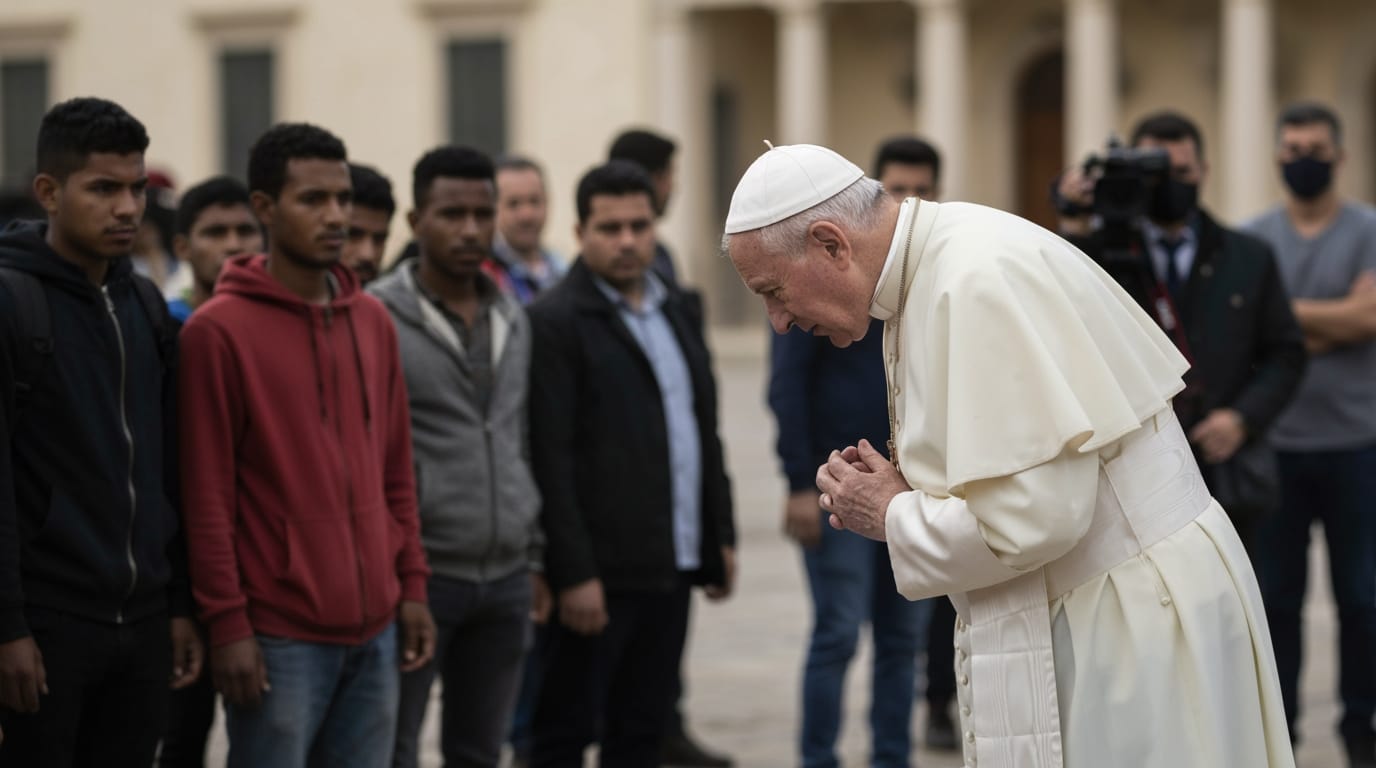
ARGUINEGUÍN, GRAN CANARIA – In a historic and emotionally charged visit to Spain's Canary Islands, Pope Leo XIV today made an impassioned plea for human dignity, condemning the global indifference to the plight of migrants traversing the perilous Atlantic route. Arriving in Gran Canaria, the Pontiff’s first act was to visit the Port of Arguineguín, a site once dubbed the "port of shame" due to the squalid conditions endured by thousands of desperate arrivals, where he profoundly declared his reverence for the human spirit of those seeking a new life. His gesture of bowing before the migrants underscored a central message: human dignity transcends borders and circumstance, demanding a collective re-evaluation of migration policies and humanitarian responses.
A Pontiff's Historic Arrival at Europe's Painful Frontier
Pope Leo XIV's arrival on Canary Island soil marked the first time a Roman Pontiff had visited the archipelago, imbuing his journey with immediate historical significance. Stepping off the plane at 11:51 a.m. local time on Thursday, the Pope was received by high-ranking Spanish authorities before heading directly to the Port of Arguineguín. This location, a crucial entry point on the Atlantic migration route, served as the stark backdrop for his powerful address. In 2020, Arguineguín gained notoriety for its overcrowding, with migrants forced to sleep on docks in makeshift camps, often without adequate sanitation or legal assistance for weeks, leading many to brand it the "dock of shame."
During his visit, Pope Leo XIV met with rescue workers, humanitarian volunteers, and migrants themselves, listening to their harrowing testimonies. He notably bent his head slightly, proclaiming, "Dear migrants: before saying any other word to you, I want to bow before your dignity. You are not numbers or files. You are people with a family and a home left behind; with dreams that no one has the right to despise." This profound act of humility and respect set the tone for his message, reminding the world that each migrant represents a unique story of struggle and hope. Following his speech, the Pontiff approached the water's edge and cast a wreath of flowers into the sea, a poignant tribute to the thousands who have perished attempting the treacherous journey, echoing a similar gesture made by Pope Francis in Lampedusa in 2013. He also blessed a cross crafted from pieces of migrant boats, a powerful symbol of resilience and faith amidst immense suffering.
The Perilous Atlantic Route: A Humanitarian Crisis Unfolding
The Atlantic migration route to the Canary Islands has become one of the deadliest in the world, with experts indicating it may even surpass the fatality rates of the more widely known central Mediterranean route. Migrants, often fleeing hunger, war, poverty, and exploitation in West African nations such as Senegal, Mauritania, Gambia, Mali, and Morocco, embark on journeys spanning over 1,600 kilometers in fragile boats known as 'cayucos' or 'pateras'. These voyages are fraught with extreme danger, claiming countless lives, many of whom are never identified, becoming part of the "invisible shipwrecks" the Pope highlighted.
The humanitarian crisis reached a peak in 2024, with nearly 47,000 migrant arrivals in the Canary Islands. While figures for the first five months of 2026 show a dramatic reduction to just over 3,000, this decrease comes after significant pressure and agreements between the European Union, Spain, and West African governments, raising questions about the human cost of deterrence strategies. Pope Leo XIV sharply criticized the "monsters" that still haunt these seas: "mafias that profit from despair, traffickers who enslave women and children, and those whose indifference allows the poor to be swallowed up by exploitation or forgetfulness." His words served as a sobering indictment of those who exploit human vulnerability and the systems that permit such exploitation to persist.
Upholding Dignity: A Universal Right Without Passport
Central to Pope Leo XIV's address was the unequivocal assertion that "Human dignity has no passport and does not lose its value when crossing a border." This statement challenged prevailing narratives that often strip migrants of their humanity, reducing them to statistics or legal issues. The Pontiff emphasized that managing arrivals, counting statistics, reinforcing borders, or mourning deaths after they occur is insufficient. Instead, he called for "legal and safe pathways, rescue and assistance, protection for victims of trafficking, serious reception and integration, and policies that allow people to remain in their own countries with dignity."
Testimonies heard at the port profoundly influenced the Pope's message. Tito Villarmea, a captain with Salvamento Maritimo, shared his experiences rescuing over 20,000 people in 18 years, recalling a particularly moving instance where a rescued mother revealed her 'son' was actually a daughter, illustrating the desperate measures families take. A Nigerian woman, a victim of human trafficking forced into prostitution in Spain after her baby was taken, provided a harrowing account of her journey, underscoring the deep human cost. Pope Leo XIV directly addressed women trafficked and forced into prostitution, assuring them, "If others have put a price on your body, know that God has never ceased to recognize your inestimable worth." These personal stories amplified the Pope's call for compassionate action, moving the focus from abstract policy to individual suffering.
A Call to Conscience and Global Action
Pope Leo XIV's visit transcended a mere pastoral call; it was a potent challenge to the conscience of nations and international bodies. He insisted that while there is a "right to seek refuge," there is also a profound "right not to have to migrate." This duality places responsibility not only on host nations to provide dignified reception but also on countries of origin to foster conditions of security and economic stability that negate the need for forced displacement. The Pontiff urged transit countries to protect migrants from falling prey to smugglers and for the international community to engage in genuine cooperation against human trafficking.
His condemnation of "indifference" echoed previous papal warnings against a "globalization of indifference," arguing that Europe, and indeed the world, "cannot claim to uphold human dignity while growing accustomed to the Mediterranean and the Atlantic becoming unmarked graves." This strong message implicitly targeted leaders, including those professing Christian values, who might turn away migrants with callous disregard. The Pope's visit served as a powerful reminder that humanitarian crises demand a response rooted in shared humanity, transcending political expediency or economic considerations.
Pope Leo XIV's historic visit to Gran Canaria was more than a symbolic gesture; it was a fervent appeal to humanity's collective conscience. By physically bowing before migrants and casting a wreath into the sea, he brought the abstract concept of human dignity to the forefront of a pressing global crisis. His words from the "dock of hope," as Arguineguín was symbolically re-dubbed by a banner during his visit, are a resounding call to move beyond statistics and political rhetoric, to recognize the inherent worth of every individual, and to work collaboratively towards creating a world where no one is forced to embark on such deadly journeys, and where those who do are met with compassion, safety, and respect. The Pontiff's impassioned plea underscores that genuine human progress is measured not by economic prosperity alone, but by how societies treat their most vulnerable.


