Protesters Converge on Berlin as Private Equity Elite Gathers for SuperReturn International
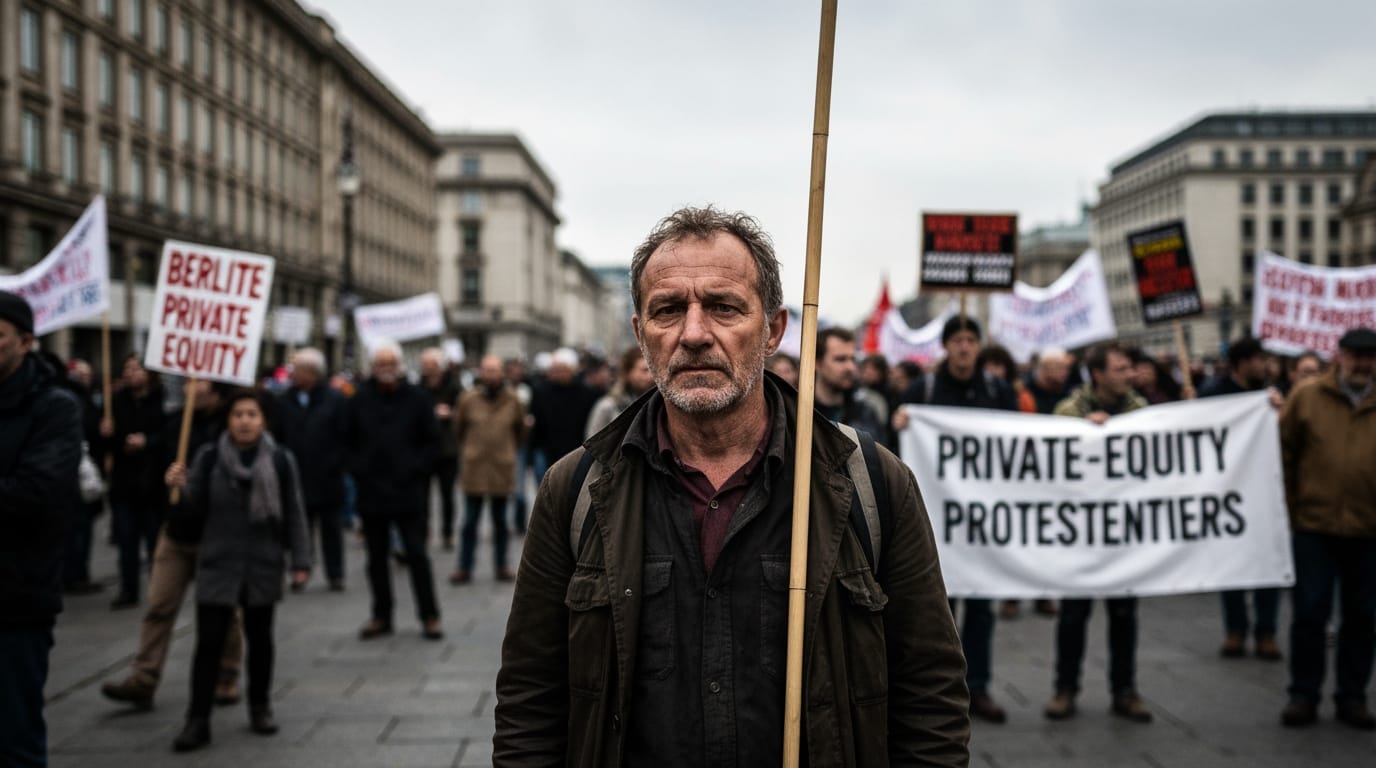
Berlin, Germany – The global capital of private equity, Berlin, became a focal point of dissent on Monday, June 8, 2026, as a coalition of advocacy groups staged a protest against the annual SuperReturn International conference. While thousands of the world's most influential private capital professionals convened behind the closed doors of the InterContinental Hotel, demonstrators outside voiced strong criticisms, accusing the industry of prioritizing short-term profits over public welfare and exacerbating social inequalities.
The protest, organized by a broad alliance including Attac Deutschland, the Arbeitsgemeinschaft bäuerliche Landwirtschaft (AbL), and the Berliner Bündnis Gesundheit statt Profite, among others, adopted the powerful slogan "Schurken stoppen – Gemeinwohl stärken" (Stop villains – Strengthen the common good). Their actions aimed to draw public attention to the significant, often controversial, impact of private equity firms on critical sectors such as healthcare, housing, pensions, and agriculture, which they argue are increasingly treated as mere commodities for speculation and profit.
The Summit: A Conclave of Capital
SuperReturn International is widely recognized as the premier global gathering for professionals in private capital, drawing an impressive roster of attendees from across the globe. This year's event, hosted at the InterContinental Hotel, reportedly brought together over 6,000 participants from more than 80 countries. The attendees included over 2,000 limited partners (LPs) – such as pension funds, endowments, and sovereign wealth funds – collectively managing an estimated $50 trillion in assets, alongside more than 3,000 general partners (GPs) who represent the private equity firms themselves. A significant majority, 81 percent, of the audience comprised C-level executives, partners, and directors from leading firms, underscoring the high-level nature of the discussions.
The conference agenda spanned a wide array of topics crucial to the private capital landscape, including technological innovation, environmental, social, and governance (ESG) factors, private credit, and secondary markets. Specialist summits delved deeper into areas like German private equity, climate and energy, and tech value creation, reflecting the industry's evolving interests and investment priorities.
Voices of Dissent: The Case Against Private Equity
The demonstration on June 8 highlighted long-standing criticisms against the private equity industry, particularly its perceived negative social consequences. Protesters emphasized that while private equity champions rapid financial returns, this often comes at the expense of workers, communities, and essential public services.
A central grievance revolves around job security and working conditions. Critics point to studies indicating that private equity takeovers frequently lead to job losses, with one 2019 study finding an average of 4.4 percent job reductions within two years of acquisition compared to control companies. They argue that while private equity firms acquire companies employing millions, they do not necessarily create new jobs; instead, their focus on "efficiency" often translates into reduced wages, benefits, and staffing, particularly in industries with large numbers of low-wage workers like food service, retail, security, and healthcare. Past instances in Germany have seen private equity firms labeled "locusts" by politicians, a term used to describe entities that "asset strip" companies, prioritize short-term gains, and potentially damage long-term economic prospects by moving jobs or cutting costs.
The opaque nature of private equity operations and its less regulated environment also fueled the protesters' concerns. They suggest that the rapid "quick flips" – where private equity investors generate significant returns over short periods of ownership – demonstrate a focus on financial engineering rather than sustainable business development. The protesters' specific mention of healthcare, housing, and agriculture underscores worries about private capital converting fundamental necessities into profit-driven ventures, potentially making them less accessible or affordable for the general public.
The Industry's Defense: Economic Contribution and Growth
Conversely, the private equity industry consistently asserts its vital role in economic growth and job creation. Reports from organizations like the American Investment Council and Ernst & Young LLP (EY) highlight that private equity-backed companies significantly contribute to national economies. In the U.S., for instance, private equity directly employed 13.3 million workers in 2024, an increase from 12 million in 2022. Workers at these companies earned an average of $85,000 in wages and benefits in 2024, a 6 percent rise from 2022 figures. Overall, private equity investments generated an estimated $2 trillion in U.S. gross domestic product (GDP) in 2024, accounting for approximately 7 percent of the total U.S. GDP.
Proponents argue that private equity is not the "job destroyer" it is often portrayed to be. They cite research suggesting that while there might be small, measurable declines in employment at individual PE-backed companies, these are often offset by gains from higher-quality new employment. Furthermore, they contend that private equity investments foster productivity and competitiveness within industries. By acquiring and restructuring companies, these firms can implement operational improvements, drive digital transformation, and infuse capital, ultimately making the entire industry more productive. The industry also points to its role as a stabilizing factor during economic downturns, providing crucial access to capital when traditional sources might hesitate.
The European private equity market, in particular, has shown resilience and growth, with transaction volumes surging even as the number of deals saw a slight decrease in 2025. Investment trends show a strong focus on technology, healthcare, and mid-market buyouts, with significant "dry powder" – uninvested capital – indicating continued potential for future investments. Optimism for the 2024-2025 buyout vintages remains high, with expectations of strong opportunities for value investors.
A Deep-Seated Debate
The protest in Berlin against SuperReturn International is a recent manifestation of a long-standing tension between the financial industry's pursuit of profit and public concerns about social equity and economic impact. While the private equity sector emphasizes its contributions to economic growth, job creation, and corporate efficiency, critics remain wary of its methods, particularly the potential for job losses, wage stagnation, and the commercialization of essential services.
The demonstrations serve as a reminder that as private capital continues to expand its influence globally, particularly in Europe where the market size is projected to reach $6.41 trillion by 2031, the scrutiny from civil society and policymakers will likely intensify. The ongoing debate reflects a fundamental divergence in perspectives: one focused on capital efficiency and shareholder value, the other on broader societal well-being and equitable distribution of wealth. This clash of ideologies ensures that conversations about the role and responsibility of private equity in the global economy will remain at the forefront for years to come.