Putin Declares Ukraine War 'Coming to an End' Amidst Fragile Ceasefire and Lingering Conflict
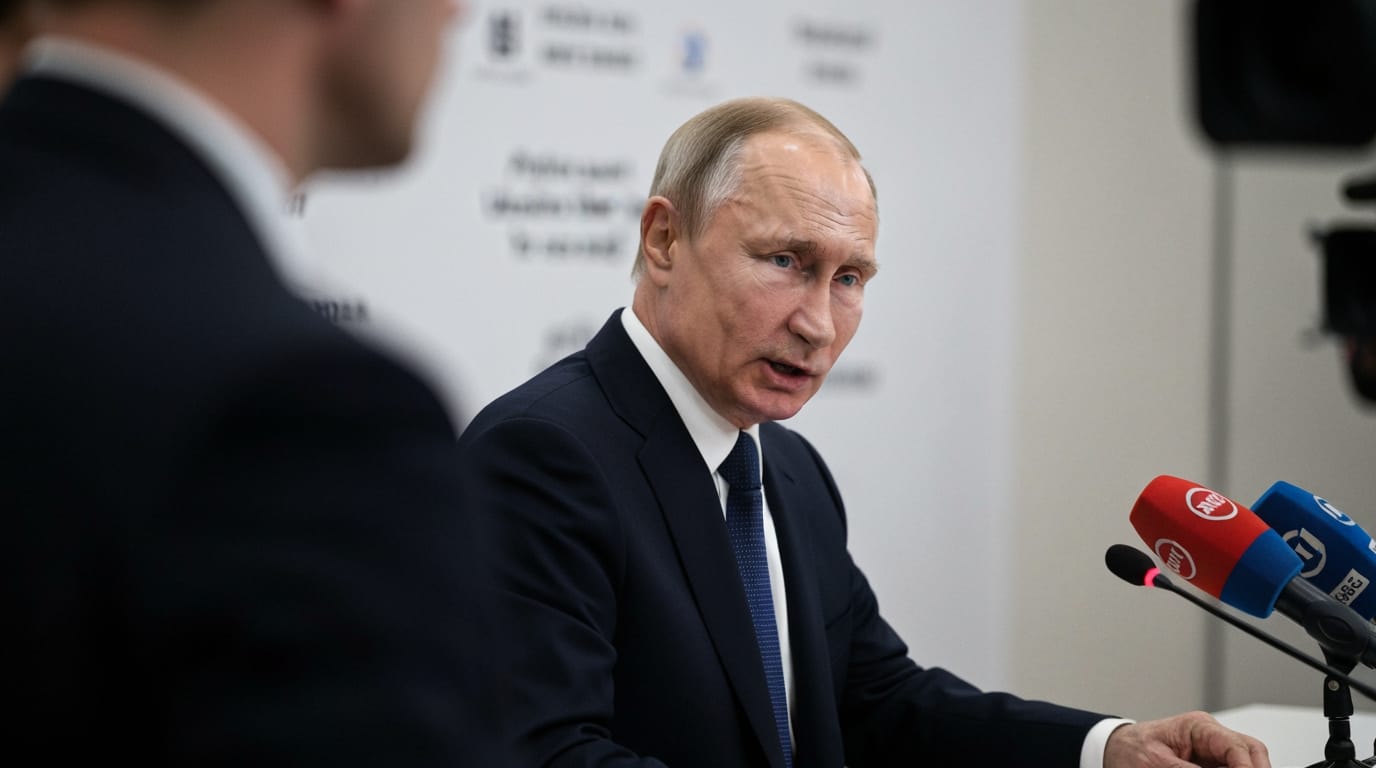
Moscow, Russia – Russian President Vladimir Putin announced Friday that he believes the protracted conflict in Ukraine is "coming to an end," a significant pronouncement made during Russia's Victory Day commemorations. The statement arrives as a fragile, U.S.-brokered ceasefire temporarily quiets parts of the front lines and international diplomatic efforts intensify, yet it clashes with the enduring realities of ongoing combat and deep-seated international skepticism regarding a swift resolution.
President Putin's remarks, delivered to journalists in Moscow on May 9, 2026, during the annual holiday marking the Soviet Union's triumph in World War II, suggested an anticipated conclusion to the nearly four-year-old war. His assertion came as Moscow hosted an unusually subdued Victory Day parade, notably devoid of tanks and heavy military equipment, with officials citing "the current operational situation" for the scaled-back display. This assertion of an approaching end to hostilities contrasts sharply with reports of continued fighting and complex diplomatic stalemates that have characterized the conflict.
The Russian leader expressed an openness to negotiations, specifically mentioning former German Chancellor Gerhard Schroeder as a preferred intermediary for discussions. He also indicated a willingness to meet with Ukrainian President Volodymyr Zelenskyy in a neutral third country, though he clarified that such a meeting would serve primarily to formalize an agreement rather than to engage in new rounds of negotiation. Putin reiterated long-standing Russian claims that the war's origins lie in Kyiv's aspirations to join the European Union and alleged Western provocations. These comments echo earlier statements from April 21, 2026, when Putin confidently declared that Russia "knows how it will end" for the conflict, albeit without publicly disclosing specific war objectives, hinting at a predetermined Russian victory.
The diplomatic landscape surrounding the conflict remains intricate and often contradictory. United States President Donald Trump recently announced a three-day ceasefire, effective from May 9 to May 11, 2026, coinciding with Victory Day celebrations, which also included provisions for a prisoner exchange involving 1,000 individuals from each side. Both Ukraine and Russia reportedly assented to this temporary truce. Putin conveyed gratitude to the U.S. for its role in facilitating these talks, yet underscored that the conflict's resolution ultimately rested between Russia and Ukraine. He also noted that Russia was awaiting a response from Kyiv regarding the proposed prisoner swap. Parallel to these developments, European Union leaders are reportedly preparing for potential discussions, though Moscow has maintained that European governments, having severed ties in 2022, must initiate any contact. Prior diplomatic attempts in 2025 and early 2026, including talks in Abu Dhabi and a U.S.-backed draft peace plan, have highlighted the persistent chasm between the two sides. Russia has consistently called for direct negotiations, maintaining that current proposals do not address its demands, while Ukraine has preferred U.S. mediation. A previous round of Geneva peace talks in February 2026 collapsed, with Russia reportedly demanding a Ukrainian withdrawal from the Donetsk region as a precondition for further discussions.
Despite the diplomatic overtures and Putin's declarations, the reality on the ground continues to be marked by intense fighting and significant human cost. Battlefield analysis from April 2026 indicated that Russia had lost territorial ground for the first time since summer 2024, a setback attributed to internal command and communication challenges within the Russian military. Ukrainian forces reportedly advanced on the southern front after SpaceX restricted Russia's access to its Starlink satellite system. However, Russia initiated a spring-summer offensive in mid-March 2026, targeting the "Fortress Belt" in Ukraine's eastern Donetsk region, though initial reports suggest "poor results" for Russian ground forces in these operations. Ukraine's critical energy infrastructure has sustained an estimated $25 billion in damage, with rebuilding costs projected to exceed $90 billion. Furthermore, Ukraine faces a reported shortage of air defense missiles, leaving it vulnerable to continued Russian aerial bombardments. Reports from the ceasefire period also indicated continued Russian assaults, with Russian forces claiming control of the village of Kryva Luka in Donetsk. Both sides have inflicted heavy casualties, with estimates suggesting nearly 1.2 million Russian casualties since February 2022 and between 500,000 and 600,000 Ukrainian casualties by December 2025. Combined casualties for both nations could reach 2 million by spring 2026. Russian territorial gains, when achieved, have been painfully slow, averaging between 15 and 70 meters per day in their most prominent offensives.
The conflict has triggered the most severe crisis in relations between Russia and the West since the 1962 Cuban Missile Crisis, deeply reshaping geopolitical alliances and international security structures. While many nations unequivocally condemned Russia's full-scale invasion in 2022, others, such as China and India, called for de-escalation and diplomatic dialogue. The Kremlin itself has acknowledged that despite U.S. eagerness for a peace deal, complex issues render a resolution distant, and talks are currently suspended. The stark divergence between President Putin's latest pronouncement and the prevailing assessment of the war's trajectory underscores the profound challenges in achieving a genuine and lasting peace.
In conclusion, President Putin's declaration that the Ukraine war is nearing its conclusion presents a narrative of an impending end to hostilities, juxtaposed against the grim realities of persistent fighting, heavy casualties, and a fractured diplomatic environment. While the U.S.-brokered ceasefire offers a glimmer of hope for de-escalation and prisoner exchanges, the fundamental disagreements over territorial integrity, security guarantees, and the future political landscape of the region remain unresolved. The road to a definitive end, accepted by all parties, appears to be fraught with significant obstacles, suggesting that a true cessation of this devastating conflict may still be a distant prospect.


