Rhine Drought Threatens German Economic Recovery as Water Levels Hit Record Lows
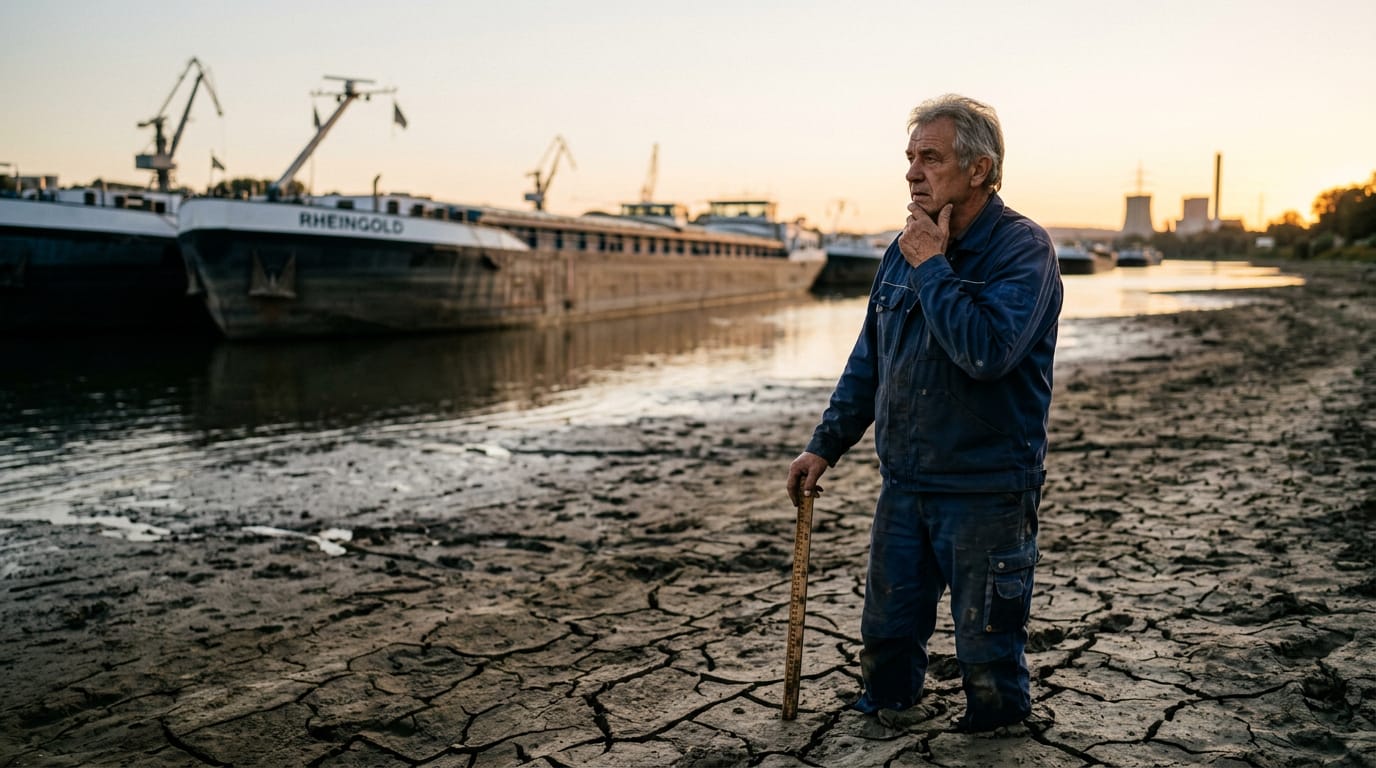
FRANKFURT, Germany – Germany's economic recovery, nascent but steady, faces a severe new challenge as record-low water levels on the Rhine River choke a vital artery of European trade and industry. Persistent drought and scorching summer heat have rendered large sections of the waterway barely navigable, disrupting supply chains, increasing transport costs, and forcing industrial giants to curb production, posing a significant threat to the nation's fragile growth trajectory.
The Rhine, a 1,233-kilometer (766-mile) river originating in the Swiss Alps and flowing to the North Sea, is more than just a waterway; it is an indispensable industrial backbone for Germany and neighboring countries. Roughly 80% of all goods transported on Germany's inland waterways rely on the Rhine, connecting key industrial clusters like Rhine-Ruhr steel, Rhine-Main, and the Ludwigshafen chemical complex to the global port of Rotterdam. Its strategic importance has historically positioned major industries along its banks, leveraging efficient barge transport for raw materials and finished goods.
The Lifeline Under Strain: Unprecedented Lows and Shipping Constraints
Water levels on the Rhine have plummeted to historically unprecedented lows, particularly at Kaub, a critical bottleneck between Mainz and Koblenz. On August 3, the gauge at Kaub registered just 24 centimeters (9.4 inches), marking the lowest level ever recorded and falling below the previous 2018 record. This alarming situation is occurring unusually early in the year, with little significant rainfall forecast to alleviate the crisis. Levels in other major river cities like Cologne and Duisburg have also fallen to or below previous record lows.
The direct consequence of these shallow waters is a drastic reduction in shipping capacity. Barges, which typically carry thousands of tons of cargo, are now limited to loading as little as 20% to 30% of their usual capacity to avoid running aground. To transport the same volume of goods, companies are forced to use multiple smaller vessels or increase the frequency of trips, leading to a surge in operational costs. For instance, shipping rates for petroleum products between Karlsruhe and coastal ports have soared to €200 per tonne, a dramatic increase from €45 just weeks prior. The logistical challenge is immense, with estimates suggesting that replacing a single barge's cargo could require up to 100 trucks or an entire freight train, options that Germany's existing road and rail infrastructure are ill-equipped to fully absorb.
Economic Ripple Effects Across Key Sectors
The disruption on the Rhine casts a long shadow over Germany's industrial landscape. Major sectors heavily reliant on the river for transporting raw materials like coal, chemicals, oil products, and steel, as well as for shipping finished goods, are feeling the immediate impact.
The chemical industry, a pillar of the German economy, is particularly vulnerable. Companies like Covestro, which depends on the Rhine for 75% of its raw material intake and over 30% of its manufactured product shipments, are reporting supply and production disruptions. Lanxess, another chemical firm, described the situation as "very difficult," with barge deliveries severely restricted and some loading areas inaccessible. Steelmakers, such as Thyssenkrupp, have already reduced hot-metal production at their Duisburg operations due to delays in raw material deliveries. The agricultural sector is also facing rising freight costs for essential goods like grain, animal feed, and fertilizers.
Economists are warning of a tangible hit to Germany's overall economic performance. The Kiel Institute for the World Economy found that a month of low water during the 2018 drought reduced inland shipping volumes by approximately 25% and industrial production by about 1%, ultimately shaving 0.3 percentage points off Germany's GDP growth. Experts from ING and the Kiel Institute for the World Economy project that the current situation, being more severe and prolonged, could result in a reduction of Germany's third-quarter GDP growth by 0.1 to 0.2 percentage points, with some estimates reaching 0.35% if low levels persist. This represents a significant setback for an economy that had just begun to show signs of a long-awaited recovery.
Amplifying Germany's Energy Challenges
The Rhine drought also exacerbates Germany's already complex energy situation. Barges are crucial for transporting coal to power plants, and the reduced navigability directly threatens the feedstock supply for some generators. This could lead to feedstock shortages, potentially tightening electricity supply during peak demand periods and putting upward pressure on wholesale power prices. Furthermore, low water levels can affect the cooling systems of thermal and nuclear power plants located along the river, further straining power generation capacity.
With the ongoing energy crisis stemming from geopolitical tensions, particularly regarding gas supplies, the disruption to coal transport presents an additional layer of vulnerability for Germany's energy security as it heads into the colder months.
A Recurring Crisis and the Path Forward
This is not Germany's first encounter with a debilitating Rhine drought; the events of 2018 served as a stark precursor. However, the current conditions are noted as more severe and occurring earlier in the year. Climate change is widely identified as a primary driver, leading to more frequent and intense periods of low water levels and higher water temperatures. Projections indicate that in the future, winter flows in the Rhine are expected to increase, while summer flows will decrease, largely due to a shift from snow and glacier melt to rainfall-dominated hydrological regimes.
In response, the German government, led by Transport Minister Steffen Bilger, has convened emergency meetings with industry executives, shipping companies, and port authorities to address the crisis. Discussions include accelerating projects to deepen critical sections of the Rhine, expanding alternative transport capacities such as rail, and prioritizing cargo. The government also launched a unified Low Water Information System (NIWIS) in July to provide real-time data on water levels, aiming for better resource management. Some industries have already adapted by acquiring low-water optimized ships and increasing storage capacities, demonstrating a growing awareness of the need for resilience against climate-induced disruptions. However, these adaptations may not be sufficient to fully offset the scale of the current challenge.
Conclusion
The severe Rhine drought is more than an environmental phenomenon; it is a profound economic shock reverberating through Germany's industrial heartland. While the country has shown resilience in past crises, the convergence of record-low water levels, inflationary pressures, and ongoing energy concerns presents a formidable obstacle to sustainable recovery. The imperative for long-term solutions, including infrastructure adaptation, diversified logistics, and aggressive climate change mitigation, has never been clearer. Germany's ability to navigate this complex challenge will be a critical test of its economic fortitude and its capacity to adapt to a changing climate.