Roman Fresco Sparks National Debate as Angel Bears Striking Resemblance to Prime Minister Meloni
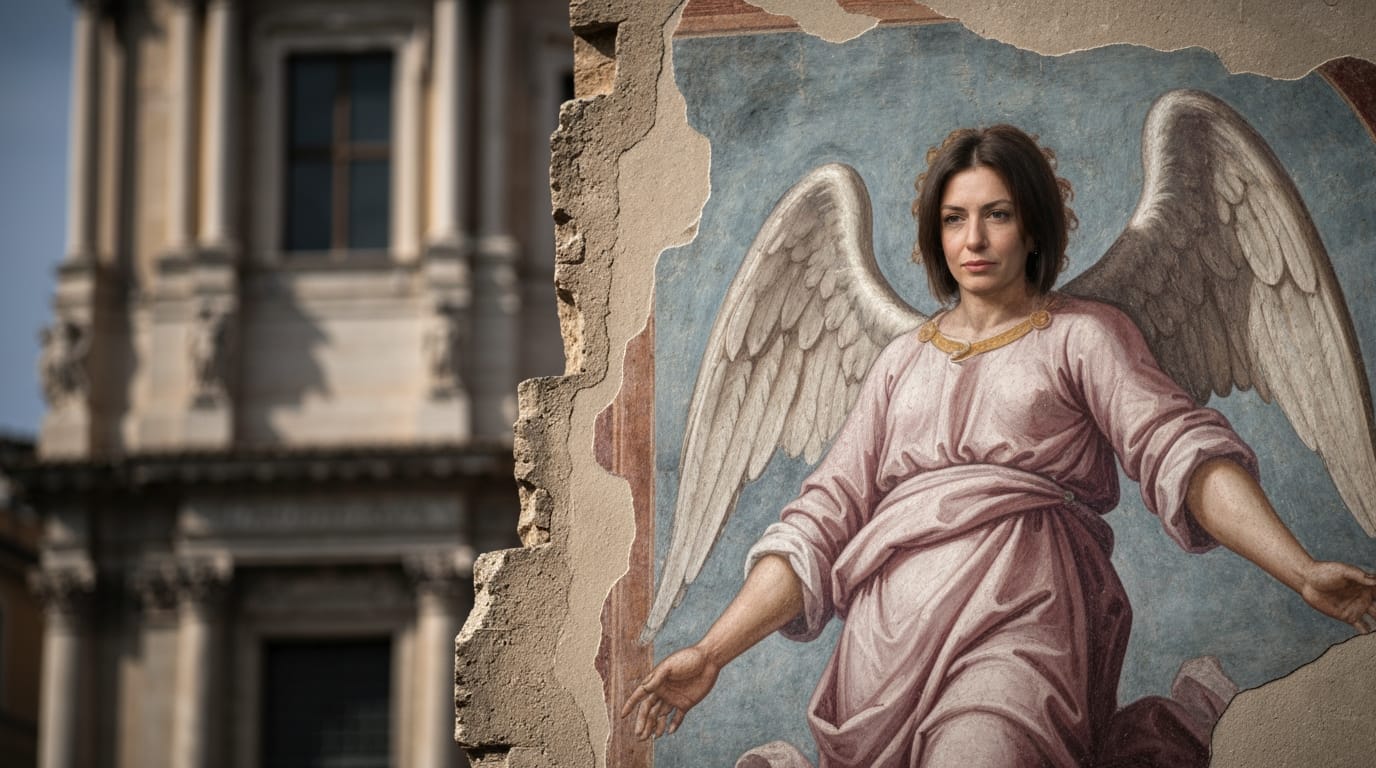
ROME – A recent restoration of an angelic figure within the historic Basilica of San Lorenzo in Lucina in central Rome has ignited a widespread controversy across Italy, as many observers contend the cherub's countenance now bears an unmistakable likeness to Prime Minister Giorgia Meloni. The unexpected visual coincidence has transcended mere artistic discussion, evolving into a heated national debate encompassing concerns over political influence in cultural heritage, artistic integrity, and public perception.
The controversy emerged in late January 2026, following the completion of restoration work on a fresco located in a chapel of the ancient basilica. Pictures of the revitalized artwork, particularly one of two angels flanking a bust of Italy's last king, Umberto II, quickly circulated online, fueling speculation and drawing immediate comparisons to the nation's leader. The striking similarity, first highlighted by the Italian newspaper La Repubblica, rapidly transformed a routine conservation project into a significant cultural and political talking point.
The Genesis of a Likeness: Art, Restoration, and Public Outcry
The fresco in question, originally painted in the year 2000, suffered water damage in 2023, necessitating restoration efforts. Bruno Valentinetti, an 80-year-old local craftsman and pensioner, undertook the volunteer restoration work, claiming to have simply reproduced the existing elements of the original artwork. He maintained that the angel's face was merely an accurate recreation of what was already present and denied any intention of modeling it after the Prime Minister. In fact, Valentinetti explicitly stated his lack of affinity for Meloni, explaining that he survives on a social pension and performs maintenance for the church in exchange for boarding. He also revealed that the original angel from 2000 was inspired by a much younger "old flame" of his residing abroad.
Despite the restorer's assertions, the visual resemblance was widely noted. The specific angel, depicted kneeling before Umberto II's bust and holding an outline of Italy, prompted immediate and diverse reactions from the public and political spheres alike. Over the last weekend of January and into early February, the Basilica of San Lorenzo in Lucina, a church dating back to the 4th century and situated in a prominent central Rome piazza, saw an unusual influx of visitors eager to photograph the contentious fresco. This surge in curious onlookers at times reportedly disrupted church services, underscoring the widespread public fascination with the unfolding situation.
Official Probes and Political Repercussions
The burgeoning controversy quickly escalated beyond casual observation, prompting official inquiries from both secular and religious authorities. Italy's Culture Minister, Alessandro Giuli, mandated an inspection of the fresco on January 31, 2026. The ministry's primary objective is not to debate the perceived likeness but to ascertain whether the restoration adhered strictly to the original design and whether any unauthorized alterations were made. Cultural heritage regulations dictate that restorers must faithfully reproduce existing elements, especially for artworks that, while relatively modern like the 2000 fresco, are still part of a historic site. Should the inspection reveal intentional modifications, measures would be taken to return the artwork to its initial composition.
Concurrently, the Diocese of Rome expressed its "astonishment" regarding the Meloni-like appearance of the angel. In an official statement, the diocese indicated its unawareness of any deliberate intent by the restorer and initiated its own investigation into the matter. The diocese emphasized the importance of religious art being free from "inappropriate use" for political purposes. Monsignor Daniele Micheletti, the basilica's parish priest, acknowledged the resemblance but downplayed its significance, stating that he did not recall the original features of the angel and found the current depiction "not a problem."
A Divided Public and the Humor of the Prime Minister
The reactions from Italy's political landscape were sharply divided. Opposition parties swiftly voiced their disapproval, calling for urgent action and raising concerns about potential political propaganda infiltrating sacred artistic spaces. Representatives from the Democratic Party, the Five Star Movement, and the Green and Left Alliance urged the Culture Minister to intervene, citing the incident as a possible breach of the Cultural Heritage Code and an "unacceptable precedent" of arbitrary alterations to public heritage. One spokesperson for the Five Star Movement stressed that art and culture should not risk becoming tools for propaganda.
In contrast to the opposition's gravity, Prime Minister Giorgia Meloni herself responded to the situation with characteristic humor. She took to social media, sharing an image of the fresco and lightheartedly commenting, "No, I definitely don't look like an angel," accompanied by a laughing emoji. Her lighthearted dismissal aimed to defuse the brewing controversy, but it did little to quell the ongoing debate among critics.
The Enduring Interplay of Art and Power
The incident in the Basilica of San Lorenzo in Lucina highlights a recurring tension between artistic expression, political influence, and cultural preservation, especially potent in a nation as rich in heritage as Italy. Historically, art in Italy, particularly during the Renaissance, was frequently commissioned and utilized by powerful families and religious leaders, including popes, as a means of projecting power, establishing legitimacy, and even subtle propaganda. Artists often worked closely with their patrons, sometimes embedding their benefactors' images or symbols within sacred or public works to enhance their social and political standing.
The Basilica of San Lorenzo in Lucina itself carries historical weight, being associated with right-wing political figures. The positioning of the angel resembling Meloni near a bust of Umberto II, the last King of Italy, has been interpreted by some observers as reinforcing certain political narratives, rekindling debates about monarchy, nationalism, and the prime minister's party roots. This intricate layering of history, art, and contemporary politics underscores why a seemingly minor artistic restoration could generate such a significant national discussion.
Conclusion
As investigations proceed, the Roman fresco controversy continues to evolve, serving as a compelling illustration of how art, even in its most sacred forms, can inadvertently become entwined with modern political narratives. The debate underscores the delicate balance between artistic freedom, faithful restoration, and the potential for perceived political messaging within public and religious spaces. Whether an intentional act, an unconscious influence, or a mere coincidence, the angelic likeness has prompted a national dialogue on the sanctity of cultural heritage and its susceptibility to contemporary interpretations, reinforcing Italy's enduring connection between its profound artistic legacy and its vibrant, often contentious, political landscape.