Romania's Government Collapses as Far-Right Firewall Crumbles, Reshaping European Political Landscape
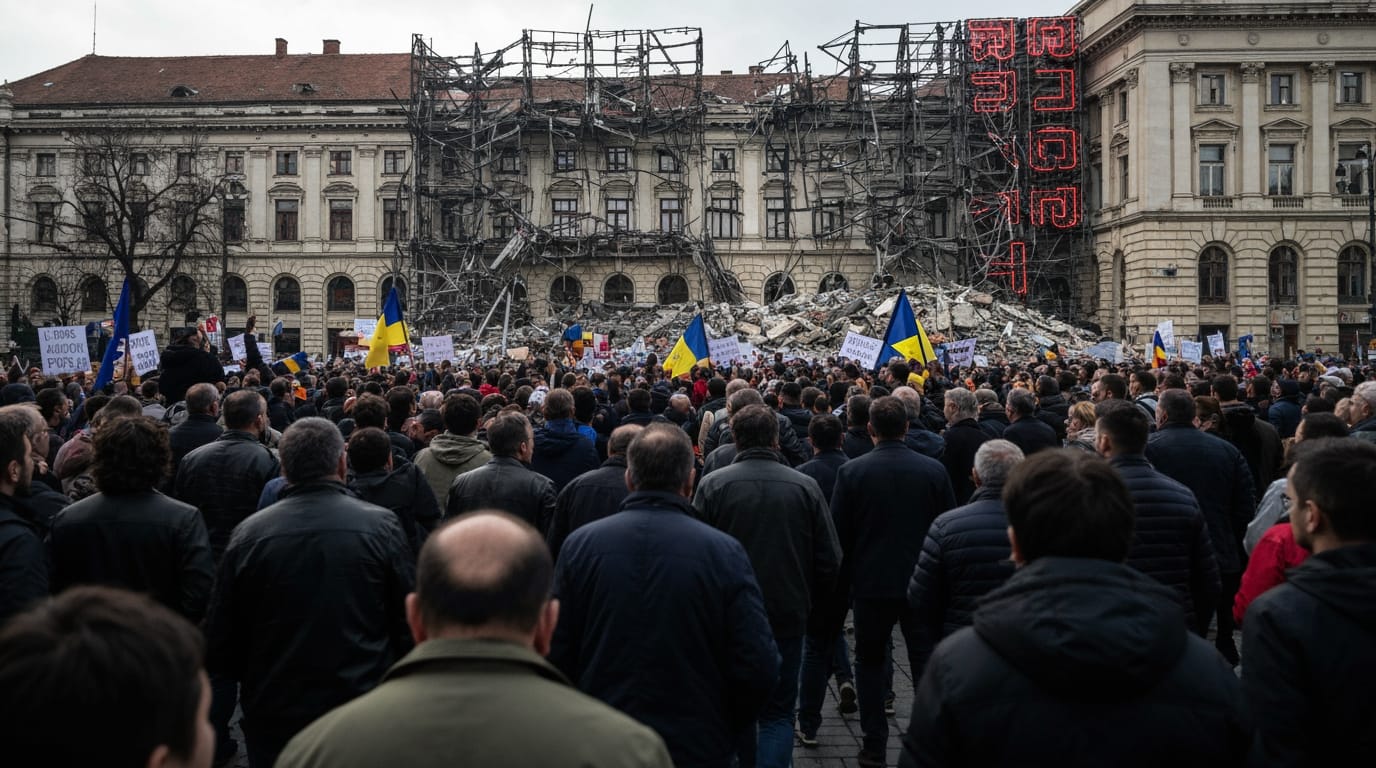
Bucharest, Romania – Romania's pro-European government collapsed this week, losing a no-confidence vote that saw the center-left Social Democratic Party (PSD) align with the ultranationalist, far-right Alliance for the Union of Romanians (AUR). The dramatic turn of events has shattered a long-standing "firewall" against extremist parties in Europe, sending ripples of concern across the continent and plunging Romania into renewed political uncertainty.
The government, led by Prime Minister Ilie Bolojan of the National Liberal Party (PNL), fell on May 5, 2026, less than a year after taking office. The motion, which passed with 281 votes in the 464-seat parliament, signals a profound shift in Romanian politics and a significant victory for the burgeoning far-right movement.
Austerity Drives Political Upheaval
The immediate catalyst for the government's collapse was a deepening rift over austerity measures championed by Prime Minister Bolojan. His administration, sworn in June 2025, had embarked on a challenging path to address Romania's severe budget deficit, one of the highest within the European Union. Bolojan's program included tax increases, freezes on public sector wages and pensions, and significant cuts to public spending – policies aimed at stabilizing the economy and unlocking crucial EU funding.
These stringent economic reforms, however, proved deeply unpopular and strained the ruling coalition. The Social Democratic Party, the largest party in parliament, withdrew its support from Bolojan's government in late April 2026, arguing that the austerity measures were harming the economy and the living standards of Romanians. The PSD's departure left the government in a minority position, setting the stage for the no-confidence vote. Prime Minister Bolojan defended his actions, stating he "chose to do what was urgent and necessary for our country," inheriting a deficit that reached 9.3% of GDP in 2024 and 7.9% in the fourth quarter of 2025.
The Erosion of the "Cordon Sanitaire"
The decision by the PSD to collaborate with the far-right AUR to oust the government marks a critical moment for European politics. Across much of Europe, mainstream parties have historically maintained a "cordon sanitaire"—an informal agreement to exclude extremist parties from governance and power-sharing. This unspoken rule aimed to safeguard democratic institutions from groups perceived as a threat to liberal values.
The pan-European Party of European Socialists (PES), to which the PSD belongs, has largely prided itself on upholding this principle. However, the alliance forged in Bucharest fundamentally breaches this long-standing taboo. President Nicușor Dan had previously drawn a clear line, stating he would not nominate a prime minister for a coalition that included AUR. This week's vote, however, saw that "Chinese wall" effectively "smashed," as one expert described it, potentially setting a precedent with "huge repercussions" across the continent. While some analysts suggest the PSD's move was a strategic convergence primarily aimed at removing Bolojan, its symbolic and practical implications for containing the far-right are undeniable.
The Ascendance of AUR
The Alliance for the Union of Romanians (AUR), a right-wing populist and far-right party founded in 2019, has been on a meteoric rise in Romanian politics. Initially a "surprise" entry into parliament in the 2020 legislative elections with 10% of the vote, AUR solidified its position in the 2024 parliamentary elections by securing 18% and becoming the second-largest party in both chambers. Recent polls from January 2026 suggest AUR is now the most popular party in Romania, commanding an unprecedented 40.9% support.
AUR's success is attributed to its potent mix of ultranationalist, conservative, and Eurosceptic rhetoric, tapping into a growing public frustration with mainstream political elites. The party's platform emphasizes family, nation, Christian faith, and liberty, advocating for traditional values, opposing same-sex marriage, and supporting the unification of Romania with Moldova. AUR leaders, notably George Simion, have effectively leveraged social media platforms like TikTok to disseminate their anti-establishment message, particularly resonating in rural and economically disadvantaged communities.
The party has also capitalized on public discontent related to the COVID-19 pandemic, the energy crisis, and high inflation. It has questioned Romania's support for Ukraine and exhibited skepticism toward European Union influence, echoing sentiments among a segment of the electorate. The party gained further prominence during the tumultuous period surrounding the 2025 presidential election. Following the annulment of the first round of the December 2024 presidential election due to suspicions of foreign interference benefiting extremist candidate Călin Georgescu, a re-run was held. While AUR leader George Simion won the first round of this re-run in May 2025, he ultimately lost the runoff to centrist independent Nicușor Dan. Despite this defeat, the far-right's broad support base and parliamentary presence underscore its significant and lasting impact on the political landscape.
Navigating the Instability
Romania now faces a period of heightened political instability, a recurring theme in its post-communist history, characterized by "stable instability" with frequent government changes. President Nicușor Dan is expected to initiate consultations with political parties to navigate the crisis. While he has ruled out early elections—which are not constitutionally due until 2028—the path forward remains unclear. Potential scenarios include the formation of a new government led by a different PNL premier or a technocrat.
The political upheaval carries significant economic implications. The delay in forming a stable government could jeopardize Romania's ability to implement critical reforms by the August 31, 2026, deadline, thereby risking the disbursement of billions in vital EU recovery funds. This financial pressure could further fuel public frustration with mainstream parties, inadvertently strengthening the appeal of the far-right.
The collaboration between the center-left and the far-right to bring down a pro-European government represents a pivotal moment not just for Romania, but for the broader European political fabric. It signals a potential normalization of alliances that were once considered unthinkable, challenging the democratic immune system that has long sought to contain extremist ideologies. The long-term consequences of this shift remain to be seen, but the crumbling firewall in Bucharest serves as a stark warning about the evolving political dynamics across the continent.


