Rumors Swirl: ECB President Lagarde Reportedly Considering Early Departure Amidst Geopolitical Scrutiny
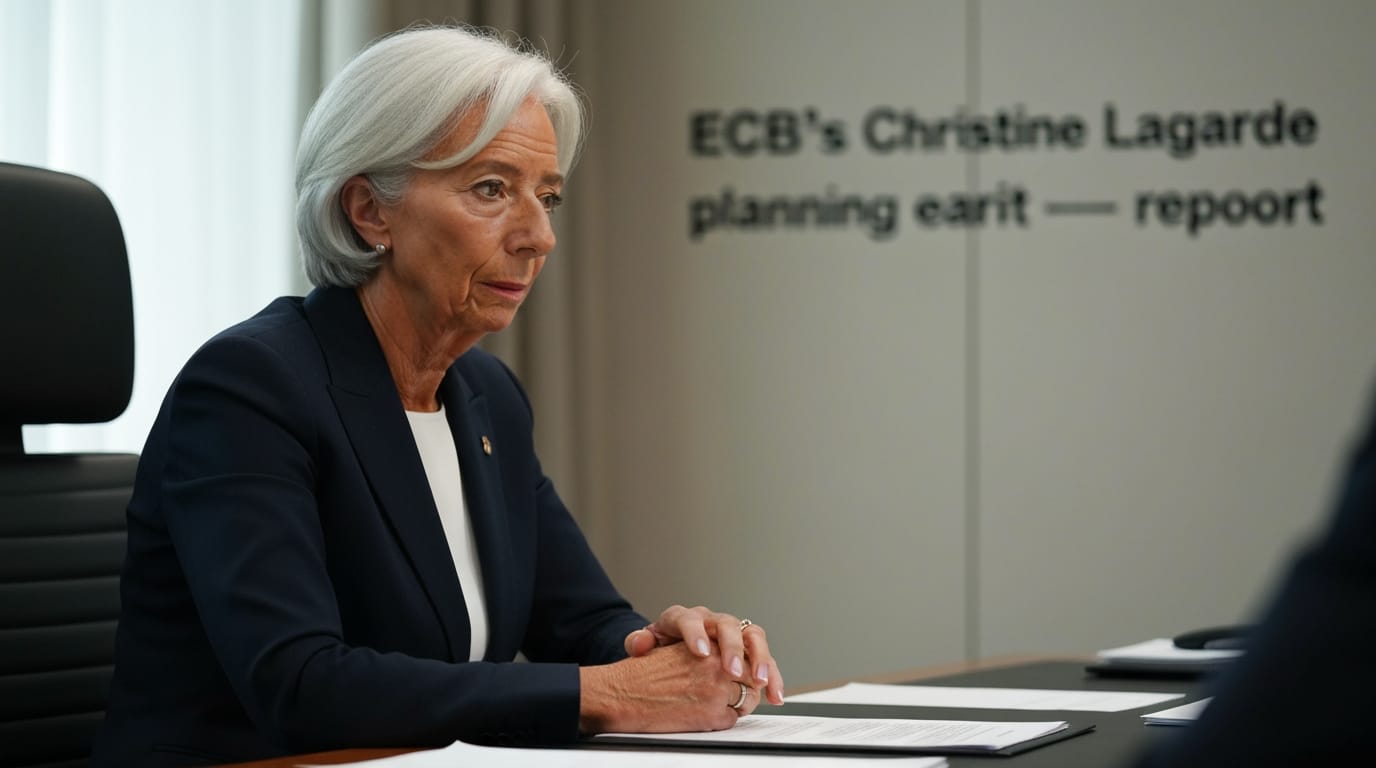
Frankfurt, Germany — Reports from the Financial Times are sending ripples through European financial circles, suggesting that European Central Bank (ECB) President Christine Lagarde is contemplating an early departure from her eight-year term, which is officially slated to conclude on October 31, 2027. The news, citing anonymous sources familiar with her thinking, indicates that Lagarde may step down prior to the French presidential elections scheduled for April 2027, a move with potentially far-reaching implications for the Eurozone's monetary policy and political landscape. While the ECB has firmly denied the allegations, stating Lagarde remains "fully focused" on her mission, the speculation has already triggered market reactions, with the euro reportedly experiencing a dip against the dollar.
The Brewing Speculation and Official Response
The Financial Times report, published earlier this week, cast a spotlight on the potential for a significant leadership change at the helm of the ECB. It suggests Lagarde is evaluating a resignation that would predate the crucial 2027 French presidential elections. This timeline has fueled conjecture that the decision is intricately linked to the broader political dynamics within the European Union, particularly concerning the influence over the selection of her successor. The euro's immediate dip following the report underscores the sensitivity of leadership stability at the central bank for market confidence.
In response to the circulating reports, an ECB spokesperson issued a statement asserting that President Lagarde is "totally focused on her mission and has not taken any decision regarding the end of her term." This official denial echoes previous instances where Lagarde herself quashed rumors of an early exit. As recently as June of last year, she publicly declared her "determination to complete my term" and famously stated she was "not a quitter." Despite these reassurances, the recent resignation of Bank of France Governor François Villeroy de Galhau before his term expired, a move widely interpreted as facilitating French President Emmanuel Macron's influence over his replacement, has intensified the scrutiny surrounding Lagarde's future.
Lagarde's Legacy: Navigating Turbulent Waters
Christine Lagarde took office as President of the European Central Bank in November 2019, succeeding Mario Draghi. Her tenure, designed for a non-renewable eight-year term, has been characterized by unprecedented global challenges and significant policy shifts. Almost immediately upon her appointment, the Eurozone, and indeed the world, plunged into the economic turmoil of the COVID-19 pandemic. Lagarde swiftly navigated the ECB through this crisis, implementing emergency measures to stabilize financial markets and support the bloc's economy.
The subsequent years brought further upheaval, including the economic repercussions of the Russia-Ukraine war and an acute energy crisis that sent shockwaves across Europe. Under Lagarde's leadership, the ECB faced the daunting task of combating record-high inflation, which surged to over 10% in 2022. In response, the central bank embarked on the sharpest monetary tightening cycle in its history, aggressively raising interest rates to curb price increases. This resolute approach has shown tangible results, with inflation in the Eurozone receding significantly to 1.7% by January. Her leadership has been credited by many with bringing a steady hand to monetary policy during some of the most volatile periods in recent European economic history, maintaining a critical balance between stimulating growth and taming inflationary pressures.
The Geopolitical Chessboard: Why an Early Exit?
The underlying motivations for a potential early departure are deeply intertwined with the intricate political dynamics of the European Union. A primary theory suggests that an early exit by Lagarde would enable French President Emmanuel Macron, whose second term concludes in April 2027, to play a decisive role in selecting her successor. Macron is barred from running for a third term, making the period leading up to the 2027 elections a critical window for him to shape key European appointments.
Furthermore, there is an unspoken concern that delaying the succession process could see the appointment influenced by a potentially different political landscape in France. Polls suggest that the far-right National Rally, led by figures like Marine Le Pen or Jordan Bardella, could gain significant power in the upcoming French presidential elections. European leaders are reportedly keen to avoid a scenario where the crucial ECB presidency is determined under such a political shift, preferring to secure a successor under the current political balance in Paris and Berlin.
The balancing act of allocating senior EU economic posts involves complex negotiations among member states, often considering political affiliations and national origins. An early vacancy at the ECB would trigger a fresh round of this "horse-trading," allowing governments to strategically position their preferred candidates and maintain a desired equilibrium across the bloc's most powerful institutions. The recent example of the Bank of France governor's early resignation underscores the strategic nature of such decisions, aimed at ensuring the current leadership has a hand in shaping future institutional direction.
The Race for Frankfurt: Potential Successors and Complications
Should Lagarde indeed step down prematurely, a formidable race to lead the Eurozone's central bank would ensue. Several prominent names have already emerged as potential candidates, including former Bank of Spain Governor Pablo Hernandez de Cos, Dutch Central Bank President Klaas Knot, ECB Executive Board Member Isabel Schnabel, and Bundesbank President Joachim Nagel.
An early departure could significantly impact this succession battle, potentially narrowing the field or giving an advantage to certain contenders. Analysts suggest that an early appointment might favor individuals like Klaas Knot, who has not yet taken on a new significant role, compared to candidates who might be less available. The process of selecting an ECB president is notoriously complex, involving intense lobbying and negotiation among Euro area member states, striving for a balance that reflects geographical and political considerations.
Adding another layer of complexity is the current composition of top EU leadership. With Ursula von der Leyen, a German, currently heading the European Commission until 2029, there's speculation that appointing another German to the ECB presidency could disrupt the delicate national balance of power within the EU's most influential institutions. Such a move could be seen as concentrating too much power in one nation, making a German candidate less likely if Lagarde were to depart early.
Uncertainty on the Horizon
The speculation surrounding Christine Lagarde's potential early exit injects a degree of uncertainty into the future direction of the European Central Bank and, by extension, the Eurozone economy. While the ECB's official stance is one of continuity and focus, the reports highlight the critical intersection of high-stakes monetary policy and the intricate geopolitical maneuvering within the European Union. A change in leadership at such a pivotal institution would inevitably lead to questions about the continuity of current monetary policy strategies, particularly regarding interest rate trajectories and the ongoing fight against inflation.
As the Eurozone continues to navigate a complex economic landscape, a smooth and predictable transition at the ECB is paramount for maintaining market confidence and economic stability. While Lagarde has delivered a period of crucial guidance through unprecedented crises, the mere possibility of her early departure underscores the constant interplay between economic imperatives and political calculations at the highest levels of European governance. The coming months will undoubtedly be closely watched as observers seek clarity on the future leadership of one of the world's most influential central banks.