SpaceX Advances Mars Ambitions with Latest Starship Mega-Rocket Test Flight
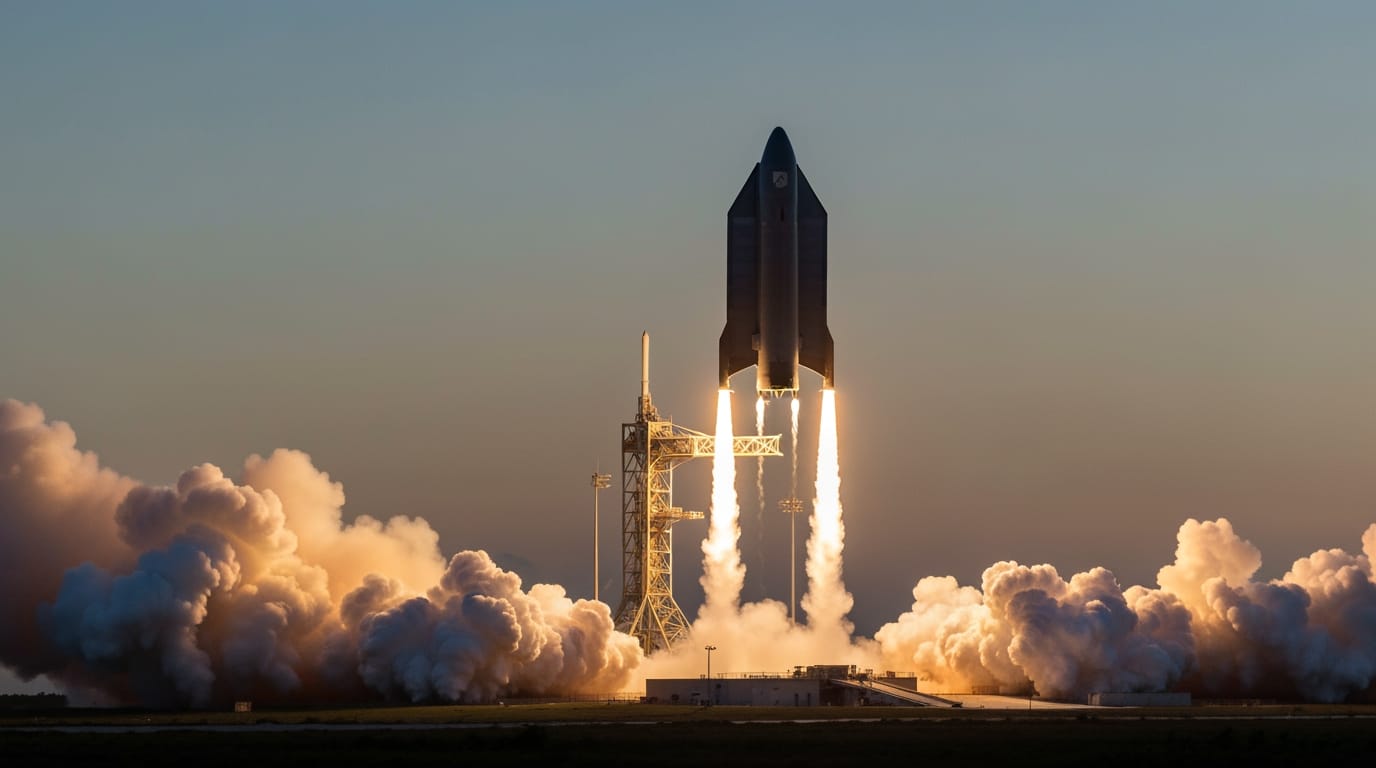
BOCA CHICA, Texas – SpaceX successfully launched its most powerful Starship rocket to date, an upgraded "V3" version, on Friday, May 22, 2026, marking a significant step in the company's ambitious program to enable human missions to the Moon and Mars. The towering 407-foot (124-meter) vehicle, consisting of the Super Heavy booster and Starship upper stage, blasted off from SpaceX’s Starbase facility on the southern tip of Texas, carrying 20 mock Starlink satellites and two observation satellites. This twelfth test flight of the Starship program demonstrated enhanced capabilities and further advanced the iterative development crucial for making the fully reusable rocket a reality.
The Dawn of Starship V3: A New Era of Testing
The latest iteration of Starship, dubbed V3, represented a considerable upgrade, boasting more engine thrust and launching from a brand-new pad designed to withstand the immense power of the mega-rocket. The launch followed a last-minute scrub due to a minor glitch with a launch pad system and previous weather delays. Initial reports indicated that the revamped booster featured bigger and stronger grid fins for steering, and a more robust fuel transfer line to feed its 33 main engines, which collectively generate up to 18 million pounds of thrust. The mission's primary goal was to thoroughly test these new components in a flight environment and gather critical data on its heat shield, while demonstrating capabilities essential for full and rapid reusability.
The flight profile for this latest test saw the Super Heavy first stage perform a controlled splashdown in the Gulf of Mexico, approximately seven minutes and twenty-four seconds after liftoff, following a successful boostback burn. The Starship upper stage continued its trajectory, reaching space and subsequently executing a controlled reentry, showcasing its ability to navigate the atmosphere at hypersonic speeds. The upper stage then performed a landing burn, concluding with a soft splashdown in the Indian Ocean roughly one hour and six minutes after launch. While neither stage was recovered for reuse during this trial, the successful controlled splashdowns represented a critical milestone in proving the system's reusability potential. The two modified Starlink satellites deployed during the flight were designed to scan Starship's heat shield and transmit imagery, testing methods for analyzing its readiness for future return-to-launch-site missions.
An Iterative Journey: Building on Lessons Learned
SpaceX's Starship development has been characterized by an iterative, rapid prototyping approach, where each test flight provides invaluable data, often learned from spectacular failures. Earlier Starship flights experienced midair explosions and uncontrolled reentries, which the company has systematically addressed through design modifications and software upgrades.
A notable previous success, Flight 4 on June 6, 2024, set a precedent by achieving the first controlled splashdown of both the Super Heavy booster and the Starship upper stage. That flight saw improvements aimed at preventing issues encountered during Flight 3, where engine failures were attributed to liquid oxygen filter blockage and the ship experienced excessive roll rates due to clogged control valves. For Flight 4, modifications included bolstered hardware in the booster's oxidizer tanks and additional roll control thrusters for the ship. SpaceX also experimented with jettisoning the hot-staging adapter after the boostback burn to reduce booster mass, a temporary change aimed at perfecting controlled water landings. This philosophy of continuous improvement, where the "payload for this test was the data," underpins the entire Starship program.
Starship's Grand Vision: Moon, Mars, and Beyond
Starship is envisioned as a fully reusable, two-stage super heavy-lift launch vehicle, designed to carry both crew and cargo far beyond Earth orbit. The system comprises the Super Heavy first-stage booster and the Starship upper stage, both powered by methane-burning Raptor engines. Notably, both stages are constructed from stainless steel, a choice made by SpaceX CEO Elon Musk for its cost-effectiveness, ease of manufacturing, and robust performance at cryogenic temperatures and during high-temperature atmospheric reentry.
Once fully operational, Starship is projected to have an unprecedented payload capacity, capable of carrying over 100 metric tons to orbit in its reusable configuration and eventually transporting up to 100 people. Its primary mission objectives are transformative: serving as the Human Landing System (HLS) for NASA’s Artemis program to return astronauts to the Moon, and ultimately enabling the colonization of Mars. NASA is specifically relying on Starship for the Artemis III and IV missions, with a crewed lunar landing anticipated as early as 2028. Beyond lunar and Martian ambitions, Starship is also designed to deploy large satellites, facilitate the development of space stations, and potentially enable point-to-point transport on Earth, drastically reducing travel times globally.
The Road Ahead: Overcoming Challenges for a Multi-Planetary Future
Despite the progress demonstrated in the latest V3 flight and previous tests, Starship's development remains a complex and dynamic undertaking. While the recent flight achieved its primary objectives of controlled splashdowns, the ultimate goal is full reusability, including the intricate maneuver of catching the Super Heavy booster with the launch tower's mechanical arms at Starbase.
SpaceX continues to refine its designs and operational procedures to achieve rapid reusability and significantly increase launch cadence, which is central to its long-term vision of making humanity a multi-planetary species. The program faces ongoing engineering challenges, regulatory approvals, and the inherent risks of pushing the boundaries of space technology. However, each test flight, whether fully successful or yielding unexpected results, provides critical data that inches the company closer to its audacious goals. The successful debut of Starship V3 underscores SpaceX's persistent pursuit of a future where space travel is routine and sustainable, paving the way for humanity's expanded presence beyond Earth.


