Spain Rejects Reported US Plans to Punish NATO Allies Amid Iran War Tensions
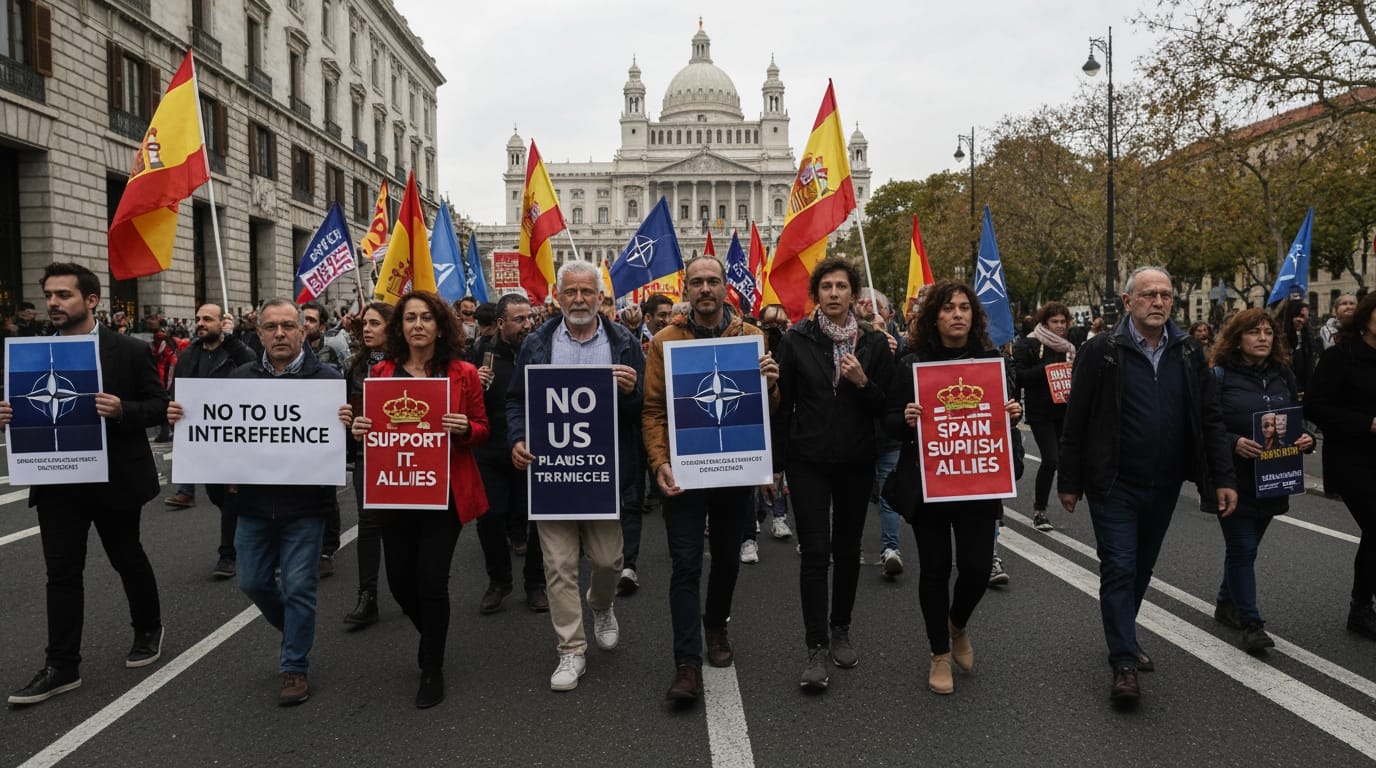
NICOSIA, Cyprus – Spanish Prime Minister Pedro Sánchez has firmly dismissed reports of an internal Pentagon email suggesting punitive measures against NATO allies, including the potential suspension of Spain, for their reluctance to support U.S. operations in the ongoing war with Iran. Sánchez, speaking from Nicosia, asserted that Madrid operates based on official communications, not leaked internal memos, and underscored Spain's commitment as a "loyal partner" within the alliance, always adhering to international law. This diplomatic pushback highlights growing fissures within NATO as the United States seeks broader allied involvement in the conflict in the Middle East.
The Pentagon's Internal Deliberations Stir Controversy
The controversy erupted on April 24, 2026, following reports of a leaked internal Pentagon email outlining various options for the United States to address what it perceives as insufficient support from certain NATO members regarding the Iran war. The memo, reportedly circulating at high levels within the U.S. Defense Department, specifically mentioned the possibility of suspending Spain from the North Atlantic Treaty Organization and reviewing the U.S. position on Britain's claim to the Falkland Islands. The rationale behind these proposed actions stems from Washington's frustration over allies' perceived reluctance or outright refusal to grant the U.S. access, basing, and overflight rights (ABO) for operations related to the Iran conflict. A U.S. official, speaking anonymously, summarized the email's intent as sending a strong signal to "decrease the sense of entitlement on the part of the Europeans." President Donald Trump has been a vocal critic of allies who, in his view, have failed to support American actions in the Iran war and efforts to police the Strait of Hormuz.
Spain's Principled Stance on International Legality
In response to these revelations, Prime Minister Pedro Sánchez maintained a calm yet resolute posture. "We do not work with emails; we work with official documents and government positions, in this case, of the United States," Sánchez stated, effectively downplaying the significance of the leaked memo. He emphasized Spain's unwavering commitment to the alliance, asserting that Madrid is "fulfilling its responsibilities without fail, as the good NATO allies we are."
The core of Spain's divergence with the U.S. lies in its interpretation of international law regarding the Iran conflict. Spain has explicitly refused to allow U.S. forces involved in the war to use bases on its territory or airspace, contending that the U.S.-Israeli actions in the Iran war contravene international law. This position has earned Spain the ire of the Trump administration, which has even reportedly threatened trade retaliation. Spanish Foreign Minister Jose Manuel Albares further elaborated on this, stating that recent U.S. complaints and threats against NATO allies are prompting European nations to explore alternative security arrangements and take greater control of their own defense.
NATO's Legal Framework and Political Realities
The notion of suspending or expelling a member state from NATO, as floated in the Pentagon email, faces significant legal and practical hurdles. The North Atlantic Treaty, the alliance's founding document, does not contain any mechanism for the involuntary removal of a member. Membership can only be terminated by voluntary withdrawal, requiring a one-year notice to the U.S. government. Experts suggest that NATO is fundamentally built on consensus and political trust rather than enforcement mechanisms for expulsion. Therefore, any attempt to force Spain out of the alliance would be extraordinarily difficult, if not impossible, under current rules.
Despite the lack of a formal expulsion mechanism, the mere suggestion underscores the deep political tensions and frustrations simmering within the alliance. The debate highlights how differences in strategic priorities and interpretations of international law can strain the cohesion of a long-standing military pact. While the U.S. views access and basing rights as fundamental for NATO, European allies like Spain prioritize adherence to international legal norms in their foreign policy.
The Enduring Debate Over Defense Spending
Beyond the immediate crisis ignited by the Iran war, the reported U.S. frustrations are intertwined with a long-standing point of contention within NATO: defense spending. The U.S. has consistently pressed allies to increase their military expenditures, arguing that it disproportionately shoulders the financial burden of collective security. While NATO previously set a benchmark for members to spend at least 2% of their Gross Domestic Product (GDP) on defense by 2024, the alliance, under U.S. pressure, adopted a more ambitious goal in 2025: to reach 5% of GDP on defense by 2035, with 3.5% allocated to core military needs.
Spain has historically been among the lowest spenders within NATO, dedicating approximately 1.2% to 1.3% of its GDP to defense in recent years. Although Spain committed to reaching the 2% target by 2025 and announced a €10.5 billion investment plan to achieve this, it has expressed reluctance to commit to the new 5% target, seeking a "more flexible formula" or even an exemption. Prime Minister Sánchez reiterated Spain's current military spending at 2.1% of GDP, which he deems "sufficient and realistic," in line with its earlier commitment. This ongoing disparity in defense contributions, coupled with divergent views on military engagements outside NATO's core defense mandate, continues to test the alliance's unity.
Conclusion: A Test of Alliance Resilience
The leaked Pentagon email and Spain's unequivocal response mark a significant moment in trans-Atlantic relations, exposing underlying tensions over strategic autonomy, adherence to international law, and burden-sharing within NATO. While Prime Minister Sánchez has sought to defuse the situation by focusing on official channels, the incident reveals a chasm between Washington's expectations for allied support in its unilateral military actions and the principled stands of some European partners. The North Atlantic Treaty Organization, designed for collective defense, now faces the challenge of maintaining cohesion when members diverge on external conflicts and financial commitments. The coming months will likely see continued diplomatic maneuvering as the alliance navigates these strains, with the resilience of the trans-Atlantic bond once again under scrutiny.


