Supreme Court Revives Pro-Republican Texas Electoral Map for 2026 Midterms
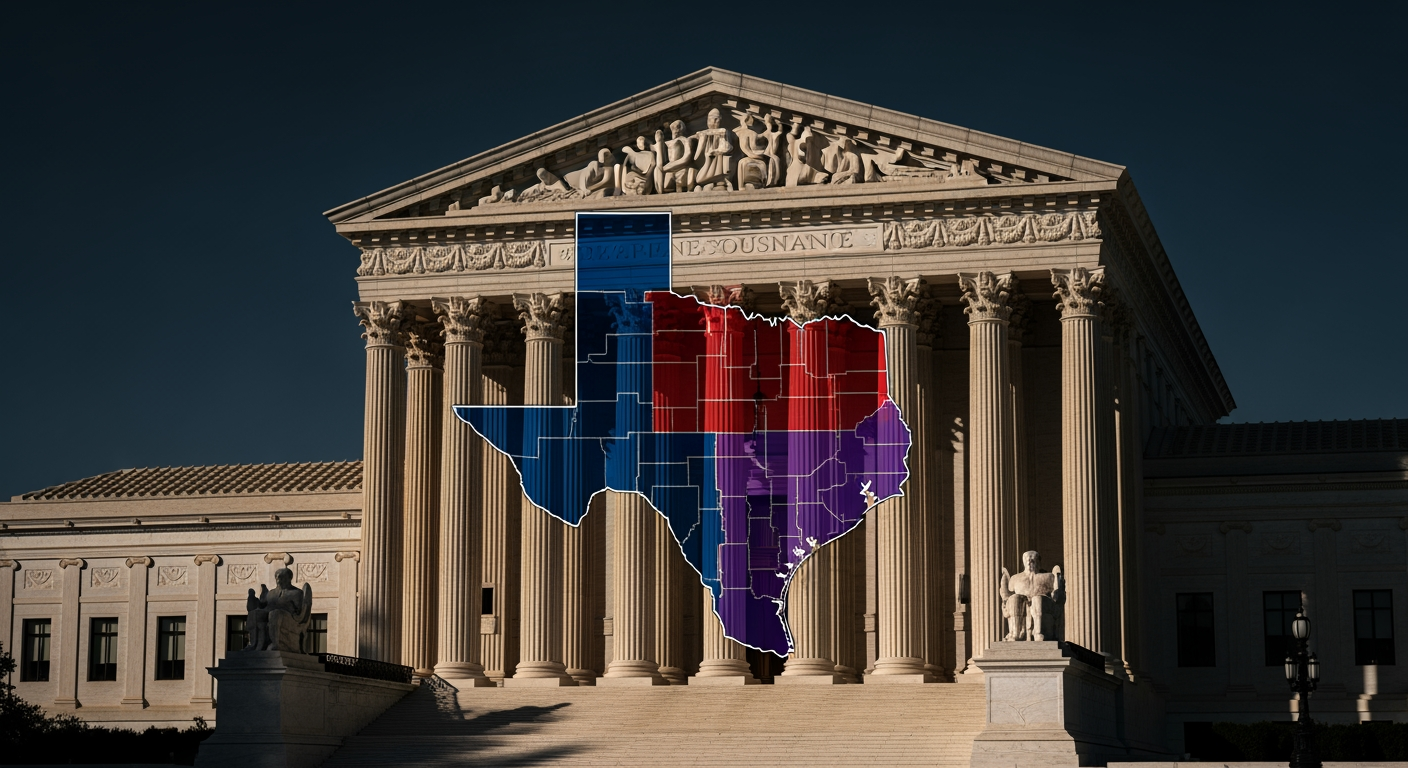
Washington, D.C. - The U.S. Supreme Court on Thursday reinstated a redrawn Texas congressional map, a move poised to significantly bolster Republican prospects in the 2026 midterm elections and potentially secure the party's narrow majority in the House of Representatives. The 6-3 decision, issued without a signed opinion, temporarily overrides a lower court's finding that the map constituted an unlawful racial gerrymander, allowing Texas to proceed with the new district lines for the upcoming election cycle.
This emergency order represents a pivotal victory for Texas Republicans and the Trump administration, which had actively encouraged the mid-decade redistricting effort. Critics, including voting rights organizations and the court's three liberal justices, immediately condemned the ruling, arguing it greenlights a discriminatory electoral scheme that dilutes the voting power of minority communities in Texas.
The Court's Swift Action and Rationale
The Supreme Court's majority sided with Texas officials who appealed a lower court's injunction, citing the "Purcell principle" which cautions against altering election rules too close to an election. The high court stated that the three-judge federal district court in El Paso had "improperly inserted itself into an active primary campaign," thereby causing potential confusion for voters and election officials. With candidate filing deadlines approaching, the Supreme Court's intervention ensures the new map will be in place for the March primaries and the crucial 2026 midterms.
In its unsigned order, the majority indicated that Texas was "likely to succeed on the merits" of its claim, suggesting that the lower court may have erred by not granting sufficient deference to the state legislature's redistricting decisions. Justice Samuel Alito, in a concurring opinion, reportedly found that Texas's motivation for redrawing the districts was "pure and simple" partisan advantage, a practice federal courts have largely deemed permissible since a 2019 Supreme Court ruling. This distinction between partisan and racial gerrymandering lies at the heart of the ongoing legal battle.
A Map Designed for Republican Gain
The contested map, approved by the Republican-controlled Texas legislature in August 2025, aims to create up to five additional Republican-leaning congressional districts. Texas currently holds 38 seats in the U.S. House, with Republicans controlling 22. The new map is projected to expand Republican control to as many as 30 seats, significantly impacting the balance of power in Washington. Governor Greg Abbott celebrated the Supreme Court's decision, declaring, "Texas is officially—and legally—more red." Attorney General Ken Paxton echoed this sentiment, stating the ruling "defended Texas's fundamental right to draw a map that ensures we are represented by Republicans."
This mid-decade redistricting effort was not a typical decennial adjustment following a census. It emerged after President Donald Trump urged state GOP lawmakers to craft new House district lines to help Republicans retain their majority in the 2026 midterms. Political analysts suggest that gaining five seats in Texas could be crucial for Republicans to maintain control of the House in a potentially competitive election cycle.
Allegations of Racial Gerrymandering
The federal district court had previously blocked the map, with U.S. District Judge Jeffrey Brown, a Trump appointee, authoring the majority opinion. The lower court found "substantial evidence" that race, not just politics, was a predominant factor in drawing the 2025 map, leading to unconstitutional racial gerrymandering. Plaintiffs, including the League of United Latin American Citizens (LULAC), the Lawyers' Committee for Civil Rights Under Law, the Texas NAACP, and MALDEF, argued that the map was designed to dilute the voting power of Black and Latino communities and intentionally dismantle majority-minority districts.
A key piece of evidence cited by the lower court was a letter from the U.S. Department of Justice (under the Trump administration) that urged Texas to redraw certain "coalition" districts, which the lower court judge later identified as based on a "legally incorrect assertion" regarding their constitutionality. This convoluted sequence highlights the complex interplay of political and racial considerations in redistricting.
Dissent and Broader Implications
The Supreme Court's three liberal justices — Elena Kagan, Sonia Sotomayor, and Ketanji Brown Jackson — sharply dissented from the majority's decision. Justice Kagan asserted that the order "disrespects the work of a District Court that did everything one could ask to carry out its charge." She further argued that the stay "ensures that many Texas citizens, for no good reason, will be placed in electoral districts because of their race," a clear violation of constitutional principles the court has long upheld.
This ruling adds another chapter to the contentious history of redistricting in Texas, a state with a long record of legal battles over electoral maps. While federal courts cannot block partisan gerrymandering, racial gerrymandering remains illegal under the Voting Rights Act of 1965. The Supreme Court's current conservative majority has been perceived as generally skeptical of claims related to racial considerations in district drawing, raising concerns among voting rights advocates about the future of Section 2 of the Voting Rights Act.
The decision's immediate effect is to solidify the highly partisan Texas map for the upcoming election cycle. Beyond Texas, this ruling also influences a broader national trend where both Republican and Democratic-led states are engaged in aggressive mid-decade redistricting efforts to gain partisan advantage. California, for instance, has undertaken its own redistricting to favor Democrats, an effort now facing legal challenges from the Trump administration.
Conclusion
The Supreme Court's decision to revive Texas's new electoral map underscores the high stakes of redistricting, particularly in an era of intense political polarization. While the Court emphasized procedural concerns about judicial intervention close to an election, the ruling's practical effect is to permit the use of a map widely acknowledged to be a partisan gerrymander, despite lower court findings of racial discrimination. This outcome is expected to significantly shape the 2026 midterm landscape, giving Republicans a substantial advantage in their quest for congressional control, while leaving civil rights groups to grapple with what they view as a profound setback for fair representation in Texas. The intricate dance between partisanship and race in redistricting is likely to continue as a defining feature of American electoral politics.
Sources
Related Articles


Ratko Mladić, "Butcher of Bosnia" and Convicted War Criminal, Dies at 84
THE HAGUE, Netherlands – Ratko Mladić, the former Bosnian Serb military commander known as the "Butcher of Bosnia" and convicted of genocide, war crimes, and crimes against humanity, has died at the age of 84. Serbian...


Long-Awaited 9/11 Mastermind Trial Set for 2028, Decades After Attacks
GUANTANAMO BAY, Cuba – Nearly a quarter-century after the devastating terror attacks of September 11, 2001, a military judge has finally set a trial date for Khalid Sheikh Mohammed, the alleged mastermind behind the...