The Bayeux Tapestry in London: What Is Behind the Global Frenzy
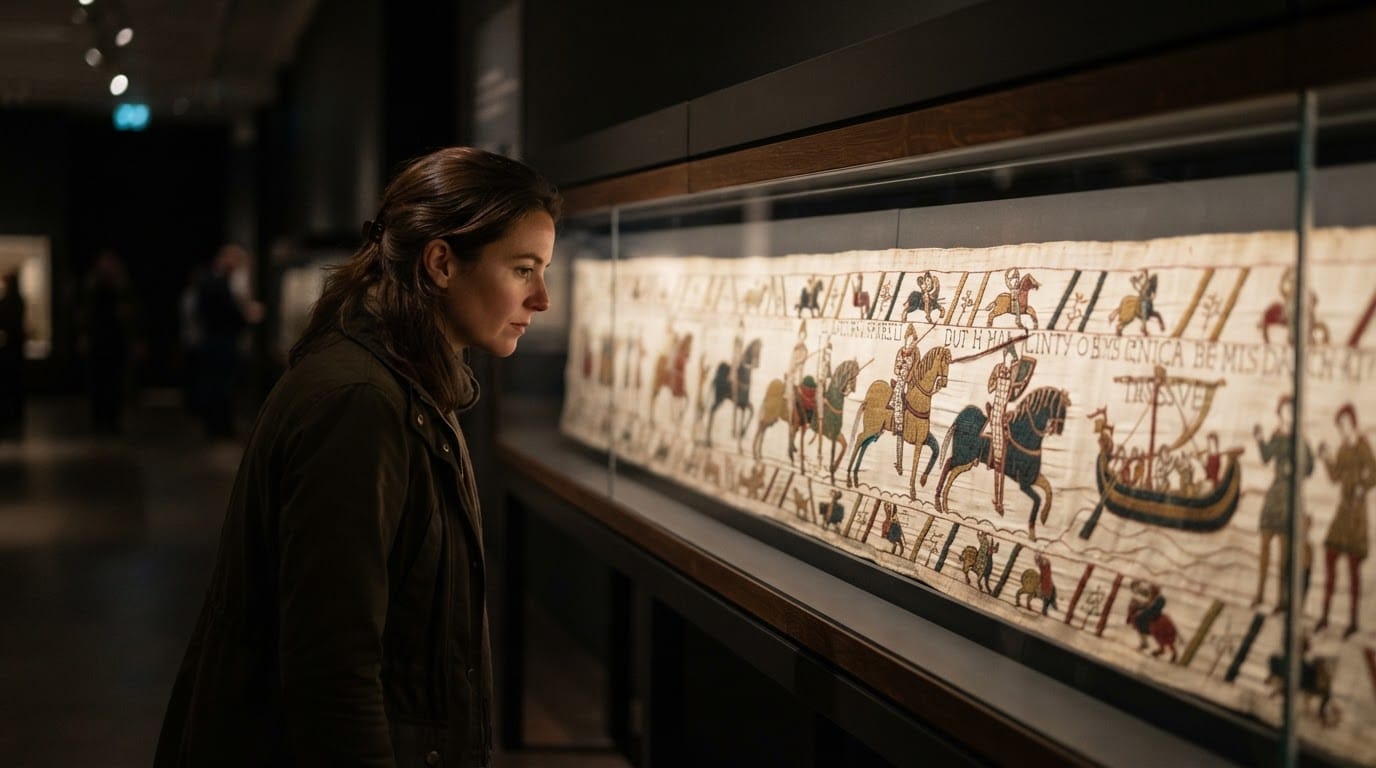
A medieval masterpiece measuring nearly 70 meters in length has ignited a rare international cultural phenomenon following its arrival at the British Museum in London. The Bayeux Tapestry, an extraordinary embroidered chronicle documenting the events leading up to the 1066 Norman Conquest of England, has crossed the English Channel for the first time in nearly a thousand years. The landmark exhibition has triggered record box-office surges, intense diplomatic negotiations, and rigorous scientific scrutiny, drawing worldwide attention to an artifact that reshaped European identity.
A Historic Return Nearly a Millennium in the Making
Technically an embroidery composed of wool yarn stitched onto fine linen, the Bayeux Tapestry is widely believed to have been crafted in southern England during the late 11th century, likely commissioned by Bishop Odo of Bayeux, the half-brother of William the Conqueror. Despite its likely English manufacture, the textile remained on French soil since at least 1077, when records first placed it inside Bayeux Cathedral.
Over the past century, British institutions repeatedly petitioned French authorities for a temporary return, including formal requests surrounding the 1953 coronation of Queen Elizabeth II and the 1966 conquest novocentenary. Every previous attempt faltered due to diplomatic hurdles, local resistance, and valid fears regarding the physical survival of the textile. The present loan became possible only when the Bayeux Tapestry Museum in Normandy scheduled extensive structural renovations, requiring the artifact to be removed from its permanent gallery and placed in temporary conservation storage. Capitalizing on that window, British and French leadership completed a bilateral cultural accord that brought the delicate work to London.
Soft Power and Cross-Channel Diplomacy
Beyond its artistic and academic stature, the arrival of the embroidery represents a calculated exercise in modern cultural diplomacy. Billed by government officials as an emblem of renewed bilateral partnership following years of post-Brexit political strain, the loan operates under a mutual state-indemnity program that values the textile at approximately $1 billion. In exchange for the embroidery, British collections agreed to lend notable historic artifacts to French institutions, including treasures recovered from the 7th-century Sutton Hoo ship burial and medieval pieces from the Isle of Lewis.
The transaction has not proceeded without sharp debate. Critics in France voiced substantial opposition, submitting public petitions and arguing that subjecting a fragile, organic work of art to transit across national borders risked irreversible wear. Art historians and conservators noted the risks of micro-climatic shifts, transport vibrations, and fiber stress. To minimize threats, French and British teams conducted months of simulated transit exercises using full-scale replicas before authorizing the secure shipment across the English Channel.
The Scale of Public Demand
The unprecedented journey has generated extraordinary public interest. When tickets for the British Museum presentation first became available, systems registered online queues exceeding 80,000 users, leading to the fastest single-day box office sellout in the museum’s history.
The display itself sets a precedent for how the artwork is viewed. Unlike past installations where the fabric was partially coiled, hung vertically, or divided, the London exhibition places the entire continuous length of 70 meters inside a climate-controlled horizontal case. Visitors move along the horizontal expanse at eye level, viewing all 58 distinct scenes in unbroken chronological succession. Surrounding the textile are contemporary 11th-century charters, Norman and Anglo-Saxon coins, and illuminated manuscripts, contextualizing the violent transfer of royal power depicted in the needlework.
Preserving a Fragile Witness to History
Public fascination with the Bayeux Tapestry rests on its visual storytelling. Across its linen canvas, the work depicts 623 people, hundreds of horses, dozens of ships, and intricate border scenes showing agricultural life, heraldic beasts, and fallen soldiers. Because it presents both the Norman claim and the Anglo-Saxon perspective with unexpected human detail, historians continue to uncover subtle political subtexts within its stitches.
Following the conclusion of its London engagement, the Tapestry is slated to return immediately to Normandy, coinciding with celebrations marking the millennium of William the Conqueror's birth. Museum officials from both nations emphasize that the logistical and physical demands of moving the ancient cloth make another loan improbable for generations.
A Fleeting Moment of Shared Heritage
The exhibition in London underscores how medieval objects continue to exert powerful sway over modern imaginations. By bridging centuries of political tension through shared heritage, the display of the Bayeux Tapestry demonstrates how ancient art can serve both as a mirror of past conflict and as an instrument of contemporary cooperation. For scholars, museum officials, and the public, the display offers a once-in-a-lifetime encounter with a foundational narrative of European history before the masterpiece returns to its permanent sanctuary.