The False Promise: Why Authoritarianism Fails to Eradicate Corruption in Southeast Asia
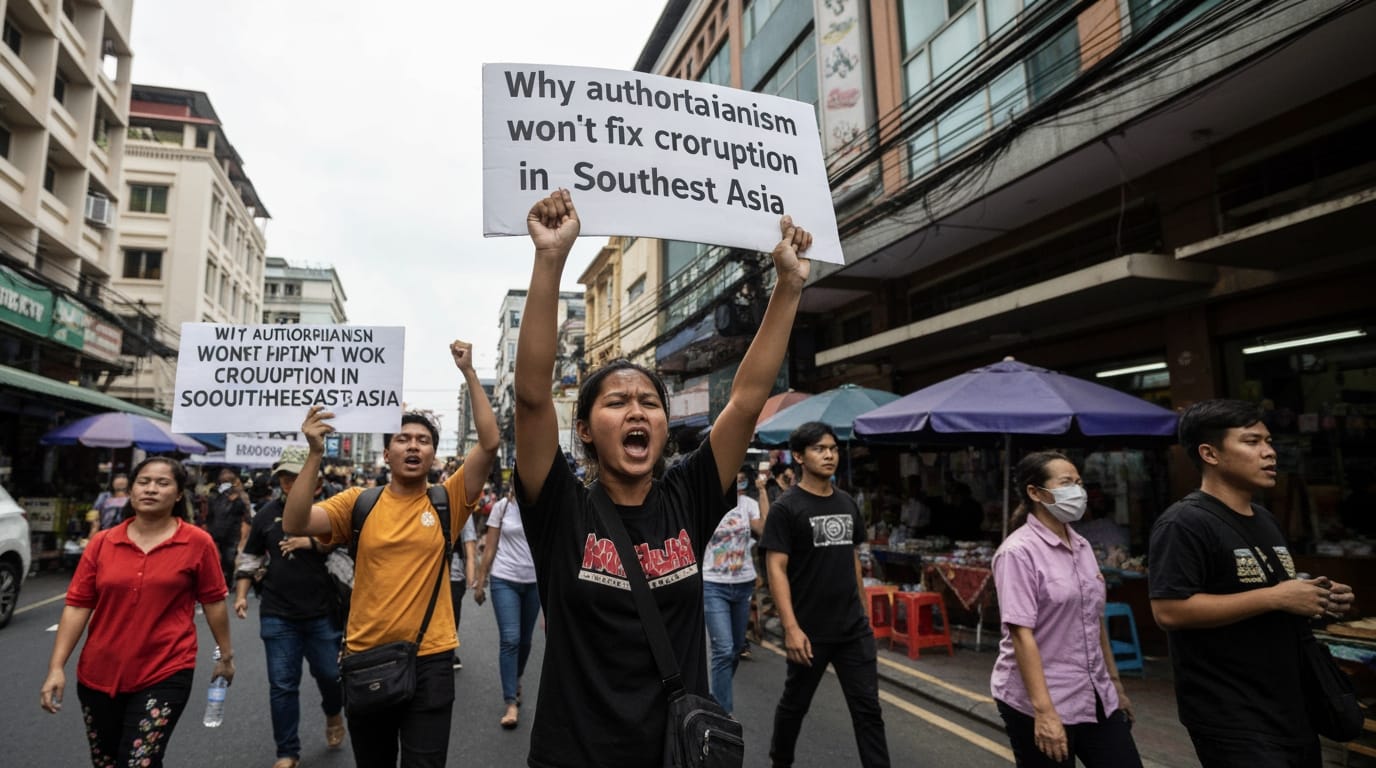
Across Southeast Asia, the allure of strongman rule often surfaces amidst public disillusionment with persistent corruption and perceived governmental inefficiencies. The promise of decisive action and swift justice from authoritarian leaders frequently resonates with citizens weary of systemic graft. However, a closer examination of regional and global trends reveals a stark reality: far from being a solution, authoritarianism often provides fertile ground for corruption to flourish, undermining governance and development rather than strengthening it.
The Siren Song of the Strongman
The appeal of authoritarian figures in combating corruption is understandable. In contexts where democratic institutions appear slow or ineffective in tackling deeply entrenched illicit practices, leaders who pledge to clean up government with an iron fist can gain significant popular support. This sentiment suggests that a concentrated power, unburdened by checks and balances, could efficiently dismantle corrupt networks. This narrative is frequently employed by leaders in the region who capitalize on public frustration, promising stability and order as prerequisites for prosperity. Historically, even some "sophisticated authoritarian regimes" have claimed to combat certain types of corruption, offering seemingly better governance and development to their populations. Yet, this perceived efficiency often comes at a steep price, creating conditions that ultimately exacerbate, rather than resolve, the problem of corruption.
The Paradox of Power: Impunity and Opacity
The fundamental flaw in the authoritarian approach to anti-corruption lies in its inherent contradiction: to effectively fight corruption, accountability, transparency, and independent oversight are paramount. These mechanisms, however, are precisely what authoritarian systems tend to dismantle or suppress in their consolidation of power. Transparency International's annual Corruption Perceptions Index consistently demonstrates a clear correlation between the health of a democracy and a country's perceived levels of public sector corruption. Full democracies, for instance, scored an average of 75 on the index, while autocratic regimes averaged a significantly lower 30, indicating much higher levels of corruption.
Authoritarian regimes centralize decision-making and limit public scrutiny, creating an opaque environment where illicit activities can thrive undetected. They often suppress independent media, civil society organizations, and judicial independence – critical watchdogs that expose and challenge corruption. When power is concentrated and unchecked, leaders and their inner circles can exploit state resources for personal gain with little fear of reprisal. This systemic lack of accountability breeds cronyism, patronage networks, and kleptocracy, where the "abuse of entrusted power for private gain" becomes institutionalized. Countries like Cambodia have seen ruling parties manipulate elections, outlaw opposition, and use legal frameworks to entrench their power rather than enforce genuine accountability.
Southeast Asia's Enduring Challenge
Southeast Asia provides numerous examples of how authoritarian tendencies undermine anti-corruption efforts. Indonesia, under the decades-long authoritarian rule of President Suharto, was plagued by widespread corruption, despite a focus on development and economic growth. More recently, the resurgence of "strongman politics" across the region, including in the Philippines and Thailand, has been accompanied by democratic backsliding and a weakening of institutions designed to curb corruption. In the Philippines, for example, the presidency of Rodrigo Duterte saw the undermining of the judiciary and a crackdown on independent media, even as he campaigned on an anti-corruption platform. The notorious history of corruption under the Marcos family in the Philippines further illustrates how concentrated power can facilitate illicit enrichment on a grand scale.
Even states perceived as having relatively lower levels of corruption, such as Singapore and Malaysia, have faced scrutiny regarding the balance between transparency pressures and the maintenance of authoritarian rule. While some sophisticated autocratic regimes may offer certain benefits, they often do so by insulating the executive from investigation and using facades of democracy to control dissent, rather than genuinely embracing open governance. The memory of past instability and civil unrest in Southeast Asian nations can lead leaders to justify repression as necessary for unity, often framing it through narratives of national security or "Asian values." However, this often translates into silencing critics and weakening checks on power, ultimately making corruption harder to detect and address.
The Path Forward: Embracing Robust Governance
Effective anti-corruption strategies hinge on the strength of independent institutions, not the strength of individual leaders with unchecked power. The United Nations Convention against Corruption (UNCAC), to which all Southeast Asian nations are signatories, emphasizes a holistic approach including prevention, enforcement, international cooperation, asset recovery, and crucially, the active involvement of government, the private sector, and civil society.
Sustainable progress against corruption requires fostering an environment of robust governance characterized by:
- Rule of Law: An independent and impartial judiciary capable of enforcing laws equally for all citizens, including those in power.
- Transparency and Accountability: Open government processes, freedom of information, and clear mechanisms for public officials to be held accountable for their actions.
- Vibrant Civil Society and Free Media: Independent organizations and a free press act as essential watchdogs, exposing corruption and advocating for reforms without fear of retribution.
- Strong Oversight Institutions: Independent anti-corruption agencies, audit bodies, and legislative oversight are critical for monitoring government activities.
- Citizen Participation: Empowering citizens to demand good governance and participate in decision-making processes.
Conclusion
While the promise of authoritarianism to swiftly resolve corruption may hold initial appeal in Southeast Asia, experience consistently demonstrates that such regimes are ill-equipped to tackle the root causes of the problem. By their very nature, authoritarian systems concentrate power, suppress oversight, and undermine the independent institutions necessary for transparency and accountability. The result is often an environment where corruption, rather than being eradicated, becomes more deeply entrenched and harder to challenge. True progress in the fight against corruption in Southeast Asia, and globally, depends not on the rise of strongmen, but on the strengthening of democratic principles, the rule of law, and the active engagement of an informed and empowered citizenry.


