The Golden Flush: Art, Opulence, and a Presidential Offer Denied
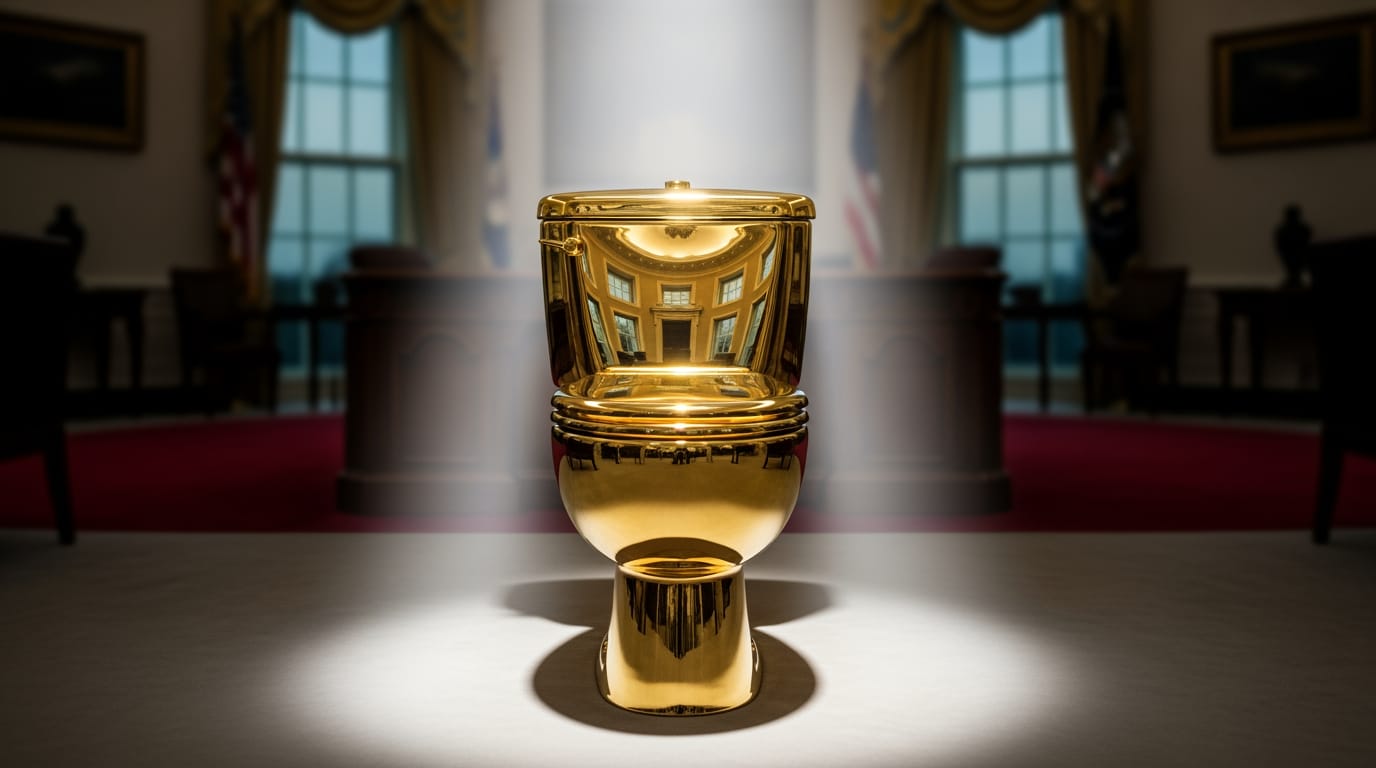
In an era frequently defined by stark contrasts and potent symbols, a single piece of art—an 18-karat solid gold toilet—has transcended its utilitarian function to become a focal point of discussion on wealth, power, and the sometimes-absurd intersection of high art and high politics. Valued in the millions, Maurizio Cattelan's "America" embarked on a journey from a public museum restroom to a stately English palace, culminating in a daring heist and an unexpected, symbolic offer to the highest office in the United States. This golden commode, both a satirical commentary on excess and a literal embodiment of it, has continually sparked debate, challenging perceptions of art, value, and the very nature of the "American dream" it purports to represent.
"America": A Glimmering Critique of Excess
The artwork, simply titled "America," was conceived by Italian conceptual artist Maurizio Cattelan. Fashioned entirely from 18-karat gold, the fully functional toilet made its debut at the Solomon R. Guggenheim Museum in New York City in September 2016. For nearly a year, it was installed in a public, gender-neutral restroom on the museum's fifth floor, inviting visitors to use it as they would any other facility. Over one hundred thousand people waited in line for the opportunity to experience this opulent commode, a testament to its provocative allure.
Cattelan, known for his satirical and often controversial pieces, aimed to create art accessible to all. He described "America" as "one-percent art for the ninety-nine percent," a pointed commentary on wealth inequality. While the artist himself suggested the idea for the piece predated Donald Trump's political ascent, he acknowledged that the concept of extreme wealth and ostentation was "probably in the air" at the time. Guggenheim chief curator Nancy Spector further elaborated on its meaning, positioning the golden toilet as a "cipher for the excesses of affluence" and a modern-day take on Marcel Duchamp's readymade urinal, "Fountain." Its estimated value ranged from "more than $1 million" initially to later figures of £4.75 million (approximately $6 million) and even up to $12 million, underscoring the substantial material worth inherent in its artistic statement.
The White House Exchange: A Van Gogh Refusal, a Golden Alternative
In a turn of events that further cemented "America's" place in cultural commentary, the artwork became indirectly involved in a notable exchange with the White House. In January 2018, the Trump administration reportedly requested to borrow Vincent van Gogh's 1888 painting "Landscape With Snow" from the Guggenheim Museum, intending to display it in the private living quarters of the President and First Lady.
However, the request was ultimately denied. Nancy Spector, the Guggenheim's chief curator, informed the White House that the Van Gogh painting was too fragile for travel and already scheduled for an upcoming exhibition at the Guggenheim Bilbao. In an unexpected counter-offer, Spector proposed an alternative loan: Cattelan's "America." Her email, obtained by media outlets, stated that Cattelan "would like to offer it to the White House for a long-term loan," adding, "It is, of course, extremely valuable and somewhat fragile, but we would provide all the instructions for its installation and care."
The gesture was widely interpreted as a pointed commentary on the administration, particularly given President Trump's known affinity for gilded aesthetics and Spector's own public criticisms of his presidency. While the White House did not formally respond to the offer, the incident ignited a fresh wave of public discussion on the role of art in political discourse, the perceived opulence of the Trump era, and the museum's provocative stance.
Blenheim Palace: A Daring Heist
Following its highly publicized run at the Guggenheim, "America" embarked on a new exhibition at Blenheim Palace, the historic birthplace of Winston Churchill, in Oxfordshire, England. The golden toilet became the centerpiece of Cattelan's first major solo exhibition in the United Kingdom in more than two decades. However, its stay at the stately home was dramatically cut short.
In the early hours of September 14, 2019, just two days after the exhibition opened to the public, a group of thieves executed a brazen burglary. They forced their way into the palace, ripped the 18-karat gold toilet from its plumbing, and fled the scene. The removal of the plumbed-in artwork caused significant flooding and damage to the 18th-century palace, a UNESCO World Heritage site. Authorities swiftly launched an investigation, describing the theft as a "bold and brazen" act.
The incident captured international headlines, not only due to the object's immense value—with the gold alone estimated at £2.8 million—but also because of the sheer audacity of stealing such a prominent and unwieldy artwork. Several individuals were subsequently charged in connection with the theft and conspiracy to transfer criminal property. While some arrests and convictions have been made, the golden toilet itself has never been recovered. Investigators believe it was likely broken up and melted down, potentially smuggled out of the United Kingdom, turning a unique piece of art into a mere quantity of gold.
Enduring Symbolism and Public Fascination
"America's" journey, from its conceptualization as a critique of wealth to its role in a political exchange and its dramatic theft, highlights its enduring power as a symbol. Cattelan's work tapped into a deep vein of public fascination and discomfort with extreme affluence, particularly when juxtaposed against societal inequality. The functioning aspect of the toilet forced a direct, visceral engagement with the artwork, blurring the lines between observer and participant, and between high art and everyday necessity.
The proposed loan to the White House, whether a genuine offer or a pointed jab, served to amplify the artwork's inherent message, placing it squarely in the context of national leadership and public perception. The refusal of a classic masterwork in favor of a golden commode, while perhaps intended as a playful or subversive act by the museum, inadvertently created a powerful narrative about artistic integrity versus perceived political opportunism. The subsequent theft at Blenheim Palace added a layer of dramatic irony, transforming a commentary on material value into a tangible loss, and further solidifying its status as an object of peculiar intrigue. The fate of "America" remains uncertain, its physical form likely lost, yet its narrative continues to resonate as a powerful, albeit often humorous, exploration of art, money, and power in the modern age.