Trump Dominates Davos 2026 with Renewed Greenland Push and Sharp Critique of Europe
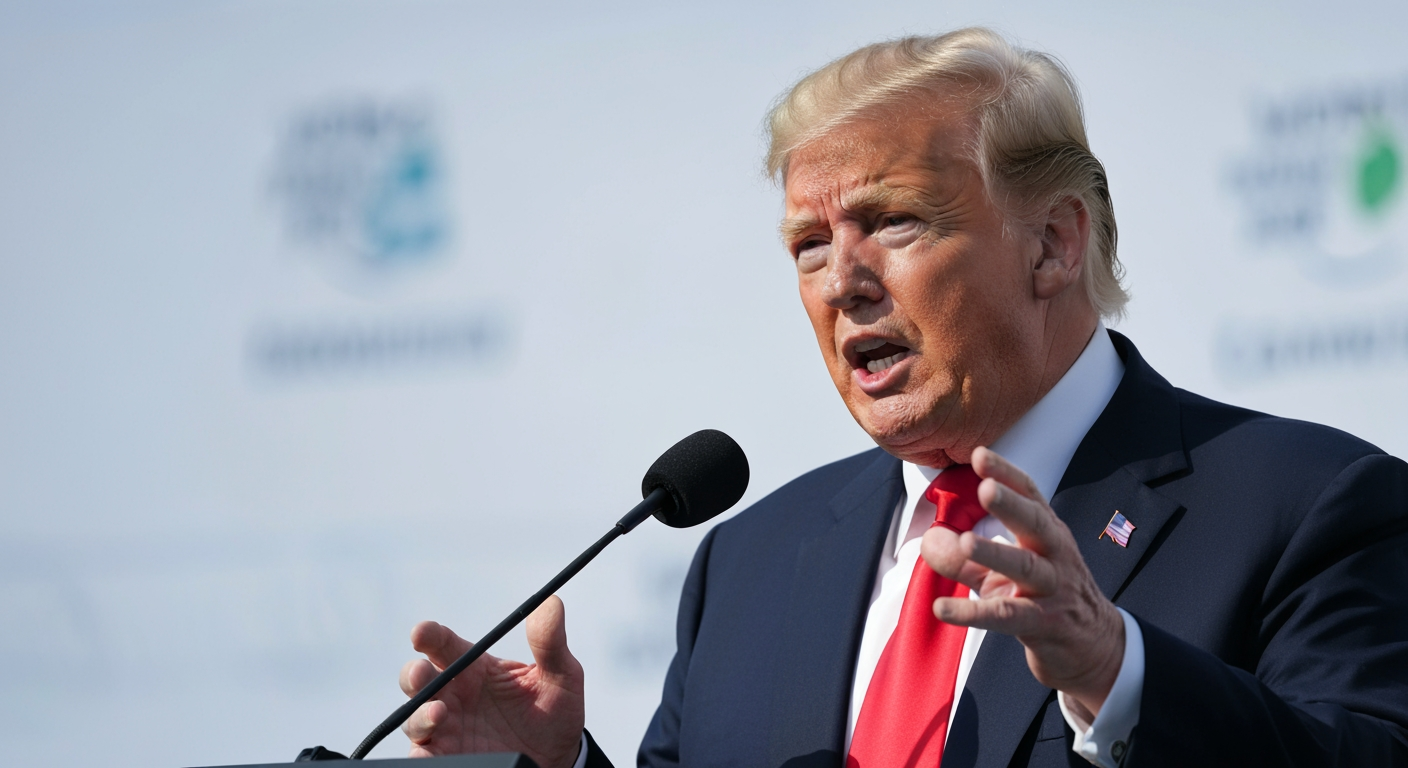
DAVOS, Switzerland – Former U.S. President Donald Trump delivered a characteristically forceful address at the World Economic Forum (WEF) in Davos on Wednesday, seizing the global stage to champion his signature policies, tout American economic strength, and renew his controversial ambition to acquire Greenland. His nearly 70-minute speech was marked by a blend of self-congratulation, pointed criticism of European allies, and a firm call for "immediate negotiations" regarding the Arctic island, sending ripples through an already tense international gathering.
Trump's appearance, following a delay due to an electrical issue with Air Force One, immediately set a confrontational tone at the elite forum, which draws leaders from government, business, and civil society worldwide. His remarks underscored his consistent approach to foreign policy and trade, emphasizing national interest above multilateral cooperation and directly challenging the prevailing sentiments often expressed at the WEF.
The Resurgent Greenland Overture: A Strategic Imperative
A central and perhaps most provocative element of Trump's address was his renewed insistence on the United States acquiring Greenland from Denmark. Describing the vast Arctic territory as a "strategic piece of ice" vital for "world protection" and U.S. national security, Trump called for prompt discussions. He asserted that the United States needed to control the island, arguing it is an "enormous unsecured island" that is "actually part of North America."
While explicitly stating that the U.S. would not use force to take the island, he simultaneously reminded the audience of America's "unstoppable force," a subtle yet clear message regarding the nation's power. He further criticized Denmark, labeling the NATO ally as "ungrateful" for past U.S. protection during World War II, a historical reference aimed at bolstering his case for what he considers a vital strategic asset. This renewed push for territorial acquisition, first floated during his presidency, has consistently been met with firm rejections from Denmark and Greenland's local government. European leaders have warned that such an approach could strain the transatlantic alliance, an apprehension that was palpable among attendees in Davos.
Economic Nationalism Meets European Scrutiny
Beyond the Greenland issue, Trump dedicated a significant portion of his speech to highlighting the perceived triumphs of the U.S. economy. He proclaimed America as the "world's economic engine," attributing success to his efforts in taming inflation and spurring growth. He suggested that Americans were "very happy" with his leadership, painting a picture of domestic economic prosperity under his guidance. This portrayal came amidst a global economic landscape still grappling with various challenges, providing a stark contrast to some of the more cautious outlooks presented by other speakers at the forum.
However, Trump's economic self-praise was coupled with sharp criticism directed at Europe. He repeatedly declared that Europe was "not heading in the right direction" and claimed that parts of the continent were "not even recognizable." These remarks touched upon long-standing tensions, particularly concerning NATO commitments and broader geopolitical divergences. His comments amplified concerns among European leaders already wary of his protectionist trade policies and transactional approach to alliances. The underlying message was clear: European nations needed to reassess their trajectory and align more closely with what he presented as the American model for success.
Diplomatic Fallout and Global Repercussions
Trump's candid and often provocative statements at Davos did not go unchallenged, sparking immediate diplomatic concern and, in some cases, outright opposition. European Commission President Ursula von der Leyen publicly dismissed Trump's recent tariff threat against eight European countries over the Greenland dispute as a "mistake" and questioned his trustworthiness. French President Emmanuel Macron further escalated the rhetoric, suggesting the European Union possessed a "trade bazooka" — a powerful economic tool — that could be deployed in retaliation to any aggressive trade measures. These exchanges underscore the fragile state of transatlantic relations and the potential for a trade war to erupt over the Greenland issue.
The "chilly" political atmosphere noted by observers in Davos was a direct consequence of Trump's confrontational tone and his willingness to issue tariff threats and territorial demands at a forum ostensibly dedicated to economic cooperation. His stance on Greenland and his broader criticism of European policies have deepened anxieties about the stability of NATO and the future of the rules-based international order. While inside the Congress Center, global leaders grappled with the implications of his words, distant protesters outside made their voices heard, symbolizing broader societal dissent against his policies and approach.
A Broader Geopolitical Agenda
Beyond the headline-grabbing issues of Greenland and Europe, Trump touched upon several other aspects of his geopolitical worldview. He reiterated his unverified claim of having stopped a "war between India and Pakistan," a statement he has made numerous times despite denials of third-party intervention from India. He also invoked a recent U.S. military action in Venezuela, stating that an operation to capture its leader Nicolas Maduro served as proof of American strength.
His visit to Davos also included a schedule of bilateral meetings with leaders from Switzerland, Poland, and Egypt, indicating continued diplomatic engagement despite the controversies. Furthermore, Trump is slated to preside over the launch of his "Board of Peace," an initiative established to oversee redevelopment efforts in Gaza following a fragile ceasefire. This endeavor, however, has raised concerns among U.S. allies, particularly given Trump's suggestion that the board could eventually expand its role to address global crises beyond Gaza, traditionally a domain of institutions like the United Nations. He acknowledged supporting the UN but expressed belief it had failed to reach its full potential, echoing his long-standing skepticism toward multilateral bodies.
Conclusion
Donald Trump's 2026 appearance at the World Economic Forum in Davos served as a potent reaffirmation of his distinct and often disruptive approach to global affairs. His renewed push for Greenland, coupled with a confident assertion of U.S. economic might and a pointed critique of Europe, dominated discussions and cast a shadow over the forum's traditional agenda of cooperation. The ensuing reactions from European leaders, ranging from outright dismissal to veiled threats of retaliation, underscore the deep fissures that persist within the international community. As the Davos forum continues, the impact of Trump's address is likely to resonate, shaping future debates on trade, alliances, and the strategic balance of power, with the ambitious Greenland overture standing as a testament to his unwavering and unconventional foreign policy vision.
Related Articles


The Regulatory Maze: Why Taming Social Media Harms Remains an Elusive Quest
The digital public square, once heralded as a beacon of connection and information, has increasingly become a battleground rife with misinformation, hate speech, cyberbullying, and threats to mental health. Despite...


Gamescom 2026: Industry Thrives Amid Record Success, Grapples with AI's Transformative Power
COLOGNE, GERMANY – Gamescom 2026, the world's largest video game trade fair, concluded its latest edition with resounding success, demonstrating the enduring vitality and economic strength of the global gaming industry....


Volkswagen's Defining Moment: Restructuring Talks Poise to Reshape German Automotive Landscape
Wolfsburg, Germany – Europe's largest automaker, Volkswagen, stands at a critical juncture, facing what its CEO, Oliver Blume, has termed a "more than critical" situation. Intense internal discussions, dubbed "crunch...