Trump Launches "Shield of the Americas" Coalition to Counter Cartels, Reassert Influence
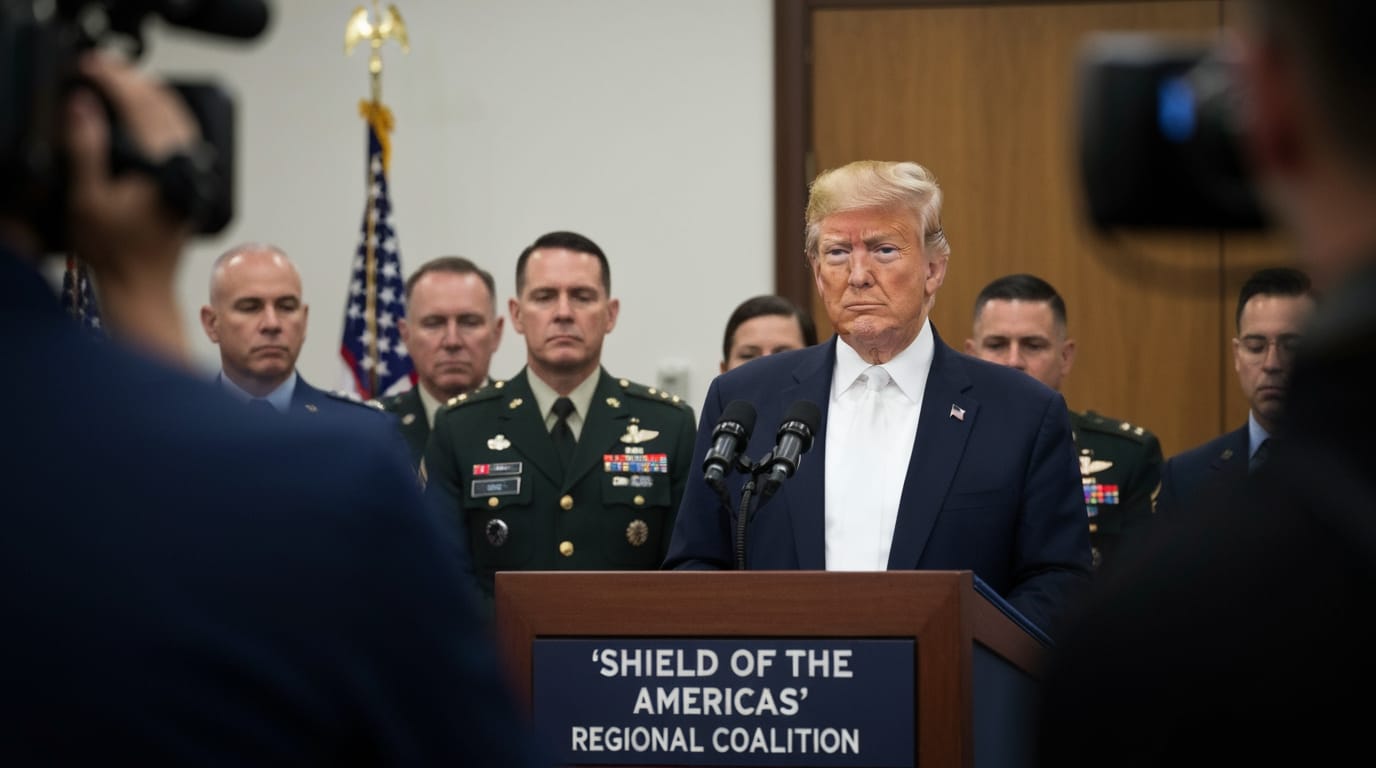
MIAMI, Florida – President Donald Trump officially launched the "Shield of the Americas" initiative today, a new U.S. security coalition aimed at enhancing regional cooperation across the Western Hemisphere. The announcement came during a summit at Trump National Doral, bringing together leaders from over a dozen Latin American and Caribbean nations to address critical issues including organized crime, drug trafficking, border security, and migration challenges. The initiative signals a renewed, assertive push by the administration to solidify U.S. strategic interests and influence in its immediate sphere, particularly against perceived foreign incursions.
The "Shield of the Americas," also referred to as the Americas Counter-Cartel Coalition (ACCC), is positioned as a cornerstone of the administration's broader foreign policy for the region. President Trump emphasized the need for a unified front to combat what he described as widespread lawlessness fueled by transnational criminal organizations. The initiative's stated goals extend beyond mere security cooperation, aiming to foster greater freedom, security, and prosperity throughout the hemisphere. The summit culminated in discussions focused on practical strategies to dismantle powerful cartels and fortify regional defenses against various threats.
A New Strategic Vision for the Americas
The "Shield of the Americas" is an embodiment of the administration's "America First" foreign policy, articulated through what officials term the "Donroe Doctrine" — a modern interpretation of the 19th-century Monroe Doctrine. This updated doctrine asserts the United States' preeminence in the Western Hemisphere and seeks to actively counter the growing influence of geopolitical rivals, notably China, Russia, and Iran. Secretary of State Marco Rubio, a key architect of this regional strategy, has consistently advocated for an "Americas First" approach, which is reflected in the 2025 National Security Strategy's emphasis on limiting foreign engagement in the hemisphere while securing trade and investment opportunities for U.S. businesses.
The strategic framework outlined for the "Shield of the Americas" underscores a desire to control critical supply chains and ensure continued access to strategic locations within the region. Administration officials have frequently voiced concerns regarding China's expanding economic footprint and infrastructure investments across Latin America, viewing these as potential challenges to U.S. security and economic interests. The coalition is designed to enlist and expand partnerships with like-minded nations, creating a bloc that can collectively pursue and support U.S. objectives in the region.
A Coalition of "Like-Minded" Leaders Gathers
The summit in Doral attracted a significant contingent of leaders, signifying a strategic alliance to tackle pressing regional issues. Among the attendees were President Javier Milei of Argentina, President Rodrigo Chaves of Costa Rica, President Daniel Noboa of Ecuador, President Nayib Bukele of El Salvador, President Nasry Asfura of Honduras, President José Raúl Mulino of Panama, President Santiago Peña of Paraguay, President Rodrigo Paz of Bolivia, President-Elect José Antonio Kast of Chile, President Luis Abinader of the Dominican Republic, President Irfaan Ali of Guyana, and Prime Minister Kamla Persad-Bissessar of Trinidad and Tobago. These leaders participated in discussions intended to outline how their nations will collaborate with the United States in the new security endeavor.
However, the gathering was notably exclusive. Major regional powers such as Brazil, Mexico, and Colombia were not invited or did not participate, a factor that has drawn criticism and led some observers to label the event as a "Right-Wing Summit of the Americas." This selective approach reflects the administration's strategy to narrow alliances to countries ideologically aligned with its foreign policy objectives. Despite the absence of some key regional players, the White House maintained that the summit aimed to strengthen relationships and foster stability.
Intensified Crackdown on Transnational Crime
A central tenet of the "Shield of the Americas" is an aggressive posture against drug cartels and organized crime networks. President Trump drew parallels between the new coalition and past efforts to combat groups like ISIS, asserting that a similar unified and decisive approach is necessary to eradicate cartels. He signed a proclamation establishing the Americas Counter-Cartel Coalition (ACCC), emphasizing the importance of military cooperation among regional partners. The President stressed that large swaths of the Western Hemisphere have fallen under the direct control of these brutal criminal organizations, posing an unacceptable threat to national security and causing widespread bloodshed and chaos.
Kristi Noem, the former Secretary of Homeland Security, has been appointed as the Special Envoy for the "Shield of the Americas." In her new role, she is expected to play a critical part in coordinating multinational efforts against transnational crime and insecurity. Noem affirmed that the initiative's goal is to promote freedom, security, and prosperity by partnering with nations to dismantle narcoterrorist gangs and counter illegal migration. The administration has underscored its commitment to stopping drug trafficking, with President Trump previously declaring cartels foreign terrorist organizations and advocating for their leaders to be met with military force. These policy directions are further contextualized by recent, high-profile U.S. interventions in the region, including an audacious military operation to capture Venezuela's then-President Nicolás Maduro and a recent intelligence-assisted raid in Jalisco, Mexico, that resulted in the death of notorious drug trafficker "El Mencho."
Looking Ahead: Implications for Regional Dynamics
The "Shield of the Americas" summit marks a significant moment for U.S. engagement in Latin America, signaling a more hands-on and militarily oriented approach to regional security. The administration's focus on building a coalition of "like-minded" nations to address specific threats like cartels and to counter external influence could redefine diplomatic dynamics across the hemisphere. The participating governments are expected to sign the Doral Charter, a declaration intended to affirm the right of the peoples of the hemisphere to self-determination, free from interference.
While proponents of the initiative highlight its potential to enhance security and stability, critics suggest that this "minilateral" approach, excluding several major regional players, might face challenges in achieving long-term, comprehensive solutions for the complex issues confronting the Americas. The impact of the "Shield of the Americas" on existing multilateral bodies and broader regional unity will be closely watched as the coalition begins to implement its strategies to safeguard the Western Hemisphere. The White House, however, remains resolute in its commitment to promoting freedom, security, and prosperity through strengthened collaboration with its regional partners.


